
[Paper Review] The Knowledge Alignment Problem: Bridging Human and External Knowledge for Large Language Models
This paper introduces the Knowledge Alignment problem, where large language models (LLMs) fail to correctly link user questions to external knowledge due to misalignment in constraints and conditions. MixAlign addresses this by combining LLM-based constraint matching with targeted human clarification, reducing hallucination by up to 27.1% and improving performance by 22.2% through high-quality, user-centered clarifications.
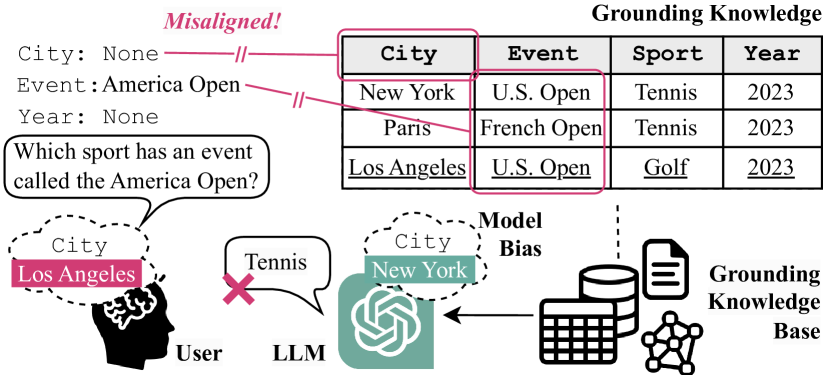
Large language models often necessitate grounding on external knowledge to generate faithful and reliable answers. Yet even with the correct groundings in the reference, they can ignore them and rely on wrong groundings or their inherent biases to hallucinate when users, being largely unaware of the specifics of the stored information, pose questions that might not directly correlate with the retrieved groundings. In this work, we formulate this knowledge alignment problem and introduce MixAlign, a framework that interacts with both the human user and the knowledge base to obtain and integrate clarifications on how the user question relates to the stored information. MixAlign employs a language model to achieve automatic knowledge alignment and, if necessary, further enhances this alignment through human user clarifications. Experimental results highlight the crucial role of knowledge alignment in boosting model performance and mitigating hallucination, with improvements noted up to 22.2% and 27.1% respectively. We also demonstrate the effectiveness of MixAlign in improving knowledge alignment by producing high-quality, user-centered clarifications.
Motivation & Objective
- To identify and formalize the Knowledge Alignment problem, where LLMs misalign user questions with external knowledge due to implicit or missing constraints.
- To address the gap in existing LLM systems that rely on biased internal knowledge instead of faithful grounding.
- To design a mixed-initiative framework that improves alignment through both automated LLM reasoning and targeted human clarification.
- To evaluate the effectiveness of knowledge alignment in reducing hallucination and improving factual consistency in question-answering tasks.
Proposed method
- MixAlign initiates with LLM-based knowledge alignment, mapping constraints in user questions to corresponding fields in the external knowledge base.
- When uncertainty arises in constraint matching, MixAlign generates targeted clarifying questions to the human user.
- The framework integrates both model-generated and human-provided clarifications to refine grounding before answer generation.
- It employs a two-stage process: explicit constraint matching followed by implicit alignment on remaining ambiguous cases.
- The system dynamically decides when to involve the user based on confidence thresholds in constraint matching.
- It is designed to minimize user effort, with an average of only 1.08–1.19 clarifying questions per instance.
Experimental results
Research questions
- RQ1How does misalignment between user questions and external knowledge contribute to LLM hallucination?
- RQ2To what extent can LLM-based constraint matching alone resolve knowledge alignment issues?
- RQ3What is the impact of human-assisted clarification on reducing hallucination and improving factual accuracy?
- RQ4How efficient is the MixAlign framework in minimizing user effort while maintaining high alignment quality?
- RQ5How does the performance of MixAlign compare to oracle-level clarification and baseline methods under varying levels of noisy or irrelevant groundings?
Key findings
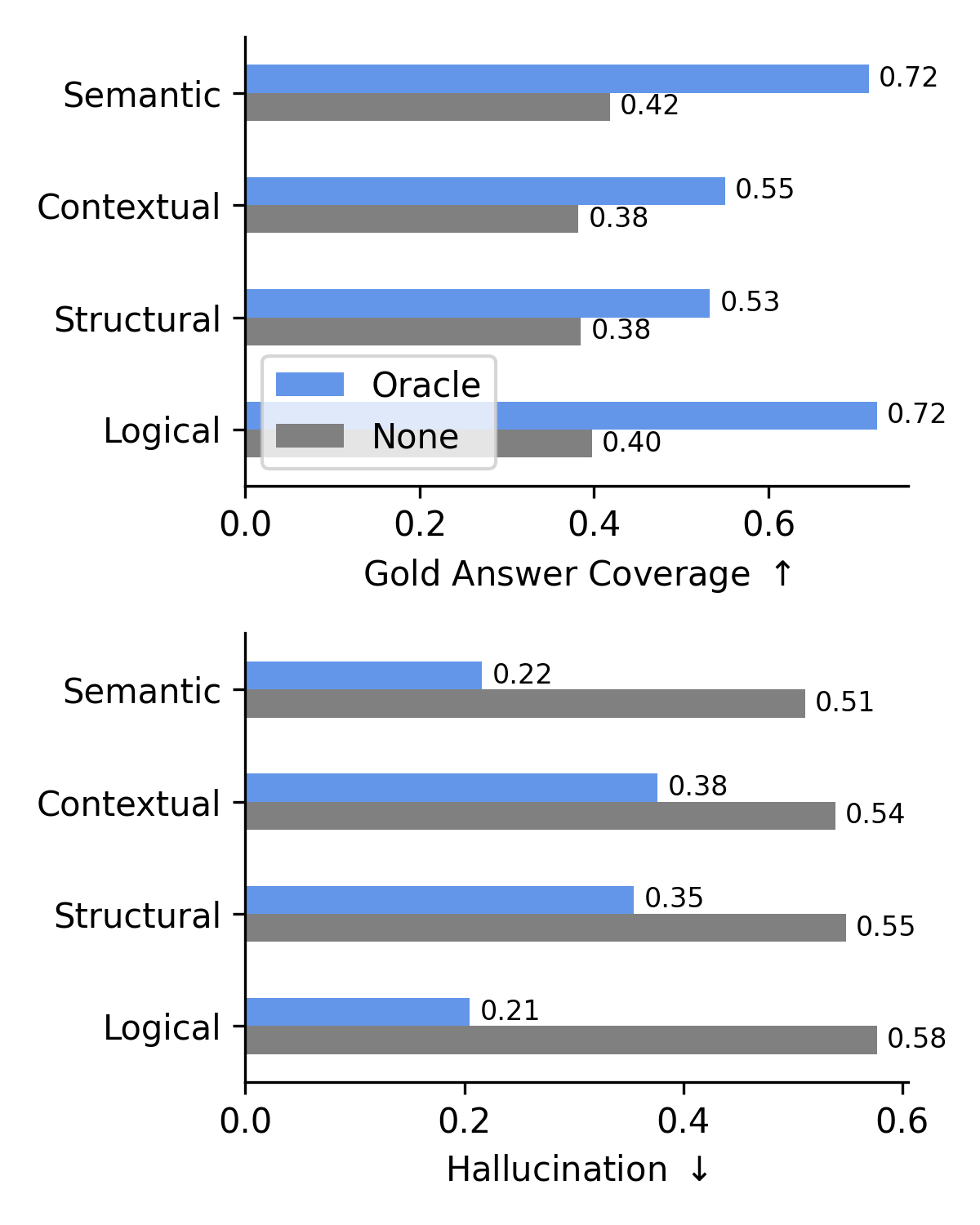
- MixAlign reduces hallucination by up to 27.1% compared to baseline models, demonstrating the critical role of knowledge alignment in improving factual consistency.
- Performance improves by up to 22.2% when using MixAlign, highlighting the benefit of aligning user intent with external knowledge.
- With more irrelevant groundings, the performance gap between MixAlign and LLM-only baselines widens, reaching 7.7% in coverage and 9.8% in hallucination, underscoring the need for clarification.
- Human assistance is essential: the w/o Human variant shows a significant performance drop, especially as noise increases, indicating LLMs struggle with confident constraint matching.
- MixAlign reduces the need for user clarification by 14.2% to 22.5% compared to naive approaches, and typically requires only 1.08–1.19 clarifying questions per instance.
- Implicit knowledge alignment is necessary: removing it consistently reduces performance, and the gap remains stable across increasing noise, indicating error propagation from explicit alignment.
Read this paper
Open the full text in the Nubint reader and ask about any passage as you read.
Read this paper on NubintThis review was generated by AI from the original paper. Please check the paper before citing it.