
[Paper Review] The Lagrangian Numerical Relativity code SPHINCS_BSSN_v1.0
This paper presents SPHINCS_BSSN_v1.0, the first Lagrangian Numerical Relativity code that solves the full Einstein equations using Smooth Particle Hydrodynamics (SPH) for matter evolution. It introduces a novel local regression-based mapping of the stress-energy tensor from particles to the spacetime mesh, enables robust neutron star collapse to black holes, and supports initial data from LORENE and FUKA. Key results include accurate gravitational wave emission from neutron star mergers and a high black hole spin ($a/M \approx 0.8$) in prompt collapse scenarios.
We present version 1.0 of our Lagrangian Numerical Relativity code SPHINCS_BSSN. This code evolves the full set of Einstein equations, but contrary to other Numerical Relativity codes, it evolves the matter fluid via Lagrangian particles in the framework of a high-accuracy version of Smooth Particle Hydrodynamics (SPH). The major new elements introduced here are: i) a new method to map the stress--energy tensor (known at the particles) to the spacetime mesh, based on a local regression estimate; ii) additional measures that ensure the robust evolution of a neutron star through its collapse to a black hole; and iii) further refinements in how we place the SPH particles for our initial data. The latter are implemented in our code SPHINCS_ID which now, in addition to LORENE, can also couple to initial data produced by the initial data library FUKA. We discuss several simulations of neutron star mergers performed with SPHINCS_BSSN_v1.0, including irrotational cases with and without prompt collapse and a system where only one of the stars has a large spin ($χ= 0.5)$.
Motivation & Objective
- To develop a Lagrangian Numerical Relativity code that solves the full set of Einstein equations using SPH for matter evolution.
- To address limitations in existing Eulerian codes by introducing a new method for mapping particle-based stress-energy tensors to the spacetime mesh.
- To enable stable and accurate simulations of neutron star mergers, including prompt collapse to black holes and systems with asymmetric spins.
- To extend initial data capabilities by integrating with the FUKA initial data library alongside LORENE.
- To provide a new, independent method for simulating multi-messenger neutron star merger events with high accuracy in gravitational wave and ejecta properties.
Proposed method
- The code evolves the BSSN formulation of the Einstein equations on a structured mesh using finite differences.
- Matter is evolved via Lagrangian SPH particles, which carry fluid properties such as rest-mass density, pressure, and velocity.
- A new local regression estimate maps the stress-energy tensor from SPH particles to the spacetime grid, improving accuracy and stability.
- The method includes additional numerical measures to ensure robustness during neutron star collapse into black holes.
- Initial data are generated using SPHINCS_ID, which supports both LORENE and FUKA libraries for constructing equilibrium configurations.
- The code uses adaptive mesh refinement and Hermite polynomial interpolation to map metric and connection fields from the grid to SPH particles.
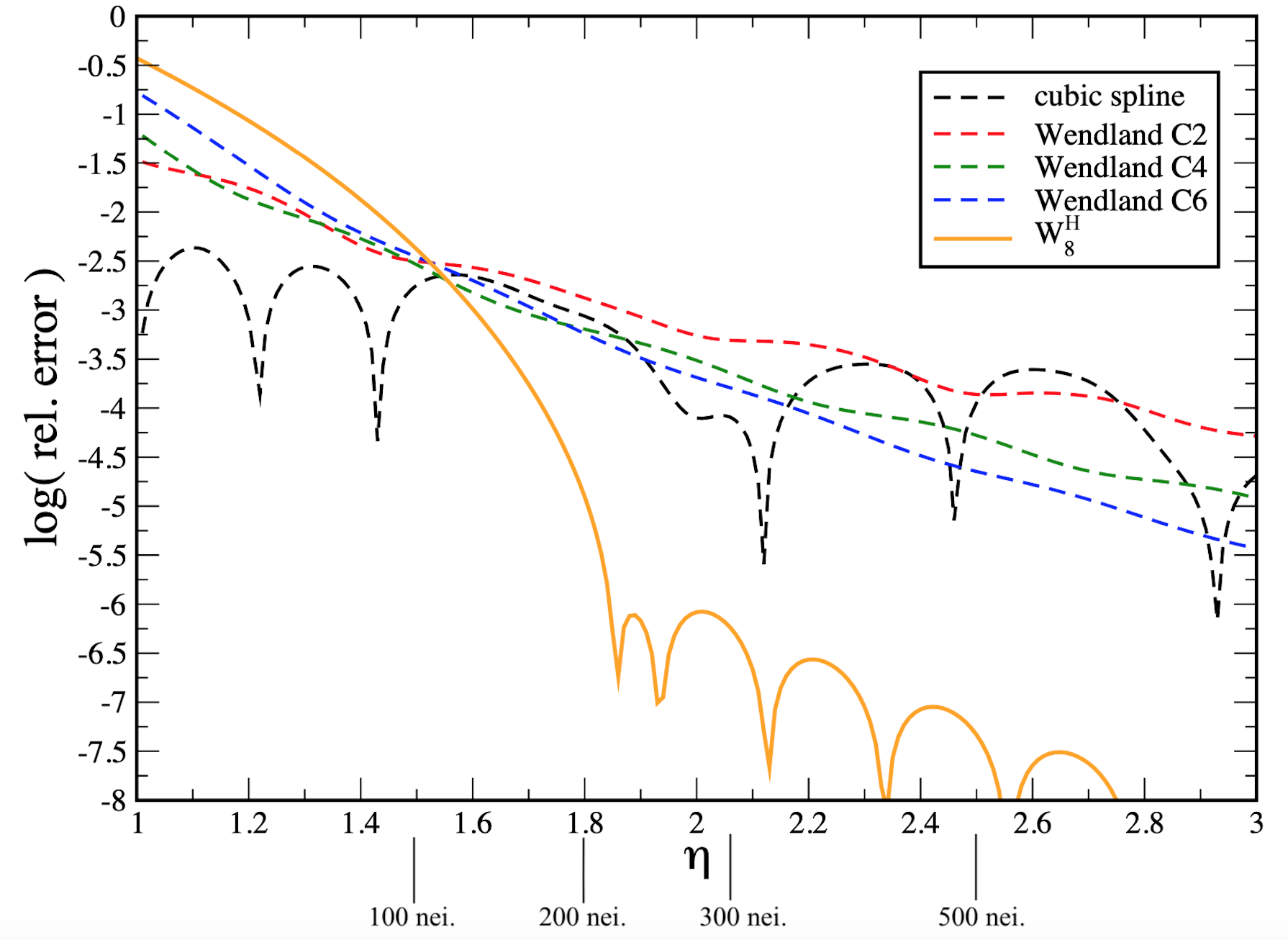
Experimental results
Research questions
- RQ1How can a Lagrangian SPH-based approach accurately and robustly evolve the full Einstein equations in neutron star merger simulations?
- RQ2What is the performance and accuracy of a new local regression-based method for mapping the stress-energy tensor from SPH particles to the spacetime grid?
- RQ3How does the inclusion of initial data from the FUKA library expand the range of physically realistic neutron star merger configurations that can be simulated?
- RQ4To what extent does the spin of one neutron star in a binary system alter the merger dynamics and gravitational wave emission compared to irrotational or equal-mass cases?
- RQ5What are the gravitational wave energy and angular momentum losses in prompt collapse and non-collapsing merger scenarios?
Key findings
- The code successfully simulates neutron star mergers with gravitational wave emission dominated by the $l=2,m=2$ mode, with about 2% of the initial ADM mass radiated away.
- In the prompt collapse case, less than $6 \times 10^{-4}$ M⊙ of mass escapes to form ejecta, and the final black hole has a high spin parameter of $a/M \approx 0.8$, exceeding typical binary black hole merger outcomes.
- The simulation of a system with one rapidly spinning neutron star ($\chi=0.5$) shows a less violent merger with a single, puffed-up tidal tail and reduced gravitational wave emission due to less central compression.
- The local regression-based stress-energy tensor mapping significantly improves numerical stability and accuracy compared to previous methods.
- The code demonstrates robustness in handling the transition from neutron star to black hole, maintaining accuracy even during extreme dynamical phases.
- The inclusion of FUKA-based initial data enables the simulation of highly spinning, asymmetric binaries, expanding the scope of accessible astrophysical scenarios.

Read this paper
Open the full text in the Nubint reader and ask about any passage as you read.
Read this paper on NubintThis review was generated by AI from the original paper. Please check the paper before citing it.