
[Paper Review] The Mass-ive Issue: Anomaly Detection in Jet Physics
This paper investigates the critical challenge of jet mass bias in anomaly detection for high-energy physics using Variational Autoencoders (VAEs). It demonstrates that common anomaly metrics like MSE and kNN are strongly correlated with jet mass, leading to artificial mass sculpting that distorts background rejection and compromises signal detection—highlighting the need for mass-robust metrics in model-agnostic searches for new physics.
In the hunt for new and unobserved phenomena in particle physics, attention has turned in recent years to using advanced machine learning techniques for model independent searches. In this paper we highlight the main challenge of applying anomaly detection to jet physics, where preserving an unbiased estimator of the jet mass remains a critical piece of any model independent search. Using Variational Autoencoders and multiple industry-standard anomaly detection metrics, we demonstrate the unavoidable nature of this problem.
Motivation & Objective
- To address the critical issue of jet mass bias in unsupervised anomaly detection for jet physics.
- To evaluate the performance of multiple anomaly detection metrics (e.g., MSE, kNN, EMD) in preserving unbiased jet mass distributions.
- To identify metrics that maintain high signal acceptance while minimizing artificial mass sculpting in QCD backgrounds.
- To investigate the robustness of anomaly detection under varying nominal training distributions, including massive signals like top quarks.
- To establish benchmarking criteria for fair comparison of anomaly detection methods in high-energy physics.
Proposed method
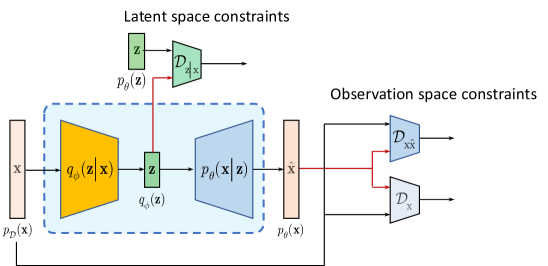
- Trained Variational Autoencoders (VAEs) on simulated QCD jets using 20 most energetic constituents as input, represented as 4-momenta point clouds.
- Applied preprocessing including centering, rotation, and normalization by jet transverse momentum to reduce degrees of freedom and improve invariance.
- Used a three-part loss function based on the information bottleneck: reconstruction loss, latent space regularizer, and mutual information minimization.
- Evaluated anomaly scores using multiple metrics: Mean Squared Error (MSE), k-Nearest Neighbors (kNN), and Earth Mover's Distance (EMD) in both input and latent spaces.
- Compared metrics via relative entropy to quantify mass sculpting and used background rejection vs. signal acceptance to assess performance.
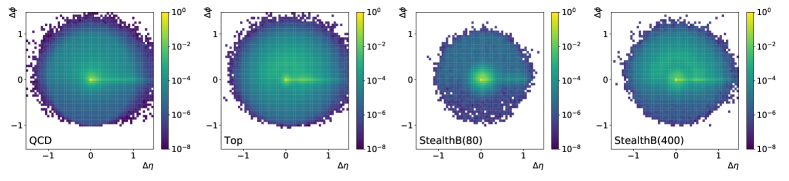
- Conducted robustness tests by retraining models on top quarks and evaluating anomaly scores for QCD and Stealth Boson signals.
Experimental results
Research questions
- RQ1How do different anomaly detection metrics affect the reconstructed jet mass distribution in QCD backgrounds?
- RQ2To what extent is the anomaly score correlated with jet mass, and how does this impact signal detection in model-agnostic searches?
- RQ3Can anomaly detection metrics remain robust when trained on a massive signal (e.g., top quarks) instead of QCD?
- RQ4Which metrics minimize artificial mass sculpting while maintaining high signal acceptance for diverse new physics models?
- RQ5How can the latent space be constrained to decorrelate from jet mass, improving detection fairness?
Key findings
- MSE and kNN anomaly metrics exhibit strong positive correlation with jet mass, leading to significant mass sculpting in the background distribution.
- kNN performs poorly in mass sculpting, while EMD shows the least distortion, making it more suitable for unbiased anomaly detection.
- MSE remains nearly unchanged when trained on top quarks or QCD, indicating it is highly sensitive to jet mass and momentum structure.
- Anomaly scores based on MSE are anti-correlated with jet transverse momentum, further reinforcing their dependence on jet kinematics.
- Training on massive signals like top quarks causes those signals to be misclassified as less anomalous, undermining detection robustness.
- The study identifies a critical need for decorrelation techniques in the latent space to decouple anomaly detection from jet mass, ensuring fair signal discovery.
Read this paper
Open the full text in the Nubint reader and ask about any passage as you read.
Read this paper on NubintThis review was generated by AI from the original paper. Please check the paper before citing it.