
[Paper Review] The metallicity dependence of the stellar initial mass function
This study uses radiation-magnetohydrodynamic simulations to investigate how metallicity affects the stellar initial mass function (IMF), finding that while metallicity induces minor IMF shifts—slightly bottom-heavier in metal-poor environments due to reduced radiation feedback—these changes are too small to explain observed IMF variations in early-type galaxies. Surface density, not metallicity, is the dominant driver of IMF variations, with higher surface density producing a more bottom-heavy IMF due to enhanced feedback efficiency.
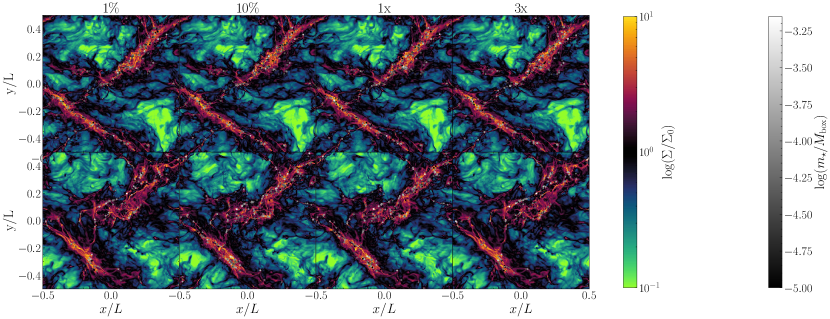
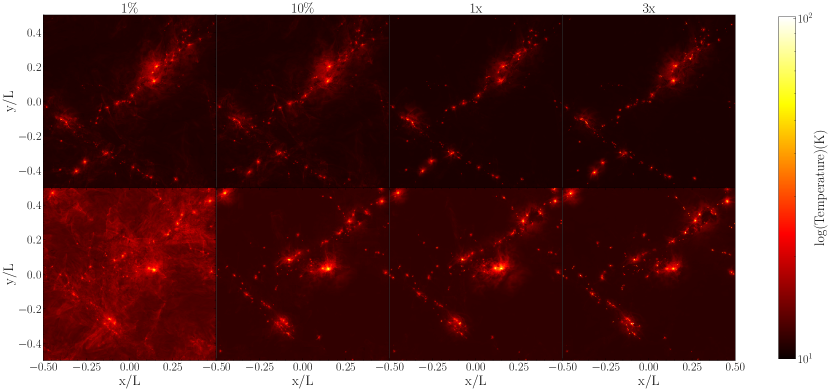
Dust is important for star formation because it is the crucial component that couples gas to stellar radiation fields, allowing radiation feedback to influence gas fragmentation and thus the stellar initial mass function (IMF). Variations in dust abundance therefore provide a potential avenue by which variation in galaxy metallicity might affect the IMF. In this paper we present a series of radiation-magnetohydrodynamic simulations in which we vary the metallicity and thus the dust abundance from 1% of Solar to 3$ imes$ Solar, spanning the range from the lowest metallicity dwarfs to the most metal-rich early-type galaxies found in the local Universe. We design the simulations to keep all dimensionless parameters constant so that the interaction between feedback and star-forming environments of varying surface density and metallicity is the only factor capable of breaking the symmetry between the simulations and modifying the IMF, allowing us to cleanly isolate and understand the effects of each environmental parameter. We find that at a fixed surface density more metal-rich clouds tend to form a slightly more bottom-heavy IMF than metal-poor ones, primarily because in metal-poor gas radiation feedback is able to propagate further, heating somewhat larger volumes of gas. However, shifts in IMF with metallicity at a fixed surface density are much smaller than shifts with surface density at fixed metallicity; metallicity-induced IMF variations are too small to explain the variations in mass-to-light ratio reported in galaxies of different mass and metallicity. We, therefore, conclude that metallicity variations are much less important than variations in surface density in driving changes in the IMF and that the latter rather than the former are most likely responsible for the IMF variations found in early-type galaxies.
Motivation & Objective
- To isolate the impact of metallicity on the stellar initial mass function (IMF) by controlling all other dimensionless parameters in simulations.
- To determine whether metallicity variations—through dust abundance—can explain observed IMF differences between early-type and spiral galaxies.
- To disentangle the roles of radiation feedback and protostellar outflow feedback in shaping the IMF across varying metallicities and surface densities.
- To assess whether metallicity-induced IMF shifts are sufficient to account for observed mass-to-light ratio variations in galaxies of different metallicities.
Proposed method
- Conduct radiation-magnetohydrodynamic (RMHD) simulations with varying metallicities from 1% to 300% of solar, while holding all dimensionless parameters (e.g., virial parameter, Mach number) constant.
- Systematically vary surface density and metallicity to isolate their individual effects on the IMF, ensuring only cloud optical depth changes.
- Use a consistent feedback model including protostellar outflows and radiation feedback, with dust coupling gas to radiation fields.
- Compute mass-to-light ratios using isochrones and compare simulated IMFs to the Chabrier IMF at solar metallicity to quantify deviations.
- Analyze IMF shape and mismatch parameters across different stellar population ages to assess time-dependent effects.
- Compare simulated IMF shifts to observed mass-to-light ratio variations in early-type galaxies to evaluate explanatory power.
Experimental results
Research questions
- RQ1Does metallicity variation, through changes in dust abundance, significantly alter the stellar initial mass function (IMF) in star-forming regions?
- RQ2How do radiation feedback and protostellar outflow feedback interact with metallicity to shape the IMF?
- RQ3Are metallicity-induced IMF variations large enough to explain the observed differences in mass-to-light ratios between early-type and spiral galaxies?
- RQ4How does the IMF respond to changes in surface density versus metallicity when all other dimensionless parameters are held constant?
Key findings
- At fixed surface density, metal-rich environments produce a slightly more bottom-heavy IMF than metal-poor ones, primarily due to more efficient cooling of outflow-shocked gas at higher metallicities.
- The high-mass end of the IMF is more sensitive to protostellar outflow feedback, which suppresses massive star formation more effectively at higher metallicities.
- The low-mass end of the IMF is shaped by radiation feedback, which is more effective at suppressing fragmentation in metal-poor environments due to reduced radiative coupling.
- Net IMF shifts with metallicity are small and insufficient to explain the observed mass-to-light ratio variations in early-type galaxies.
- Surface density variations produce IMF shifts that are substantially larger than those from metallicity, making it the dominant driver of IMF variation.
- The study concludes that surface density, not metallicity, is primarily responsible for the IMF differences observed between early-type and spiral galaxies.
Read this paper
Open the full text in the Nubint reader and ask about any passage as you read.
Read this paper on NubintThis review was generated by AI from the original paper. Please check the paper before citing it.