
[Paper Review] The Million Quasars (Milliquas) Catalogue, v8
The Milliquas v8 catalogue presents the final, comprehensive release of all published quasars up to 30 June 2023, including 907,144 type-I QSOs/AGN, 66,026 high-confidence radio/X-ray associated quasar candidates, and additional types such as BL Lac objects and type-II quasars, totaling 1,021,800 objects. It features sub-arcsecond astrometry (0.01 arcsec precision) using Gaia-EDR3 and other surveys, with extensive positional corrections for legacy quasars and photometric precision to 0.01 magnitude.
Announcing the final release, v8, of the Milliquas (Million Quasars) quasar catalogue which presents all published quasars to 30 June 2023, including quasars from the first releases of the Dark Energy Spectroscopic Instrument (DESI) and the SDSS-DR18 Black Hole Mapper. Its totals are 907,144 type-I QSOs/AGN and 66,026 high-confidence (~99% likelihood) radio/X-ray associated quasar candidates. Type-II and Bl Lac type objects are also included, bringing the total count to 1,021,800. Gaia-EDR3 astrometry is given for most objects. The catalogue is available on NASA HEASARC and CDS and on its home page.
Motivation & Objective
- To compile and maintain a complete, up-to-date, and astrometrically accurate catalogue of all published quasars through 30 June 2023.
- To correct positional inaccuracies in legacy quasar catalogues, especially those from the Véron-Cetty & Véron (VCV) catalogue, using modern astrometric data.
- To integrate quasar candidates from major surveys including DESI-EDR, SDSS-DR18, and LAMOST, with emphasis on high-confidence photometric quasar candidates via radio/X-ray associations.
- To provide a definitive, final release of the Milliquas catalogue as a lasting resource for future astronomical research.
Proposed method
- Aggregated data from published quasar surveys, including SDSS, DESI, LAMOST, and archival surveys, using standardized inclusion criteria from the Half Million Quasars (HMQ) catalogue.
- Applied rigorous astrometric cross-matching using Gaia-EDR3 (60.71% of objects), Pan-STARRS, SDSS-Sweeps, DESI, and historical photographic surveys to achieve sub-arcsecond positional accuracy.
- Identified and corrected 27 legacy quasar positions with offsets ≥8 arcseconds and 290 additional corrections ≥2 arcseconds, all individually vetted from original sources.
- Used radio and X-ray associations (from FIRST, ROSAT, etc.) to identify high-confidence photometric quasar candidates with pQSO ≥ 99%, enhancing selection reliability.
- Incorporated redshifts, photometry (u-g, g-r, r-i, i-z), and multi-wavelength associations from CDS, HEASARC, and survey-specific databases.
- Provided data via CDS, NASA HEASARC, and the official Milliquas website in FITS and ASCII formats, with comprehensive ReadMe and reference metadata.
Experimental results
Research questions
- RQ1What is the total number of confirmed and candidate quasars in the astronomical literature up to 30 June 2023?
- RQ2How accurate are the astrometric positions of legacy quasars, and what corrections are needed to align them with modern reference frames?
- RQ3To what extent can radio and X-ray associations improve the selection of high-confidence photometric quasar candidates?
- RQ4How does the Milliquas v8 catalogue compare in completeness and accuracy to previous quasar catalogues, especially the VCV and HMQ?
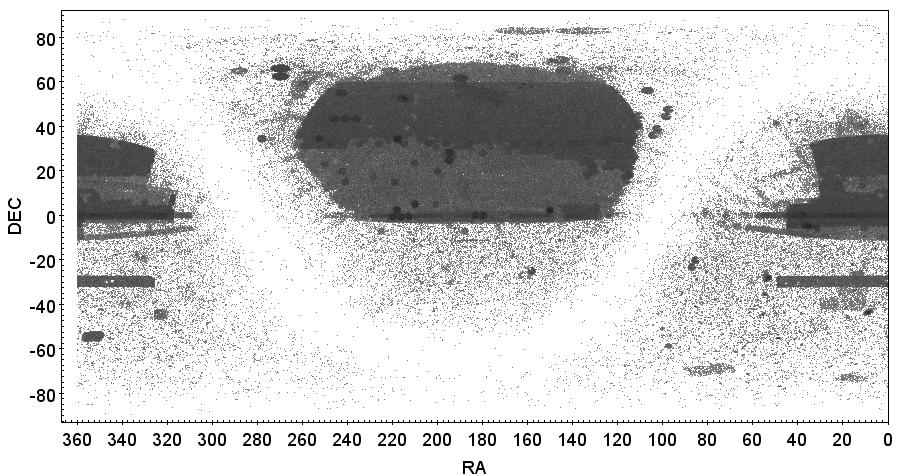
- RQ5What is the distribution of quasar types (type-I, type-II, BL Lac, candidates) across the sky, and how does it reflect survey coverage and sensitivity?
Key findings
- The Milliquas v8 catalogue contains 1,021,800 quasars and quasar candidates, including 907,144 type-I QSOs/AGN, 45,816 type-II objects, 2,814 BL Lac objects, and 66,026 high-confidence (pQSO ≥ 99%) radio/X-ray associated quasar candidates.
- A total of 27 new astrometric corrections of ≥8 arcseconds were identified and applied to legacy quasars, with 290 additional corrections of ≥2 arcseconds, significantly improving positional accuracy.
- Gaia-EDR3 provided astrometry for 60.71% of objects, making it the primary reference frame, followed by Pan-STARRS (8.34%), SDSS-Sweeps (27.79%), and DESI (1.69%).
- The catalogue includes red-blue photometry with a precision of 0.01 magnitude and radio/X-ray associations, including double-lobed radio structures, enhancing source characterization.
- Milliquas v8 is the final edition of the catalogue, with the enduring legacy of its accurate astrometry for all legacy quasars, which future catalogues should adopt.
- The dataset is publicly available via CDS, HEASARC, and the official Milliquas website in multiple formats, including FITS, with full metadata and reference lists.
Read this paper
Open the full text in the Nubint reader and ask about any passage as you read.
Read this paper on NubintThis review was generated by AI from the original paper. Please check the paper before citing it.