
[Paper Review] The MiniPile Challenge for Data-Efficient Language Models
The paper introduces MiniPile, a 6GB, curated subset of The Pile containing 1 million documents, designed to enable data-efficient language model pre-training on academic budgets. Using a three-step process—embedding inference with E5-Large, k-means clustering, and human-guided filtering of low-quality clusters—it achieves only a 1.9% and 2.5% performance drop on GLUE and SNI benchmarks when pre-training BERT and T5 models, respectively, compared to models trained on 2.6x to 745x more data.
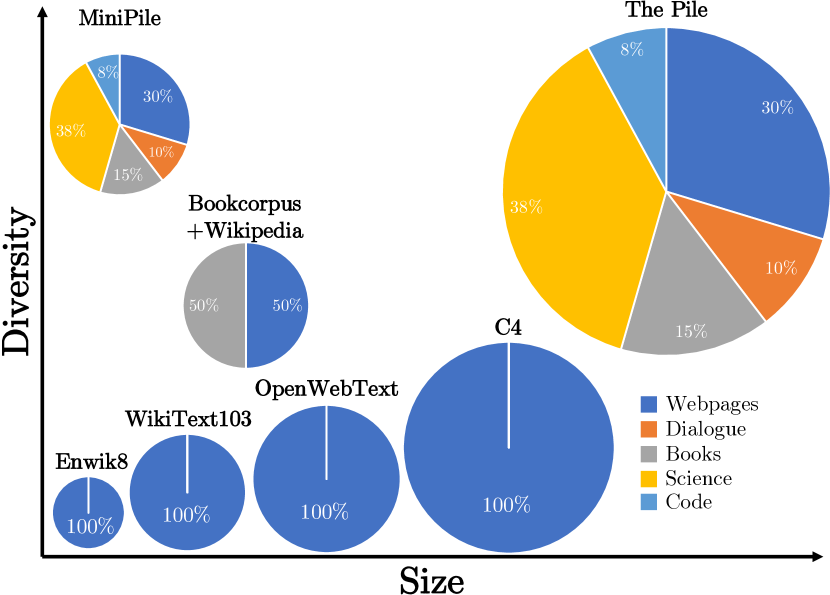
The ever-growing diversity of pre-training text corpora has equipped language models with generalization capabilities across various downstream tasks. However, such diverse datasets are often too large for academic budgets; hence, most research on Transformer architectures, training procedures, optimizers, etc. gets conducted on smaller, homogeneous datasets. To this end, we present The MiniPile Challenge, where one pre-trains a language model on a diverse text corpus containing at most 1M documents. MiniPile is a 6GB subset of the deduplicated 825GB The Pile corpus. To curate MiniPile, we perform a simple, three-step data filtering process: we (1) infer embeddings for all documents of the Pile, (2) cluster the embedding space using $k$-means, and (3) filter out low-quality clusters. To verify MiniPile's suitability for language model pre-training, we use it to pre-train a BERT and T5 model, yielding a performance drop of only $1.9\%$/$2.5\%$ on the GLUE and SNI benchmarks compared to the original pre-trained checkpoints trained on $2.6$x/$745$x the amount of data. MiniPile is available at https://huggingface.co/datasets/JeanKaddour/minipile.
Motivation & Objective
- Address the gap in data-efficient pre-training by enabling researchers with limited computational resources to train models on diverse, high-quality corpora.
- Reduce reliance on small, homogeneous datasets like WikiText103 or enwik8, which limit model generalization.
- Create a scalable, curated alternative to The Pile that maintains diversity while filtering out low-quality and harmful content.
- Demonstrate that a 1M-document subset can yield strong downstream performance with minimal accuracy drop compared to full-scale pre-training.
- Provide a reproducible, publicly available benchmark dataset for evaluating data-efficient training methods.
Proposed method
- Extract dense embeddings for all documents in the deduplicated 825GB The Pile using the E5-Large sentence embedding model.
- Apply batchified k-means clustering with cosine distance on normalized embeddings, using k=220 clusters (10 per Pile sub-dataset).
- Filter clusters by assessing document proximity to cluster centroids and having a human annotator evaluate representative examples (5 closest, 5 most distant).
- Exclude clusters deemed low-quality based on content, such as near-duplicates, pornography, or navigation bars.
- Pre-train BERT-Base and T5-Base models on the filtered MiniPile subset to evaluate downstream performance.
- Compare fine-tuned model performance on GLUE and SNI benchmarks to original models pre-trained on significantly larger corpora.
Experimental results
Research questions
- RQ1Can a 1M-document, 6GB subset of The Pile achieve competitive downstream performance compared to models pre-trained on much larger datasets?
- RQ2Does clustering-based filtering of document embeddings effectively remove low-quality and harmful content while preserving information-rich data?
- RQ3To what extent does MiniPile maintain the diversity of The Pile, enabling generalization across multiple NLP tasks?
- RQ4How does pre-training on MiniPile compare to pre-training on small, homogeneous datasets like WikiText103 in terms of downstream performance?
- RQ5Can a human-in-the-loop filtering step on cluster-level representations yield a high-quality, scalable dataset without requiring full corpus inspection?
Key findings
- Pre-training BERT-Base on MiniPile results in a 1.9% performance drop on the GLUE benchmark compared to the original BERT model pre-trained on 16GB of data.
- Pre-training T5-Base on MiniPile results in a 2.5% performance drop on the SNI benchmark compared to the original T5 model pre-trained on 745x more data.
- The MiniPile dataset, despite being only 6GB and containing 1 million documents, maintains sufficient diversity and information content to support strong downstream generalization.
- Human-guided filtering of clusters based on centroid proximity and representative examples successfully removed harmful and low-quality content, including near-duplicates and explicit material.
- Random subsampling within clusters outperformed selecting only the top-l closest documents to centroids, indicating that outlier removal alone is insufficient for optimal pre-training.
- The MiniPile dataset is publicly available at huggingface.co/datasets/jeankaddour/minipile, enabling reproducible research in data-efficient NLP.
Read this paper
Open the full text in the Nubint reader and ask about any passage as you read.
Read this paper on NubintThis review was generated by AI from the original paper. Please check the paper before citing it.