
[Paper Review] The nearby eclipsing stellar system delta Velorum. II. First reliable orbit for the eclipsing pair
This study presents the first reliable spectroscopic orbit of the eclipsing binary components in the nearby multiple star system δ Velorum, using high-resolution spectroscopy and photometric light curves. It determines precise masses (2.53±0.11 M⊙ and 2.37±0.10 M⊙), radii, and orbital parameters, revealing that the stars are rapidly rotating and have evolved off the main sequence, with an estimated age of ~400 Myr.
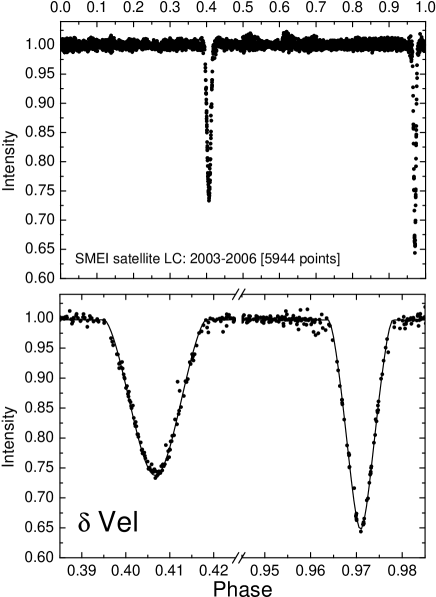
Context. The nearby multiple system delta Velorum contains a widely detached eclipsing binary and a third component. Aims. We take advantage of this system offering the opportunity to determine the set of fundamental parameters (masses, luminosities, and radii) of three coeval stars with sufficient precision to test models of stellar evolution. Methods. Extensive high-resolution spectroscopy is analyzed by the broadening function technique to provide the first spectroscopic orbit of the eclipsing pair. Simultaneous analysis of the spectroscopic data and the SMEI satellite light curve is performed to provide astrophysical parameters for the components. We use a modified Roche model assuming an eccentric orbit and asynchronous rotation. Results. The observations show that components of the eclipsing pair rotate at about two-thirds of the break-up velocity, which excludes any chemical peculiarity and results in a non-uniform surface brightness. Although the inner orbit is eccentric, no apsidal motion is seen during the SMEI photometric observations. For the inner orbit, the orbital parameters are eccentricity e = 0.29, longitude of the periastron passage omega = 109 degrees, and inclination 89.0 degrees. Conclusions. Component's masses MAa = 2.53+/-0.11 Msun, MAb = 2.37+/-0.10 Msun and MB = 1.5 Msun combined with inferred radii of Aa and Ab components indicate that the eclipsing pair has already left the Main sequence and the estimated age of the system is about 400 Myr.
Motivation & Objective
- To determine the fundamental astrophysical parameters of the eclipsing binary components in δ Velorum with high precision.
- To resolve the long-standing ambiguity in the system's orbital and physical parameters due to limited and inconsistent prior spectroscopic and photometric data.
- To test stellar evolution models by obtaining accurate masses, radii, and effective temperatures for three coeval stars in a nearby system.
- To investigate the effects of rapid rotation on surface brightness and temperature distribution in the components.
- To improve the orbital solution of the wide visual binary AB using timing and photometric data.
Proposed method
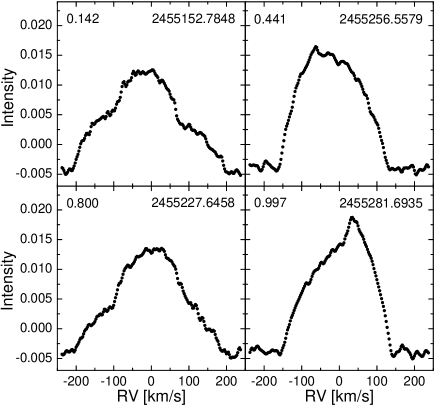
- Acquisition and analysis of high-resolution échelle spectroscopy using the broadening function technique to extract radial velocities and resolve blended line profiles.
- Simultaneous modeling of spectroscopic data and SMEI satellite photometric light curves to constrain orbital elements and stellar parameters.
- Application of a modified Roche model accounting for eccentric orbit and asynchronous rotation to describe the distorted, rapidly rotating components.
- Use of the von Zeipel theorem to predict non-uniform surface temperature distributions due to rotational modulation.
- Employment of Fourier disentangling techniques to isolate individual component spectra and improve parameter determination.
- Comparison of multi-epoch photometry and spectroscopy to assess the Rossiter-McLaughlin effect and orbital inclination.
Experimental results
Research questions
- RQ1What are the precise orbital elements of the eclipsing binary components in δ Velorum, including eccentricity, longitude of periastron, and inclination?
- RQ2How do the masses and radii of the components constrain the evolutionary state and age of the system?
- RQ3To what extent does rapid rotation affect the surface brightness and temperature distribution of the stars?
- RQ4Can the observed light curve and spectroscopic data be consistently modeled using a modified Roche geometry with eccentric orbit and asynchronous rotation?
- RQ5What is the contribution of the third component (B) to the observed spectral lines, and how can it be disentangled for accurate parameter determination?
Key findings
- The eclipsing binary has an orbital eccentricity of e = 0.290, longitude of periastron ω = 109°, and inclination i = 89.0°, indicating a near-edge-on orbit.
- Component masses are determined as M_Aa = 2.53 ± 0.11 M⊙ and M_Ab = 2.37 ± 0.10 M⊙, with the third component B having a mass of approximately 1.5 M⊙.
- The primary and secondary components rotate at 56% and 62% of their break-up velocities, respectively, leading to significant deformation and non-uniform surface brightness.
- Effective temperature ranges are predicted as 9220–9780 K for Aa and 9280–9880 K for Ab due to rotational modulation and the von Zeipel effect.
- No apsidal motion is detected during the SMEI photometric monitoring, despite the eccentric orbit.
- The system's estimated age is ~400 Myr, consistent with the components having evolved off the main sequence, as indicated by their masses and radii.
Read this paper
Open the full text in the Nubint reader and ask about any passage as you read.
Read this paper on NubintThis review was generated by AI from the original paper. Please check the paper before citing it.