
[Paper Review] The NetMob23 Dataset: A High-resolution Multi-region Service-level Mobile Data Traffic Cartography
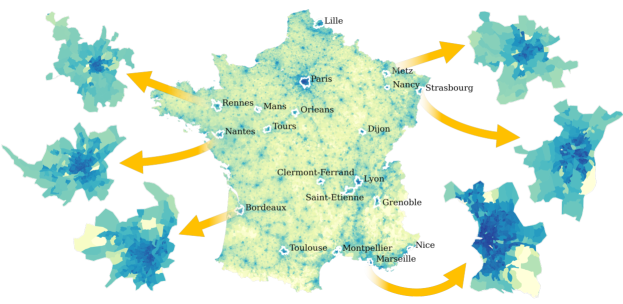
The paper introduces NetMob23, an open dataset of high-resolution, service-level mobile data traffic across 20 French metropolitan areas, covering 68 apps over 77 days with 15-minute granularity and 100x100 m2 spatial tiles.
Digital sources have been enabling unprecedented data-driven and large-scale investigations across a wide range of domains, including demography, sociology, geography, urbanism, criminology, and engineering. A major barrier to innovation is represented by the limited availability of dependable digital datasets, especially in the context of data gathered by mobile network operators or service providers, due to concerns about user privacy and industrial competition. The resulting lack of reference datasets curbs the production of new research methods and results, and prevents verifiability and reproducibility of research outcomes. The NetMob23 dataset offers a rare opportunity to the multidisciplinary research community to access rich data about the spatio-temporal consumption of mobile applications in a developed country. The generation process of the dataset sets a new quality standard, leading to information about the demands generated by 68 popular mobile services, geo-referenced at a high resolution of $100 imes100$ $m^2$ over 20 metropolitan areas in France, and monitored during 77 consecutive days in 2019.
Motivation & Objective
- Motivate the need for open, high-quality mobile network data beyond traditional CDRs.
- Provide a 68-service, service-level traffic dataset mapped to high-resolution spatial grids across multiple metropolitan areas.
- Demonstrate a generation workflow that preserves privacy while enabling rich spatiotemporal analyses.
- Offer data representations (spatial and traffic) and accompanying tools to facilitate reuse and reproducibility.
Proposed method
- Use LTE/EPC network probes to collect uplink and downlink traffic per service at eNodeBs.
- associate traffic flows with 68 services via proprietary classifiers at the network core.
- Aggregate traffic in 15-minute intervals at each eNodeB and normalize to remove absolute volume, preserving comparability.
- Construct high-resolution spatial maps by distributing eNodeB traffic over a 100x100 m2 grid using Bayes-based location probabilities p(l|i).
- Represent spatial data as GeoJSON for each metro region and provide a tile-based text format; supply Python notebooks for manipulation.
- Ensure privacy compliance under GDPR, with on-site processing and data aggregation to prevent re-identification.
Experimental results
Research questions
- RQ1How can service-level mobile data traffic be mapped from base-station traffic to high-resolution geographic grids?
- RQ2What is the spatial and temporal structure of traffic for a diverse set of mobile services across multiple metropolitan regions in a developed country?
- RQ3What anomalies or non-typical patterns appear in production-network traffic, and how do they affect analyses?
- RQ4What data representations and tooling best support reproducibility and cross-domain research using such a dataset?
Key findings
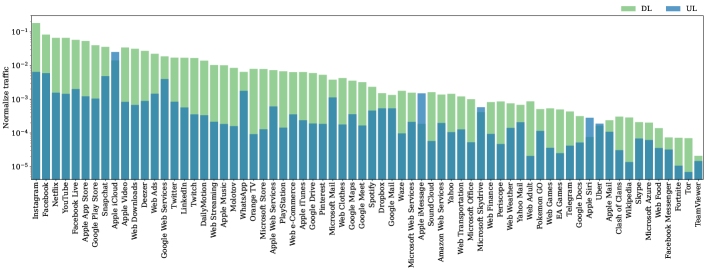
- NetMob23 provides traffic data for 68 services that together account for about 70% of Orange France’s total mobile data traffic.
- The dataset comprises over 870,000 high-resolution grid tiles covering 60 km2 per eNodeB, aggregated into 15-minute time steps.
- Anomalies such as network outages and service-specific events are observable and documented across cities and days (e.g., nationwide outages, regional issues).
- Temporal analyses reveal diverse usage patterns across apps, with UL/DL ratios varying by application and city.
- Spatial analyses show distinct geographical distributions per application, with entertainment apps more widespread and productivity apps concentrated in office areas.
Read this paper
Open the full text in the Nubint reader and ask about any passage as you read.
Read this paper on NubintThis review was generated by AI from the original paper. Please check the paper before citing it.