
[Paper Review] The Next Generation Deep Extragalactic Exploratory Public (NGDEEP) Survey
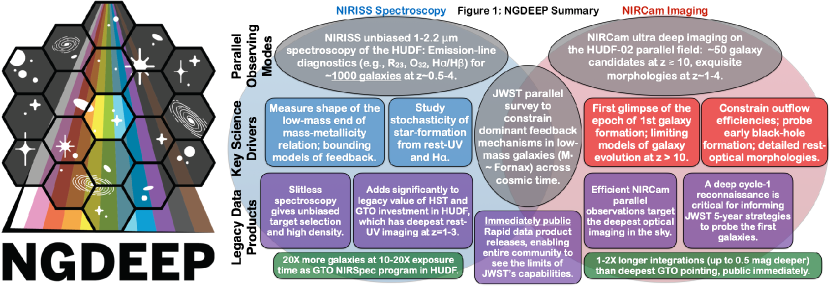
NGDEEP is a JWST Cycle 1 treasury program combining deep NIRISS slitless spectroscopy in HUDF with parallel NIRCam imaging in HUDF-Par2 to study feedback in low-mass galaxies across 0.5 < z < 4 and to push the rest-UV LF to z > 12.
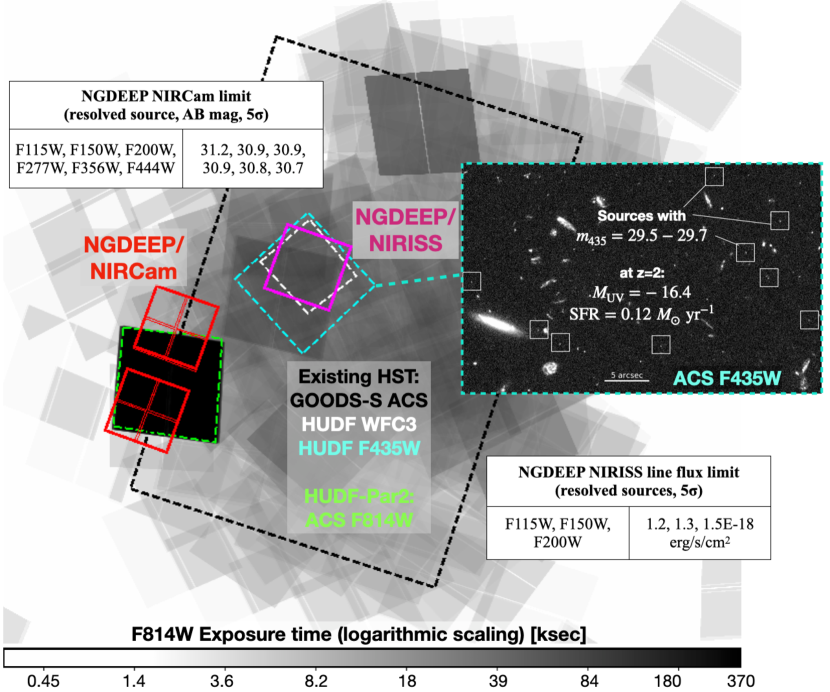
We present the Next Generation Deep Extragalactic Exploratory Public (NGDEEP) Survey, a deep slitless spectroscopic and imaging Cycle 1 JWST treasury survey designed to constrain feedback mechanisms in low-mass galaxies across cosmic time. NGDEEP targets the Hubble Ultra Deep Field (HUDF) with NIRISS slitless spectroscopy (f~1.2e-18 erg/s/cm^2, 5sigma) to measure metallicities and star-formation rates (SFRs) for low-mass galaxies through the peak of the cosmic SFR density (0.512, constraining the slope of the faint-end of the rest-ultraviolet luminosity function. NGDEEP overlaps with the deepest HST ACS optical imaging in the sky: F435W in the HUDF (m=29.6), and F814W in HUDF-Par2 (m=30), making this a premier HST+JWST Deep Field. As a treasury survey, NGDEEP data is public immediately, and we will rapidly release data products and catalogs in the spirit of previous deep field initiatives. In this paper we present the NGDEEP survey design, summarize the science goals, and detail plans for the public release of NGDEEP reduced data products.
Motivation & Objective
- Constrain feedback mechanisms in low-mass galaxies across cosmic time by measuring metallicities and SFRs from deep slitless spectroscopy.
- Characterize the low-mass end of the mass-metallicity relation (MZR) and its redshift evolution from z ~ 0.5–4.
- Probe the faint-end rest-UV luminosity function at z > 9–15 through deep NIRCam imaging in parallel fields.
- Leverage public, treasure-data releases to enable community-wide deep-field JWST science.
Proposed method
- NIRISS WFSS in HUDF (NGDEEP-NIS) to detect multiple emission lines down to ~1.2–1.5 × 10^-18 erg s^-1 cm^-2 (5σ) over 1–2.2 μm for >1000 galaxies.
- NIRCam parallel imaging in HUDF-Par2 (NGDEEP-NRC) to reach 5σ depths 30.6–30.9 AB mag across six filters from ~1–5 μm.
- Two NIRISS grism orientations and two position angles separated by ~3 degrees to improve contamination modeling and line ID.
- End-to-end simulations and JWST ETC-based depth predictions to forecast emission-line counts and continuum limits.
- Public data release plan with rapid product and catalog releases following deep-field precedents.
- Comparison with JADES/MDS/binning to assess relative depth and field overlap for high-z galaxy selection.
Experimental results
Research questions
- RQ1What is the low-mass end slope of the mass-metallicity relation (MZR) at 0.5 < z < 4 and how does it evolve with redshift?
- RQ2How do Hα-based SFRs in low-mass galaxies compare to UV-based SFRs, and what is the intrinsic scatter of the star-formation main sequence at z ~ 1–2 for M* ≲ 10^9 M⊙?
- RQ3What is the faint-end slope of the rest-UV luminosity function at z > 9–15 and how does it constrain early galaxy formation and feedback models?
- RQ4How do the observed metallicities, SFRs, and morphologies constrain feedback prescriptions in theoretical models and simulations of galaxy evolution?
- RQ5What is the expected yield of z > 10–15 galaxies in the NGDEEP-NRC field, and how does this inform high-redshift galaxy formation scenarios?
Key findings
- NGDEEP-NIS will measure multi-line metallicities for >350 galaxies at z ~ 0.5–4 down to log(M*/M⊙) ≈ 7, testing low-mass MZR predictions.
- Hα-based SFRs for ~1000 low-mass galaxies at 0.7 ≲ z ≲ 2.3 to ≈0.1 M⊙ yr^-1 will quantify SFR stochasticity and SFMS scatter.
- NGDEEP-NIS will detect >1000 galaxies with 3σ–5σ emission lines, enabling metallicity diagnostics like R23 and Ne3O2 up to z ≲ 5.
- NGDEEP-NRC will discover ~30–100 galaxies at z > 11 and constrain the faint-end of the rest-UV luminosity function up to z ~ 14–15.
- NGDEEP provides depth that is ~0.3–0.5 mag deeper than JADES in key filters, enabling robust z > 9 dropout selections and Lyα-break studies.
- Overall, NGDEEP will extend the MZR and SFMS constraints by ~0.2 dex in metallicity and reveal low-mass galaxy evolution across cosmic time.
Read this paper
Open the full text in the Nubint reader and ask about any passage as you read.
Read this paper on NubintThis review was generated by AI from the original paper. Please check the paper before citing it.