
[Paper Review] The Observers' Data Access Portal at the Keck Observatory Archive
The Keck Observatory Archive's Observers' Data Access Portal (ODAP) enables real-time monitoring and secure, low-latency access to raw, quick-look, and science-ready data from Keck telescopes within minutes of acquisition. Built with React, Python Socket.IO WebSockets, and JWT authentication, ODAP delivers metadata and data in real time, allowing observers and collaborators worldwide to download files individually, automatically, or in bulk via dynamically generated wget scripts.
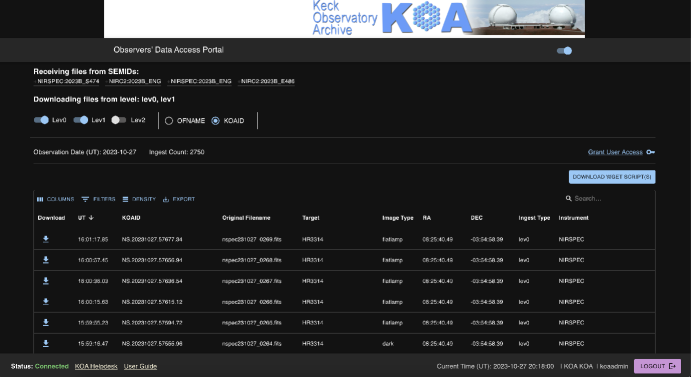
For all active instruments, the Keck Observatory Archive (KOA) now ingests raw data from the Keck Telescopes within 1 minute of acquisition, quick-look reduced data within 5 minutes of creation, and science ready reduced data for four instruments as they are created by their automated pipelines. On August 1, 2023, KOA released the Observers Data Access Portal (ODAP), which enables observers at the telescope and their collaborators anywhere in the world to securely monitor and download science, calibration, and quick-look data as they are ingested into the archive. The portal is built using Python Socket IO.WebSockets that ensure metadata appear in the portal as the data themselves are ingested. The portal itself is a dynamic web interface built with React. It enables users to view and customize metadata fields, filter metadata according to data type, and download data as they are ingested or in bulk through wget scripts. Observers have used the ODAP since its release and have provided feedback that will guide future releases.
Motivation & Objective
- To enable real-time access to Keck Observatory data for observers and collaborators during and immediately after observing runs.
- To reduce data latency from acquisition to availability, ensuring data reach users within minutes.
- To provide a secure, scalable, and dynamic web interface that supports filtering, customization, and bulk data retrieval.
- To integrate tightly with the Keck Observatory Archive and the Data Services Initiative for seamless data ingestion and access.
- To support both immediate data access during observing nights and long-term archival access via the KOA landing page.
Proposed method
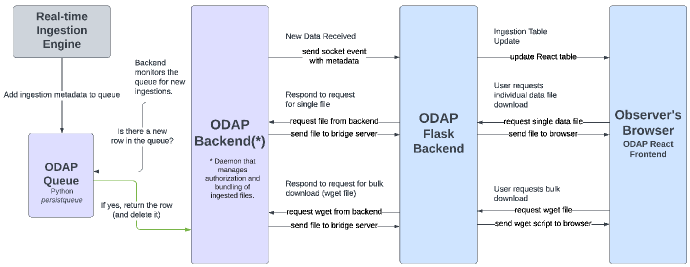
- The ODAP uses real-time WebSockets via Python Socket.IO to stream metadata from the archive to the user interface as data are ingested.
- A Flask-based backend server manages authentication, access control, and metadata forwarding to the React frontend.
- The system uses 'rooms' in WebSockets to securely deliver data only to authorized users per observing program.
- JWT (JSON Web Token) authentication ensures secure, stateless user verification with encrypted tokens containing authorized semester IDs.
- The backend dynamically generates wget scripts upon request, aggregating all relevant raw and reduced data files for a given night and program.
- Data are ingested into KOA within 1 minute of raw acquisition, quick-look data within 5 minutes, and science-ready data as pipelines complete.
Experimental results
Research questions
- RQ1How can real-time data access be achieved for observers at the telescope and their remote collaborators?
- RQ2What architectural components are required to ensure low-latency, secure, and scalable data delivery from the archive to end users?
- RQ3How can metadata and data be synchronized in real time across distributed users with fine-grained access control?
- RQ4What mechanisms enable dynamic, on-demand data retrieval including bulk downloads via wget scripts?
- RQ5How can authentication be securely managed for multiple users across multiple observing programs with minimal latency?
Key findings
- The ODAP enables data ingestion and metadata availability within 1 minute of raw data acquisition, with quick-look data available within 5 minutes.
- Observers and collaborators can access data as they are ingested, with metadata updated in real time via WebSockets.
- The portal supports secure, role-based access using JWT tokens, with exclusive access to science data for 18 months (12 months for NASA data).
- The system dynamically generates wget scripts that allow bulk downloads of all relevant files for a given night and program.
- The portal is accessible only for the current observing night; older data are available only through the main KOA landing page.
- Observers have already used the portal and provided feedback that is guiding future enhancements.
Read this paper
Open the full text in the Nubint reader and ask about any passage as you read.
Read this paper on NubintThis review was generated by AI from the original paper. Please check the paper before citing it.