
[Paper Review] The Primordial Inflation Explorer (PIXIE): Mission Design and Science Goals
The Primordial Inflation Explorer (PIXIE) is a proposed space mission to measure the cosmic microwave background (CMB) spectrum and polarization with unprecedented sensitivity across 28 GHz to 6 THz. Using a cryogenic Fourier transform spectrometer comparing the sky to an external blackbody, PIXIE achieves sub-percent absolute calibration and 200 Jy/sr sensitivity per 2.65° beam, enabling detection of spectral distortions and primordial B-mode polarization to test inflation and dark matter models.
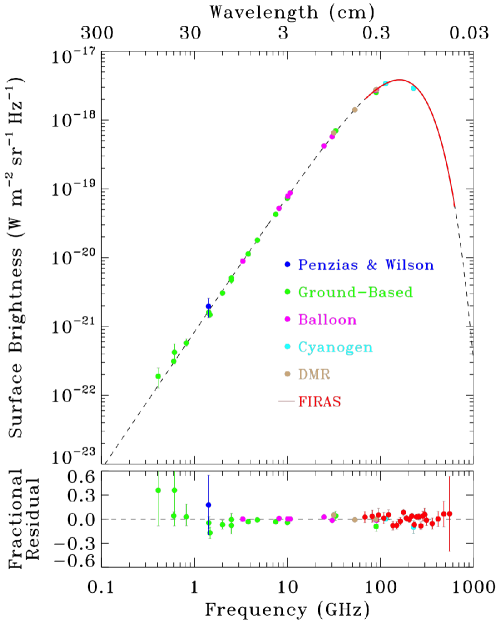
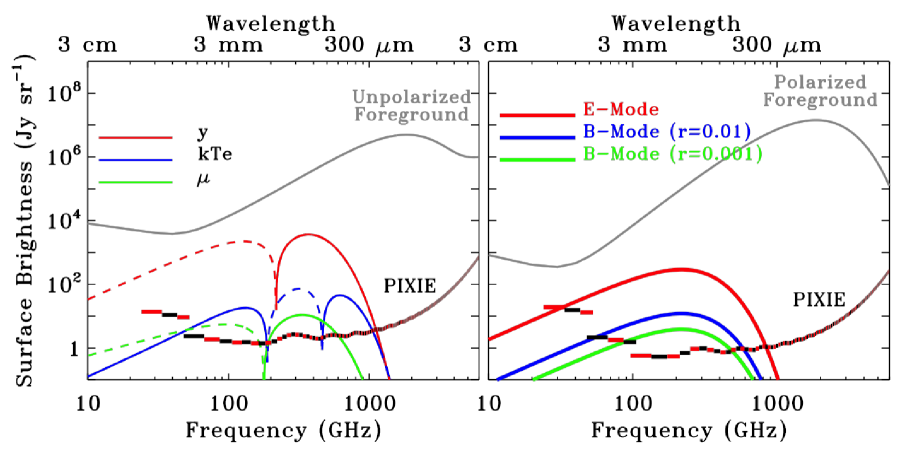
The Primordial Inflation Explorer (PIXIE) is an Explorer-class mission concept to measure the energy spectrum and linear polarization of the cosmic microwave background (CMB). A single cryogenic Fourier transform spectrometer compares the sky to an external blackbody calibration target, measuring the Stokes I, Q, U parameters to levels ~200 Jy/sr in each 2.65 degree diameter beam over the full sky, in each of 300 frequency channels from 28 GHz to 6 THz. With sensitivity over 1000 times greater than COBE/FIRAS, PIXIE opens a broad discovery space for the origin, contents, and evolution of the universe. Measurements of small distortions from a CMB blackbody spectrum provide a robust determination of the mean electron pressure and temperature in the universe while constraining processes including dissipation of primordial density perturbations, black holes, and the decay or annihilation of dark matter. Full-sky maps of linear polarization measure the optical depth to reionization at nearly the cosmic variance limit and constrain models of primordial inflation. Spectra with sub-percent absolute calibration spanning microwave to far-IR wavelengths provide a legacy data set for analyses including line intensity mapping of extragalactic emission and the cosmic infrared background amplitude and anisotropy. We describe the PIXIE instrument sensitivity, foreground subtraction, and anticipated science return from both the baseline 2-year mission and a potential extended mission.
Motivation & Objective
- To measure the cosmic microwave background (CMB) spectrum with sub-percent absolute calibration across 28 GHz to 6 THz to detect spectral distortions from early universe processes.
- To map the full-sky linear polarization of the CMB to constrain the optical depth to reionization and probe primordial inflation via B-mode detection.
- To achieve sensitivity over 1000× better than COBE/FIRAS, enabling detection of faint cosmological signals buried beneath astrophysical foregrounds.
- To provide a legacy data set for studies of the cosmic infrared background, line intensity mapping, and dark matter decay/annihilation.
- To test the thermal big bang model and rule out alternatives like steady-state cosmologies through precise spectral distortion limits.
Proposed method
- Employ a cryogenic Fourier transform spectrometer operating at 2.725 K to match the CMB blackbody temperature, minimizing thermal system noise.
- Use a dual-beam configuration comparing the sky to an external, precisely characterized blackbody calibration target to enable absolute intensity and polarization calibration.
- Measure Stokes parameters I, Q, and U across 300 frequency channels spanning 28 GHz to 6 THz with 2.65° beam resolution.
- Implement passive and active cooling systems to maintain instrument temperature stability and suppress thermal background emission.
- Utilize a scanning mode from the Sun-Earth L2 point to survey the entire sky over a 2-year baseline mission with full-sky coverage.
- Apply advanced foreground subtraction techniques using the broad spectral coverage to disentangle cosmological signals from astrophysical foregrounds.
Experimental results
Research questions
- RQ1Can PIXIE detect spectral distortions in the CMB blackbody spectrum arising from energy release in the early universe, such as from primordial density perturbation dissipation or dark matter decay?
- RQ2What is the optical depth to reionization as measured by full-sky E-mode polarization, and how precisely can it constrain the epoch of first star formation?
- RQ3Can PIXIE detect primordial B-mode polarization with tensor-to-scalar ratios r = 0.01 and r = 0.001, providing direct evidence for primordial gravitational waves from inflation?
- RQ4How precisely can PIXIE constrain the amplitude and anisotropy of the cosmic infrared background and extragalactic line intensity mapping using full-sky spectral data?
- RQ5To what extent can PIXIE improve limits on deviations from a blackbody spectrum, thereby testing the thermal history of the universe and ruling out alternative cosmological models?
Key findings
- PIXIE achieves a sensitivity of ~200 Jy/sr per 2.65° beam in each of 300 frequency channels, enabling detection of spectral distortions at levels below 5×10⁻⁵ in intensity relative to the blackbody.
- The mission provides sub-percent absolute calibration across the microwave to far-IR spectrum, crucial for detecting weak spectral features such as μ- and y-type distortions.
- PIXIE can measure the optical depth to reionization at nearly the cosmic variance limit, with uncertainty below 0.001 for a 2-year mission.
- The instrument’s sensitivity is over 1000× greater than COBE/FIRAS, allowing detection of spectral distortions from processes like primordial black hole evaporation and dark matter annihilation.
- Full-sky maps of linear polarization will constrain models of primordial inflation with sensitivity to B-mode amplitudes corresponding to tensor-to-scalar ratios r ≈ 0.001.
- The mission’s spectral coverage and calibration enable a legacy data set for studying the cosmic infrared background and extragalactic emission, with sensitivity to anisotropies at the 10⁻⁴ level.
Read this paper
Open the full text in the Nubint reader and ask about any passage as you read.
Read this paper on NubintThis review was generated by AI from the original paper. Please check the paper before citing it.