
[Paper Review] The Prompt Report: A Systematic Survey of Prompt Engineering Techniques
The paper delivers a systematic survey of prompting techniques, constructing a taxonomy of 58 text-based and 40 multimodal prompting methods, plus a 33-term vocabulary, using PRISMA-based literature review.
Generative Artificial Intelligence (GenAI) systems are increasingly being deployed across diverse industries and research domains. Developers and end-users interact with these systems through the use of prompting and prompt engineering. Although prompt engineering is a widely adopted and extensively researched area, it suffers from conflicting terminology and a fragmented ontological understanding of what constitutes an effective prompt due to its relatively recent emergence. We establish a structured understanding of prompt engineering by assembling a taxonomy of prompting techniques and analyzing their applications. We present a detailed vocabulary of 33 vocabulary terms, a taxonomy of 58 LLM prompting techniques, and 40 techniques for other modalities. Additionally, we provide best practices and guidelines for prompt engineering, including advice for prompting state-of-the-art (SOTA) LLMs such as ChatGPT. We further present a meta-analysis of the entire literature on natural language prefix-prompting. As a culmination of these efforts, this paper presents the most comprehensive survey on prompt engineering to date.
Motivation & Objective
- Establish a structured, widely usable vocabulary for prompting research and practice.
- Create a comprehensive taxonomy of prompting techniques across text and other modalities.
- Summarize the evolution and usage patterns of prompting approaches in the literature.
Proposed method
- Conduct a PRISMA-based systematic review to collect prompting literature from arXiv, Semantic Scholar, and ACL.
- Assemble a taxonomy of prompting techniques (58 text-based, 40 multimodal) and a 33-term vocabulary.
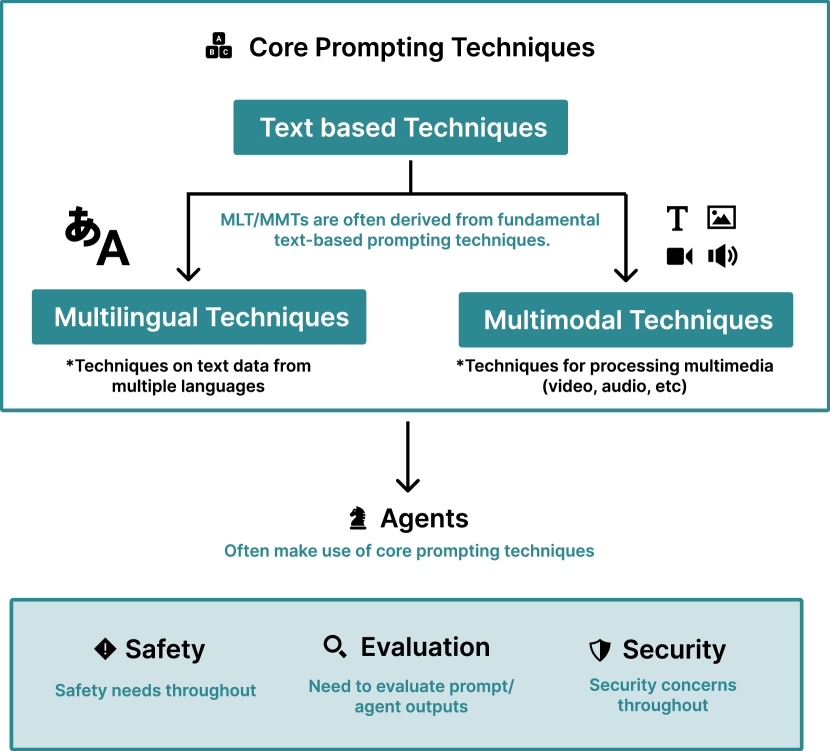
- Synthesize findings across benchmarks, multilingual and multimodal contexts, and prompting extensions such as agents and evaluation frameworks.
Experimental results
Research questions
- RQ1What are the core components and terminology that define prompts in GenAI research?
- RQ2What prompting techniques exist, and how can they be categorized into a robust taxonomy?
- RQ3How are prompting techniques applied across languages and modalities, and what extensions (agents, evaluation) exist?
- RQ4What are common evaluation practices and security/safety considerations in prompting?
- RQ5How do prompting techniques perform on benchmarks and real-world case studies?ynet?
Key findings
- A taxonomy of 58 text-based prompting techniques is presented, organized into six major categories.
- A parallel set of 40 prompting techniques covers non-text modalities (multimodal prompting).
- A vocabulary of 33 prompting terms is provided to standardize terminology.
- The study follows a PRISMA-based process and includes a meta-analysis of natural language prefix prompting.
- The work discusses agents, evaluation, security, alignment, and benchmarking within prompting research.
- Two case studies illustrate prompting techniques on benchmarks like MMLU and a real-world crisis-related task.

Read this paper
Open the full text in the Nubint reader and ask about any passage as you read.
Read this paper on NubintThis review was generated by AI from the original paper. Please check the paper before citing it.