
[Paper Review] The rising costs of training frontier AI models
The paper builds a detailed cost model for frontier AI model training using three approaches, finding amortized costs grow about 2.4x per year since 2016, with tens of millions spent per model and potential over $1B by 2027; R&D staff are a substantial portion of total costs.
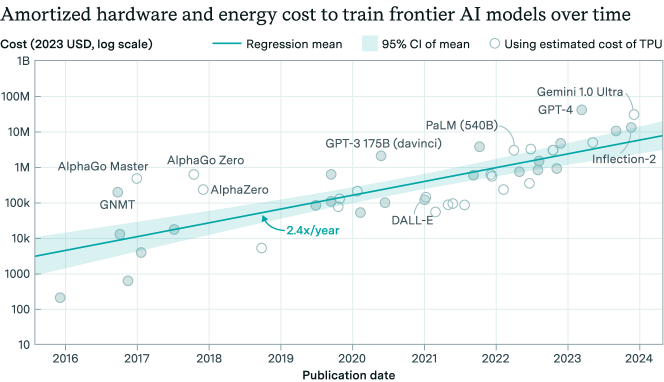
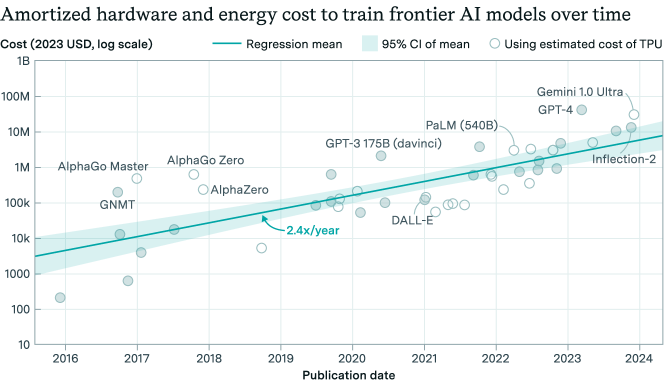
The costs of training frontier AI models have grown dramatically in recent years, but there is limited public data on the magnitude and growth of these expenses. This paper develops a detailed cost model to address this gap, estimating training costs using three approaches that account for hardware, energy, cloud rental, and staff expenses. The analysis reveals that the amortized cost to train the most compute-intensive models has grown precipitously at a rate of 2.4x per year since 2016 (90% CI: 2.0x to 2.9x). For key frontier models, such as GPT-4 and Gemini, the most significant expenses are AI accelerator chips and staff costs, each costing tens of millions of dollars. Other notable costs include server components (15-22%), cluster-level interconnect (9-13%), and energy consumption (2-6%). If the trend of growing development costs continues, the largest training runs will cost more than a billion dollars by 2027, meaning that only the most well-funded organizations will be able to finance frontier AI models.
Motivation & Objective
- Quantify the rising costs of training frontier AI models across multiple cost components.
- Decompose costs into hardware, energy, cloud rental, and R&D staff to understand major drivers.
- Provide three estimation approaches to validate cost growth and assess robustness across methods.
- Offer implications for accessibility and governance of frontier AI development.
Proposed method
- Three cost estimation approaches: (i) amortized hardware CapEx + energy for final training run, (ii) cloud rental price-based costs, (iii) total model development cost including R&D staff and experiments for selected models.
- Decomposition of hardware into AI accelerators, servers, networking, and energy with depreciation and training chip-hours to compute amortized cost.
- Energy cost modeled via TDP, power-to-TDP ratios, and data center PUE, using year-specific energy rates and vendor data.
- Validation by comparing amortized hardware+energy with cloud-based estimates; sensitivity analyses across depreciation and TPU inclusion.
- Cross-model R&D cost assessment for GPT-3, OPT-175B, GPT-4, Gemini Ultra including equity and staff composition.
Experimental results
Research questions
- RQ1What is the growth rate of amortized training costs for frontier models from 2016 to the present?
- RQ2What share of frontier-model costs come from hardware, energy, and R&D staff, and how does this split evolve over development?
- RQ3How do different cost-estimation approaches compare in magnitude and trend?
- RQ4What are the implications of rising frontier costs for access and governance of AI development?
Key findings
- Amortized training costs for frontier models have grown by 2.4× per year since 2016 (95% CI: 2.0× to 3.1×).
- Cloud-based cost estimates show a similar growth rate of 2.6× per year (95% CI: 2.1× to 3.2×).
- For notable models (GPT-3, OPT-175B, GPT-4, Gemini Ultra), R&D staff costs (including equity) account for 29%–49% of total amortized development costs; hardware costs constitute 47%–65%, and energy 2%–6% (equity-excluded: 22–33% R&D, 60–74% hardware, 2–7% energy).
- Publicly announced final training runs cost tens of millions (GPT-4: ~$40M; Gemini Ultra: ~$30M); extrapolation suggests costs could exceed $1B by 2027 at current growth rates.
- Acquisition costs (upfront hardware) are 1–2 orders of magnitude higher than amortized costs, illustrating capital barriers to entry.
- On average, about 44% of amortized hardware+energy costs go to AI accelerator chips, with 29% servers and 17% interconnect; energy costs remain a smaller but growing share.
Read this paper
Open the full text in the Nubint reader and ask about any passage as you read.
Read this paper on NubintThis review was generated by AI from the original paper. Please check the paper before citing it.