
[Paper Review] The SN 2023ixf Progenitor in M101: I. Infrared Variability
This study analyzes infrared variability in the progenitor of SN 2023ixf, a Type II supernova in M101, using 19 years of Spitzer and ground-based near-IR data. It identifies a 1091±71 day periodicity in the light curves, attributes it to pulsational instability, and derives a progenitor luminosity of M_K = -11.58±0.31 mag, implying an initial mass of 20±4 M☉—one of the most massive progenitors observed for a core-collapse supernova to date.
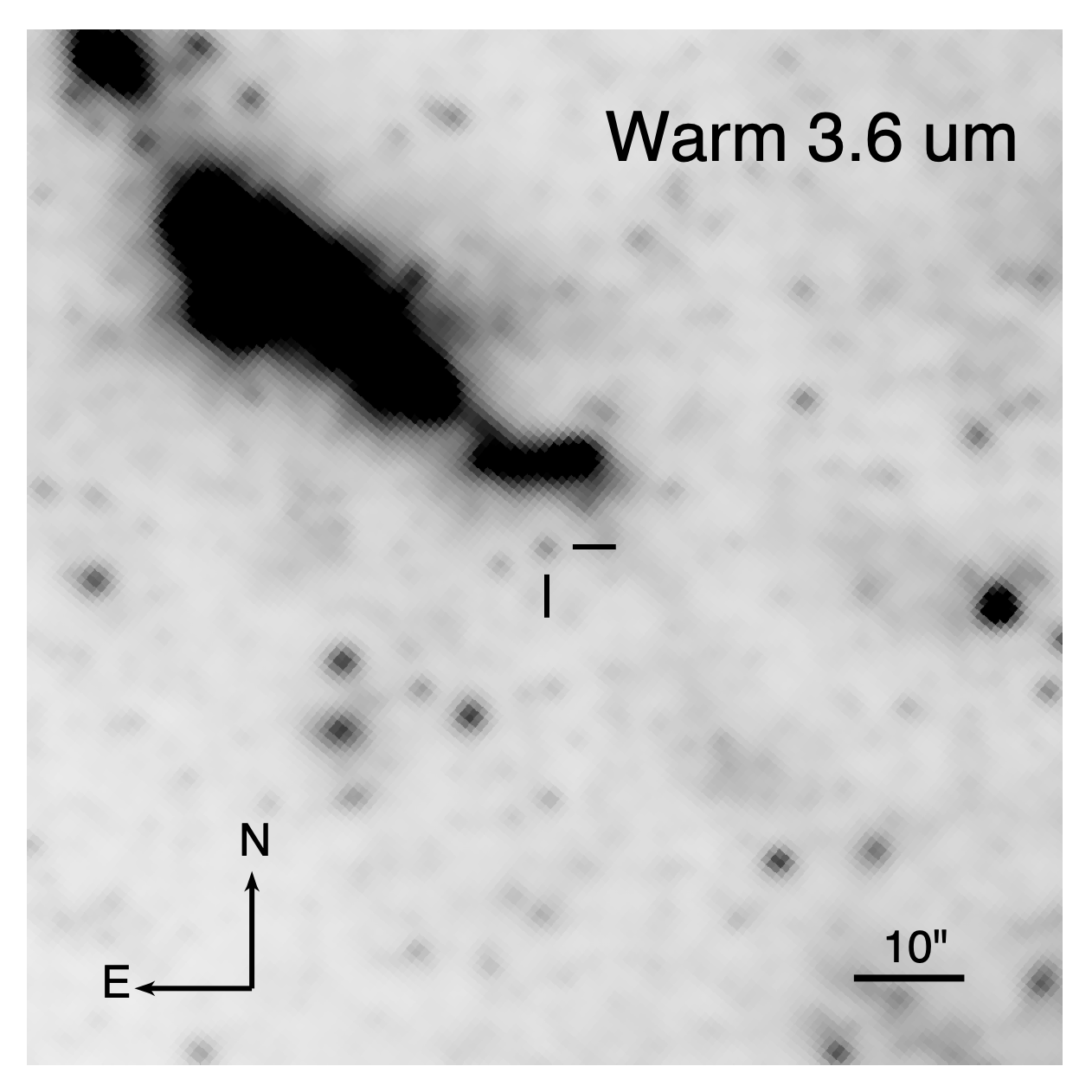
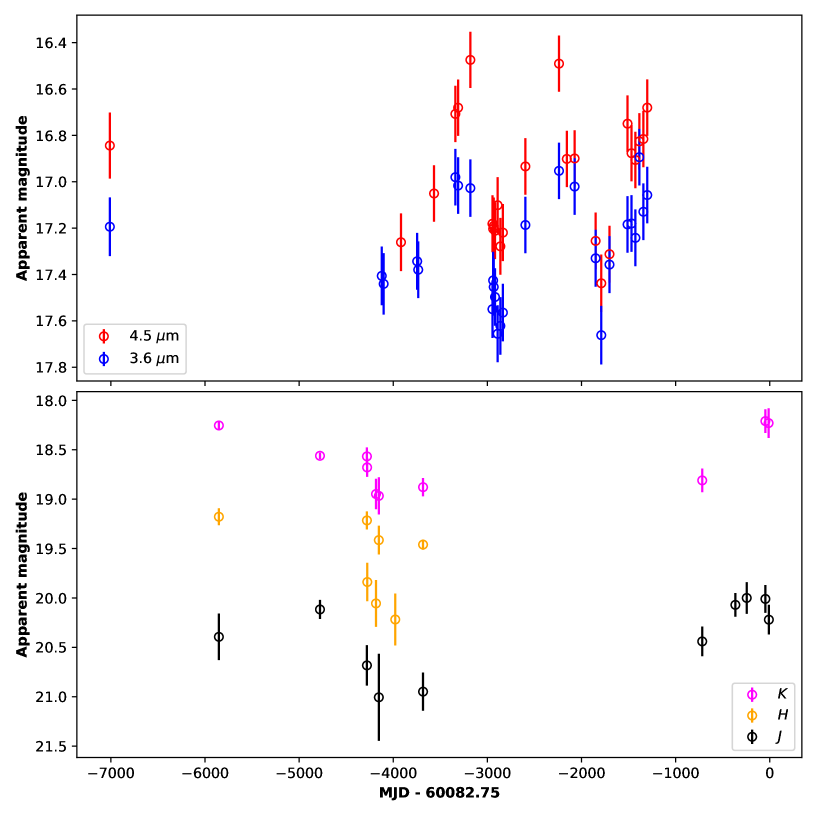
Observational evidence points to a red supergiant (RSG) progenitor for SN 2023ixf. The progenitor candidate has been detected in archival images at wavelengths (>0.6 micron) where RSGs typically emit profusely. This object is distinctly variable in the infrared (IR). We characterize the variability using pre-explosion mid-IR (3.6 and 4.5 micron) Spitzer and ground-based near-IR (JHKs) archival data jointly covering 19 yr. The IR light curves exhibit significant variability with RMS amplitudes in the range of 0.2-0.4 mag, increasing with decreasing wavelength. From a robust period analysis of the more densely sampled Spitzer data, we measure a period of 1091+/-71 days. We demonstrate using Gaussian Process modeling that this periodicity is also present in the near-IR light curves, thus indicating a common physical origin, which is likely pulsational instability. We use a period-luminosity relation for RSGs to derive a value of M_K=-11.58+/-0.31 mag. Assuming a late M spectral type, this corresponds to log(L/L_sun)=5.27+/-0.12 at T_eff=3200 K and to log(L/L_sun)=5.37+/-0.12 at T_eff=3500 K. This gives an independent estimate of the progenitor's luminosity, unaffected by uncertainties in extinction and distance. Assuming the progenitor candidate underwent enhanced dust-driven mass-loss during the time of these archival observations, and using an empirical period-luminosity-based mass-loss prescription, we obtain a mass-loss rate of around (2-4)x10^-4 M_sun/yr. Comparing the above luminosity with stellar evolution models, we infer an initial mass for the progenitor candidate of 20+/-4 M_sun, making this one of the most massive progenitors for a Type II SN detected to-date.
Motivation & Objective
- To characterize the infrared variability of the progenitor star of SN 2023ixf using archival Spitzer and ground-based near-IR data.
- To determine the physical origin of the observed variability, particularly whether it is driven by pulsational instability.
- To derive the progenitor's luminosity and initial mass independently of extinction and distance using a period-luminosity relation.
- To estimate the mass-loss rate during the pre-explosion phase using an empirical period-luminosity-based prescription.
- To provide an independent constraint on the progenitor's initial mass, enhancing understanding of massive star evolution and supernova progenitor demographics.
Proposed method
- Combined 19 years of mid-IR (3.6 and 4.5 μm) Spitzer data with near-IR (JHKs) ground-based data from UKIRT, Gemini North, and WFCAM.
- Performed robust period analysis on the densely sampled Spitzer light curves to identify a dominant periodicity of 1091±71 days.
- Applied Gaussian Process modeling to near-IR light curves to test for coherence with the mid-IR periodicity, confirming a common physical origin.
- Used the period-luminosity relation for red supergiants to derive M_K = -11.58±0.31 mag, independent of extinction and distance.
- Estimated the progenitor's luminosity at T_eff = 3200–3500 K, yielding log(L/L☉) = 5.27±0.12 to 5.37±0.12.
- Applied an empirical mass-loss prescription based on period and luminosity to estimate a mass-loss rate of (2–4)×10⁻⁴ M☉ yr⁻¹ during the pre-explosion phase.
Experimental results
Research questions
- RQ1What is the nature and origin of the infrared variability observed in the progenitor of SN 2023ixf?
- RQ2Does the observed periodicity in the mid-IR light curve persist in the near-IR, indicating a common physical mechanism?
- RQ3What is the intrinsic luminosity of the progenitor star, independent of extinction and distance estimates?
- RQ4What is the initial mass of the progenitor star based on its pulsational period and luminosity?
- RQ5What was the mass-loss rate during the pre-explosion phase, and how does it relate to the star’s pulsational properties?
Key findings
- The progenitor of SN 2023ixf exhibits significant infrared variability with RMS amplitudes of 0.2–0.4 mag, increasing with decreasing wavelength.
- A dominant periodicity of 1091±71 days was detected in the Spitzer mid-IR light curves, indicating pulsational instability.
- Gaussian Process modeling confirms that this periodicity is also present in the near-IR light curves, supporting a common physical origin.
- The progenitor’s absolute K-band magnitude was derived as M_K = -11.58±0.31 mag using the period-luminosity relation for red supergiants.
- The progenitor’s luminosity corresponds to log(L/L☉) = 5.27±0.12 at T_eff = 3200 K and 5.37±0.12 at T_eff = 3500 K, independent of extinction and distance.
- Stellar evolution models suggest an initial mass of 20±4 M☉, making this one of the most massive progenitors identified for a Type II supernova to date.
Read this paper
Open the full text in the Nubint reader and ask about any passage as you read.
Read this paper on NubintThis review was generated by AI from the original paper. Please check the paper before citing it.