
[Paper Review] The SOHO LASCO CME Catalog -- Version 2
This paper introduces Version 2 of the SOHO LASCO CME Catalog, featuring an online measurement tool for height-time tracking, combined STEREO and SDO JavaScript movies, and 3,072 newly identified CMEs from 1996–2004—mostly weak and narrow—without significantly altering the statistical properties of CMEs. The catalog is now the default at the CDAW Data Center as of May 1, 2024.
This paper provides an update on the coronal mass ejection (CME) catalog maintained at the CDAW Data Center, NASA Goddard Space Flight Center (https://cdaw.gsfc.nasa.gov/CME_list). This is version 2 (v2) of the Catalog that has been made as the default version as of May 1, 2024. The new features of the Catalog v2 are (i) online measurement tool, (ii) combination JavaScript movies from the STEREO and Solar Dynamics Observatory (SDO) missions, and (iii) insertion of newly identified CMEs for the period 1996 to 2004. The CME identification was revisited resulting in a set of $\sim$3000 new CMEs added to the Catalog. A vast majority of these CMEs are weak and narrow. The resulting statistical properties of CMEs are not significantly different from those reported using version 1.
Motivation & Objective
- To improve accessibility and interactivity of the SOHO LASCO CME Catalog for solar physics researchers.
- To address potential undercounting of coronal mass ejections (CMEs) in the original catalog by revisiting archived LASCO images from 1996 to 2004.
- To integrate multi-mission data (STEREO, SDO) into interactive visualizations for better CME analysis.
- To provide an online measurement tool enabling users to perform custom height-time measurements on CME features and radio dynamic spectra.
- To maintain consistency and improve data quality by re-evaluating CME identifications across the entire 1996–2004 period.
Proposed method
- The catalog uses a 13-column HTML table with monthly CME lists, each row containing CME metadata, links to JavaScript movies, plots, and digital data.
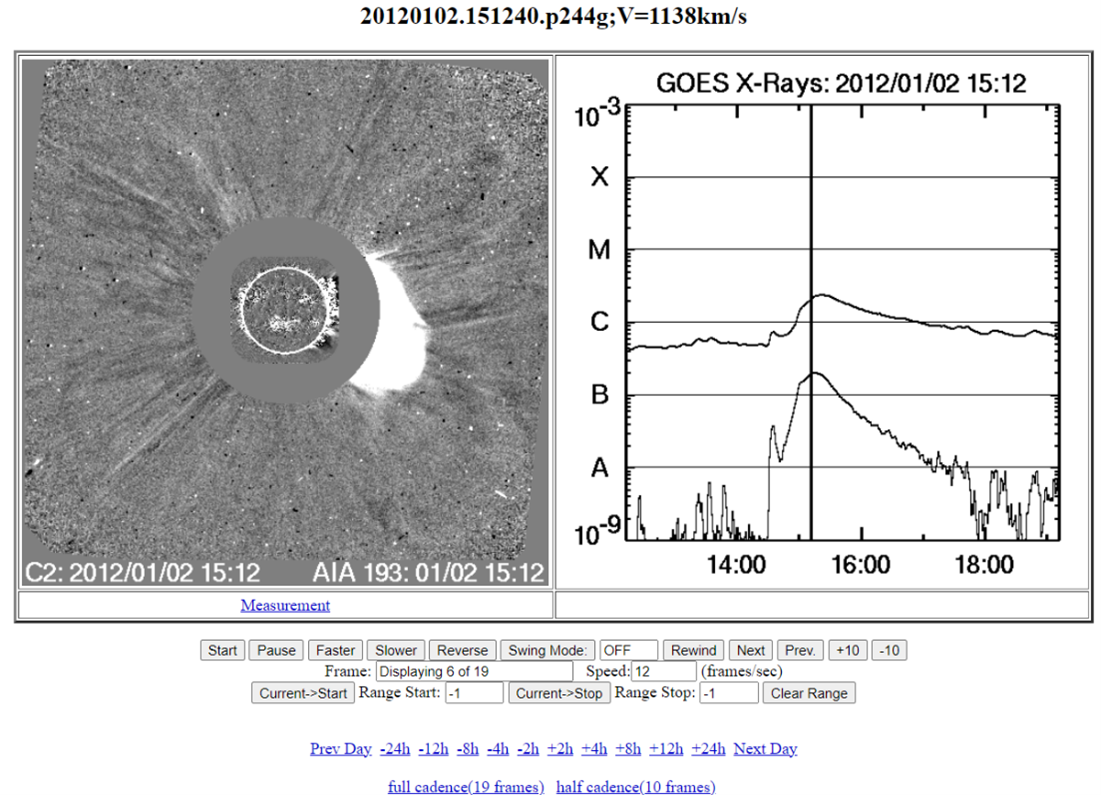
- An online measurement tool allows users to click on CME features in LASCO/C2 difference images and EUV images to extract pixel coordinates, heliographic positions, and distance in solar radii.
- JavaScript movies are generated from LASCO/C2 running difference images with superposed SDO EUV images, enabling interactive playback and time extension up to 24 hours.
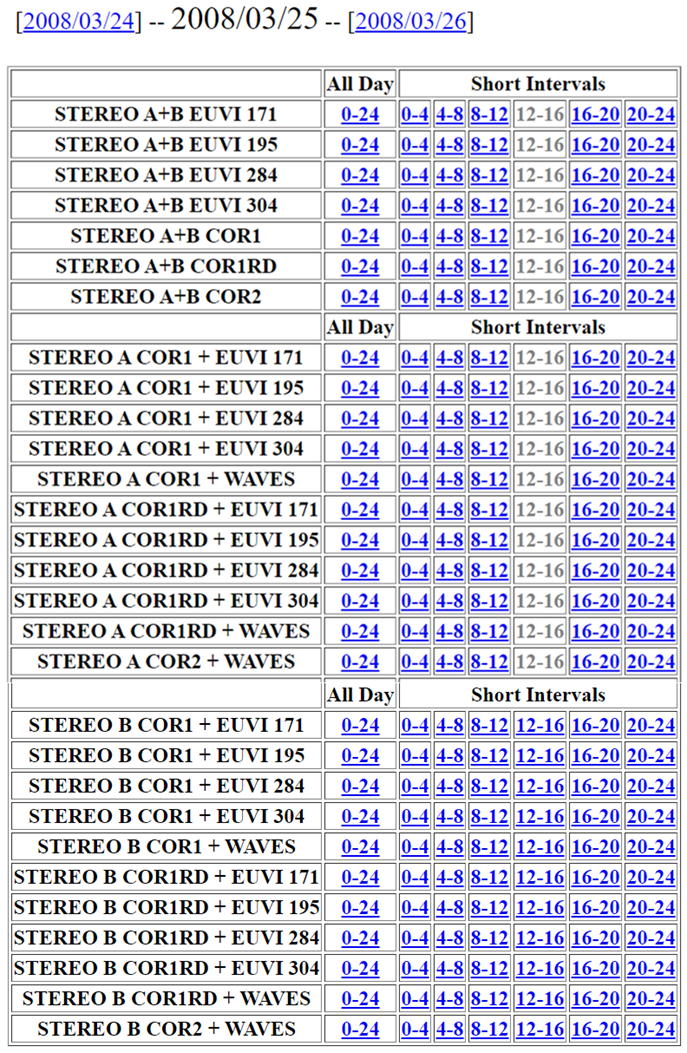
- New STEREO movies combine EUV (171, 195, 284, 304 Å), COR1 and COR2 coronagraph images, and WAVES radio dynamic spectra from both STEREO A and B spacecraft.
- A systematic re-analysis of LASCO images from 1996 to 2004 was conducted by a single analyst (G. Michałek) to ensure uniform CME identification and minimize observer bias.
- Statistical comparisons between catalog v1 and v2 were performed using speed, width, and acceleration distributions, with only CMEs having five or more height-time measurements included in acceleration plots.
Experimental results
Research questions
- RQ1How can the accessibility and interactivity of the SOHO LASCO CME Catalog be improved for solar physics researchers?
- RQ2What is the impact of revisiting archived LASCO data (1996–2004) on the total number and statistical properties of identified CMEs?
- RQ3To what extent do newly identified CMEs alter the established distributions of CME speed, width, and acceleration?
- RQ4Can integrated multi-mission visualizations (STEREO, SDO) enhance the analysis of CME morphology and evolution?
- RQ5How do the statistical properties of CMEs in solar cycles 23, 24, and 25 compare, especially in light of the inclusion of newly identified weak and narrow CMEs?
Key findings
- A total of 3,072 new CMEs were identified in the 1996–2004 period, with the vast majority being weak and narrow (angular width < 30°).
- The average CME speed decreased by 27 km/s and the average angular width decreased by 2 degrees in catalog v2 compared to v1, but the acceleration distribution remained unchanged.
- Only one halo CME was newly identified (on 2000 January 2), and it was faint and easily missed in original analysis.
- The newly added CMEs did not significantly alter the overall statistical distributions of CME speed, width, or acceleration, indicating robustness of prior catalog statistics.
- The inclusion of CMEs from solar cycles 24 and 25—characterized by weaker activity—further reduced average CME speed and width, consistent with the lower solar activity levels.
- The online measurement tool enables precise height-time measurements on CME leading edges, shocks, flux ropes, and prominence cores, with real-time display of position, distance, and heliographic coordinates.
Read this paper
Open the full text in the Nubint reader and ask about any passage as you read.
Read this paper on NubintThis review was generated by AI from the original paper. Please check the paper before citing it.