
[Paper Review] The Surprising Effectiveness of Diffusion Models for Optical Flow and Monocular Depth Estimation
The paper shows that a generic denoising diffusion model can achieve state-of-the-art or competitive results on optical flow and monocular depth estimation without task-specific architectures, while enabling uncertainty estimation and multi-modal predictions.
Denoising diffusion probabilistic models have transformed image generation with their impressive fidelity and diversity. We show that they also excel in estimating optical flow and monocular depth, surprisingly, without task-specific architectures and loss functions that are predominant for these tasks. Compared to the point estimates of conventional regression-based methods, diffusion models also enable Monte Carlo inference, e.g., capturing uncertainty and ambiguity in flow and depth. With self-supervised pre-training, the combined use of synthetic and real data for supervised training, and technical innovations (infilling and step-unrolled denoising diffusion training) to handle noisy-incomplete training data, and a simple form of coarse-to-fine refinement, one can train state-of-the-art diffusion models for depth and optical flow estimation. Extensive experiments focus on quantitative performance against benchmarks, ablations, and the model's ability to capture uncertainty and multimodality, and impute missing values. Our model, DDVM (Denoising Diffusion Vision Model), obtains a state-of-the-art relative depth error of 0.074 on the indoor NYU benchmark and an Fl-all outlier rate of 3.26\% on the KITTI optical flow benchmark, about 25\% better than the best published method. For an overview see https://diffusion-vision.github.io.
Motivation & Objective
- Demonstrate that a generic diffusion model can solve optical flow and monocular depth estimation without specialized architectures or losses.
- Address data challenges from noisy/incomplete ground truth via infilling, step-unrolled denoising, and L1 denoiser loss.
- Show how synthetic-real data mixtures improve pre-training and generalization for depth and flow tasks.
- Illustrate the model's ability to capture uncertainty and multi-modality, and enable coarse-to-fine refinement and imputation.
Proposed method
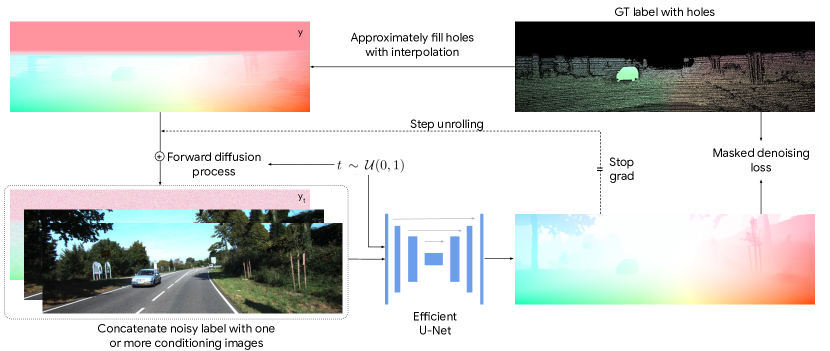
- Formulate depth and flow estimation as image-to-image translation with a conditional denoising diffusion model.
- Use infilling of missing ground truth values during training to mitigate data noise.
- Apply step-unrolled denoising during fine-tuning to reduce training-inference distribution shift.
- Incorporate an L1 denoiser loss for robustness to noisy ground truth.
- Employ coarse-to-fine refinement during inference to achieve high-resolution outputs.
- Pre-train on synthetic datasets and real data mixtures to improve generalization.
Experimental results
Research questions
- RQ1Can a generic diffusion model achieve state-of-the-art results on optical flow and monocular depth estimation without task-specific architectures?
- RQ2How can training with noisy/incomplete ground truth be stabilized for diffusion-based dense prediction tasks?
- RQ3Does multi-task self-supervised and synthetic-real pre-training enhance performance and generalization for depth and flow?
- RQ4What is the model’s capacity to capture uncertainty and multimodality in these tasks?
- RQ5Can diffusion models support coarse-to-fine refinement and missing value imputation in dense predictions?
Key findings
- DDVM achieves state-of-the-art relative depth error of 0.074 on NYU indoor depth estimation.
- For KITTI optical flow, the model attains an Fl-all outlier rate of 3.26%, about 25% better than the best published method.
- Zero-shot optical flow results on Sintel and KITTI surpass strong baselines after pre-training on a synthetic data mixture (AutoFlow, FlyingThings, Kubric, TartanAir).
- Diffusion models capture multi-modality and uncertainty via multiple samples, especially in reflective, translucent, or ambiguous regions.
- Coarse-to-fine refinement and infilling strategies significantly improve flow and depth accuracy, reducing AEPE and improving KITTI/Sintel metrics.
- The model outperforms FlowFormer on KITTI optical flow in zero-shot and fine-tuning settings, and many cases on Sintel, with some exceptions discussed.
Read this paper
Open the full text in the Nubint reader and ask about any passage as you read.
Read this paper on NubintThis review was generated by AI from the original paper. Please check the paper before citing it.