
[Paper Review] Thermodynamic Computing System for AI Applications
This paper presents the first continuous-variable thermodynamic computer, the Stochastic Processing Unit (SPU), built from RLC circuits with 8 all-to-all coupled unit cells using switched capacitors. It demonstrates Gaussian sampling and matrix inversion—marking the first experimental thermodynamic linear algebra experiment—showcasing potential for low-power, high-efficiency acceleration of probabilistic AI workloads like uncertainty quantification and generative modeling.
Recent breakthroughs in artificial intelligence (AI) algorithms have highlighted the need for novel computing hardware in order to truly unlock the potential for AI. Physics-based hardware, such as thermodynamic computing, has the potential to provide a fast, low-power means to accelerate AI primitives, especially generative AI and probabilistic AI. In this work, we present the first continuous-variable thermodynamic computer, which we call the stochastic processing unit (SPU). Our SPU is composed of RLC circuits, as unit cells, on a printed circuit board, with 8 unit cells that are all-to-all coupled via switched capacitances. It can be used for either sampling or linear algebra primitives, and we demonstrate Gaussian sampling and matrix inversion on our hardware. The latter represents the first thermodynamic linear algebra experiment. We also illustrate the applicability of the SPU to uncertainty quantification for neural network classification. We envision that this hardware, when scaled up in size, will have significant impact on accelerating various probabilistic AI applications.
Motivation & Objective
- To develop a physics-based, thermodynamic computing system that matches the stochastic nature of probabilistic AI algorithms.
- To overcome limitations of digital hardware in accelerating computationally intensive probabilistic AI tasks such as Bayesian inference and generative modeling.
- To demonstrate a working prototype of a continuous-variable thermodynamic computer capable of both sampling and linear algebra operations.
- To validate the feasibility of thermodynamic computing for real-world AI workloads through experimental implementation.
- To establish a foundation for scaling up thermodynamic hardware to achieve thermodynamic advantage over digital systems in speed or energy efficiency.
Proposed method
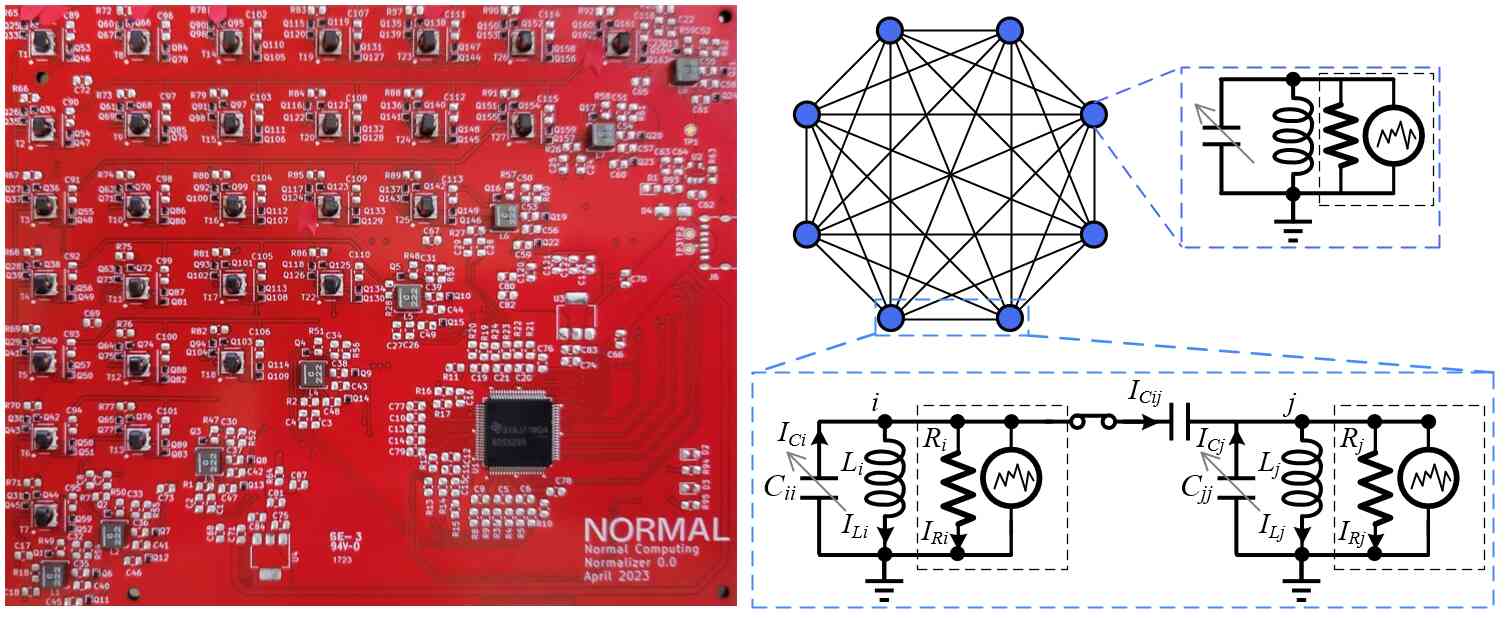
- The SPU is implemented as a printed circuit board with 8 RLC unit cells, each containing an inductor, tunable capacitor (via switched capacitor banks), and a current noise source.
- All unit cells are fully connected via switched capacitors with bipolar coupling enabled through a center-tapped transformer.
- Noise is generated using FPGA-based 16-bit LFSRs with Gold code generation and RC filtering to approximate Gaussian distributions.
- Pulse Density Modulation (PDM) controls noise variance by duty-cycling the LFSR output to achieve desired stochastic dynamics.
- Sampling is performed at 12 MHz using an 8-channel 10-bit ADC, with data read after setting capacitance values and initiating noise.
- The system interfaces with digital hardware via an FPGA co-processor, enabling parameter configuration and data upload for downstream processing.
Experimental results
Research questions
- RQ1Can a continuous-variable thermodynamic computer be physically realized to perform probabilistic AI primitives such as sampling and linear algebra?
- RQ2Does the SPU achieve accurate Gaussian sampling and matrix inversion using analog RLC circuits with stochastic dynamics?
- RQ3Can thermodynamic computing outperform digital hardware in speed or energy efficiency for probabilistic AI workloads?
- RQ4How can uncorrelated, controllable noise be generated in a scalable analog hardware platform for thermodynamic computation?
- RQ5What is the practical feasibility of scaling this system to achieve thermodynamic advantage in real-world AI applications?
Key findings
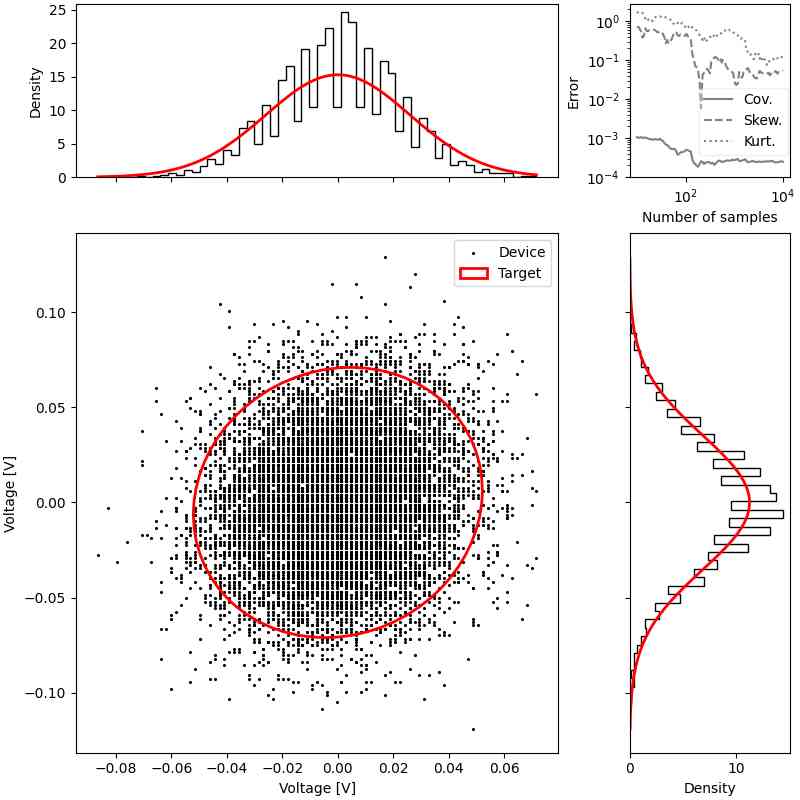
- The SPU successfully demonstrates Gaussian sampling from user-defined multivariate distributions using analog RLC circuits with stochastic noise.
- The system performs matrix inversion experimentally for the first time in a thermodynamic computing context, validating its use for linear algebra primitives.
- The sampling rate of 12 MHz was optimized to minimize temporal correlation between samples, ensuring statistical independence.
- Noise sources are generated via LFSRs with Gold code combination and RC filtering, approximating Gaussian distributions with high fidelity.
- The FPGA-based control system enables precise configuration of circuit parameters and real-time data acquisition from the ADC.
- The hardware interface enables integration with digital systems, supporting co-processing for AI workloads such as uncertainty quantification in neural networks.
Read this paper
Open the full text in the Nubint reader and ask about any passage as you read.
Read this paper on NubintThis review was generated by AI from the original paper. Please check the paper before citing it.