
[Paper Review] Thought Cloning: Learning to Think while Acting by Imitating Human Thinking
Thought Cloning trains agents to think in language by imitating human thoughts during action, enabling faster learning, better generalization, and improved safety and interpretability compared to Behavioral Cloning.
Language is often considered a key aspect of human thinking, providing us with exceptional abilities to generalize, explore, plan, replan, and adapt to new situations. However, Reinforcement Learning (RL) agents are far from human-level performance in any of these abilities. We hypothesize one reason for such cognitive deficiencies is that they lack the benefits of thinking in language and that we can improve AI agents by training them to think like humans do. We introduce a novel Imitation Learning framework, Thought Cloning, where the idea is to not just clone the behaviors of human demonstrators, but also the thoughts humans have as they perform these behaviors. While we expect Thought Cloning to truly shine at scale on internet-sized datasets of humans thinking out loud while acting (e.g. online videos with transcripts), here we conduct experiments in a domain where the thinking and action data are synthetically generated. Results reveal that Thought Cloning learns much faster than Behavioral Cloning and its performance advantage grows the further out of distribution test tasks are, highlighting its ability to better handle novel situations. Thought Cloning also provides important benefits for AI Safety and Interpretability, and makes it easier to debug and improve AI. Because we can observe the agent's thoughts, we can (1) more easily diagnose why things are going wrong, making it easier to fix the problem, (2) steer the agent by correcting its thinking, or (3) prevent it from doing unsafe things it plans to do. Overall, by training agents how to think as well as behave, Thought Cloning creates safer, more powerful agents.
Motivation & Objective
- Motivate the use of language-like thinking to improve sample efficiency, generalization, planning, and replanning in RL agents.
- Propose Thought Cloning, an imitation learning framework that jointly learns to think (in natural language) and act from synchronized thought-action demonstrations.
- Demonstrate that Thought Cloning outperforms Behavioral Cloning on a synthetic thought dataset in BabyAI, with stronger out-of-distribution generalization and safety benefits.
Proposed method
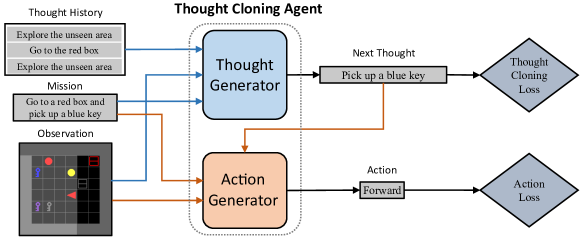
- Introduce a bi-level Thought Generator and Action Generator architecture.
- Train with a joint loss: Thought Cloning loss predicting thoughts and Action loss predicting actions, conditioned on mission, observations, and thought history.
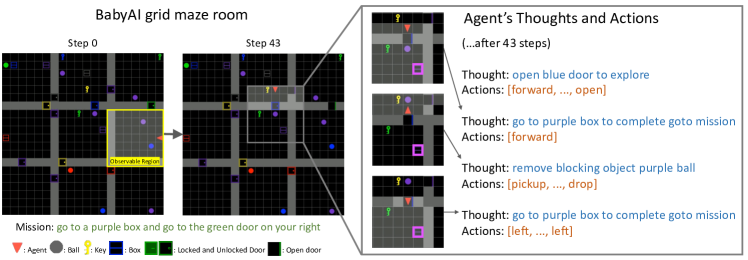
- Use a synthetic thought dataset derived from BabyAI with thought transcripts aligned to actions and missions, plus noise to simulate real data.
- Implement Thought Generator using memory-augmented LSTM with FiLM fusion; optionally leverage pre-trained Vision-Language Models for scaling.
- Compare Thought Cloning to Behavioral Cloning and a TC variant without the thought imitation loss to isolate the benefit of thinking supervision.
- Evaluate on 1M-trajectory BabyAI data, with 8 training epochs and teacher-forcing schedule to gradually move to auto-regressive thought generation.
Experimental results
Research questions
- RQ1Can a dual-model imitation framework that learns to think and act from human thought demonstrations outperform traditional Behavioral Cloning?
- RQ2Do agents trained with Thought Cloning generalize better to out-of-distribution environments, and can they adapt via fine-tuning?
- RQ3Do the interpretability and safety benefits (e.g., ability to intervene on thoughts) hold in practice?
- RQ4Does incorporating human-like thinking enable faster learning and planning/replanning in challenging, partially observable domains?
Key findings
- Thought Cloning learns faster than Behavioral Cloning and maintains superior performance through training.
- Thought Cloning outperforms a TC variant without the thought imitation loss, showing the benefit is not solely due to more parameters.
- Thought Cloning generalizes better to out-of-distribution environments in zero-shot and fine-tuning scenarios.
- The approach provides interpretability metrics (Future Action Declaration Score) and enables Precrime Intervention to prevent unsafe plans.
- With oracle high-level thoughts, Thought Cloning achieves near-optimal performance across most environments.
- Results suggest scaling Thought Cloning with large-scale human thought data could substantially boost capability and safety.
Read this paper
Open the full text in the Nubint reader and ask about any passage as you read.
Read this paper on NubintThis review was generated by AI from the original paper. Please check the paper before citing it.