
[Paper Review] Tianyu: search for the second solar system and explore the dynamic universe
The Tianyu project proposes a dual-1-meter telescope survey at Lenghu, China, using high-cadence photometry to detect long-period transiting exoplanets, particularly cold giants, and to explore time-domain phenomena. With a photometric precision of 0.1% for V<14 stars, it aims to discover over 300 transiting exoplanets, including ~12 cold giants, and 1–2 solar system analogs over five years, enabling confirmation via follow-up facilities like Earth 2.0.
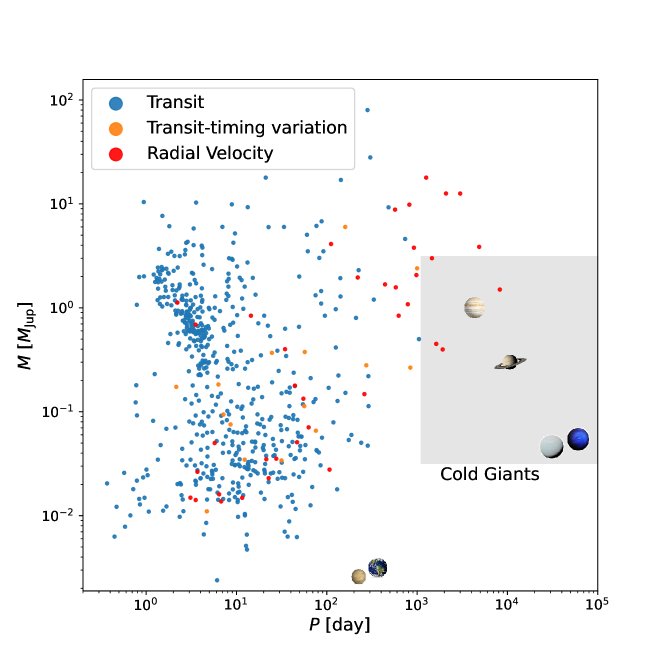
Giant planets like Jupiter and Saturn, play important roles in the formation and habitability of Earth-like planets. The detection of solar system analogs that have multiple cold giant planets is essential for our understanding of planet habitability and planet formation. Although transit surveys such as Kepler and TESS have discovered thousands of exoplanets, these missions are not sensitive to long period planets due to their limited observation baseline. The Tianyu project, comprising two 1-meter telescopes (Tianyu-I and II), is designed to detect transiting cold giant planets in order to find solar system analogs. Featuring a large field of view and equipped with a high-speed CMOS camera, Tianyu-I will perform a high-precision photometric survey of about 100 million stars, measuring light curves at hour-long cadence. The candidates found by Tianyu-I will be confirmed by Tianyu-II and other surveys and follow-up facilities through multi-band photometry, spectroscopy, and high resolution imaging. Tianyu telescopes will be situated at an elevation about 4000 meters in Lenghu, China. With a photometric precision of 1% for stars with V < 18 mag, Tianyu is expected to find more than 300 transiting exoplanets, including about 12 cold giant planets, over five years. A five-year survey of Tianyu would discover 1-2 solar system analogs. Moreover, Tianyu is also designed for non-exoplanetary exploration, incorporating multiple survey modes covering timescales from sub-seconds to months, with a particular emphasis on events occurring within the sub-second to hour range. It excels in observing areas such as infant supernovae, rare variable stars and binaries, tidal disruption events, Be stars, cometary activities, and interstellar objects. These discoveries not only enhance our comprehension of the universe but also offer compelling opportunities for public engagement in scientific exploration.
Motivation & Objective
- To search for solar system analogs with multiple cold giant planets, crucial for understanding planetary habitability and formation.
- To overcome the limitations of transit surveys like Kepler and TESS, which lack sensitivity to long-period planets due to short observation baselines.
- To conduct a high-precision photometric survey of ~100 million stars using a large-field-of-view telescope with high-speed CMOS imaging.
- To enable confirmation of exoplanet candidates through multi-band photometry, spectroscopy, and high-resolution imaging using Tianyu-II and other facilities.
- To extend beyond exoplanets by probing fast optical transients, rare variables, and solar system objects across timescales from sub-seconds to months.
Proposed method
- Deploy two 1-meter telescopes, Tianyu-I and Tianyu-II, at a 4,000-meter elevation site in Lenghu, Qinghai, for optimal atmospheric conditions.
- Equip Tianyu-I with a large-format, high-speed CMOS camera to achieve hour-long cadence photometry across a wide field of view.
- Implement a three-mode survey strategy: 80% medium-cadence (1-hour), 10% high-cadence (sub-second to second), and 10% low-cadence (hour to month) observations.
- Achieve photometric precision of <0.1% for V<14 stars and <1% for V<18 stars, enabling detection of deep, long-period transits.
- Use Tianyu-II for follow-up confirmation with multi-band filters, spectrographs, and potentially adaptive optics to classify and validate candidates.
- Integrate data from TESS, Kepler, and other surveys to enhance sensitivity to long-period transiting planets and improve detection efficiency.
Experimental results
Research questions
- RQ1What is the expected yield of transiting cold giant planets in a five-year high-cadence photometric survey of 100 million stars?
- RQ2How many solar system analogs with coplanar, multiple cold giant planets can be detected under a 10% occurrence rate for Earth twins?
- RQ3What is the capability of Tianyu to detect fast optical transients such as infant supernovae, tidal disruption events, and electromagnetic counterparts of gravitational wave events?
- RQ4How effective is the survey in identifying rare variable stars, Be stars, and active small bodies like comets and interstellar objects?
- RQ5To what extent can the Tianyu survey contribute to the detection and characterization of near-Earth objects and trans-Neptunian objects?
Key findings
- Tianyu is projected to detect over 300 transiting exoplanet candidates, including approximately 12 cold giant planets, within five years of operation.
- With a photometric precision of 0.1% for V<14 stars and 1% for V<18 stars, Tianyu achieves high sensitivity to deep, long-period transits.
- The survey is expected to discover 1–2 solar system analogs, assuming coplanarity and a 10% occurrence rate for Earth twins, which could be confirmed by future missions like Earth 2.0.
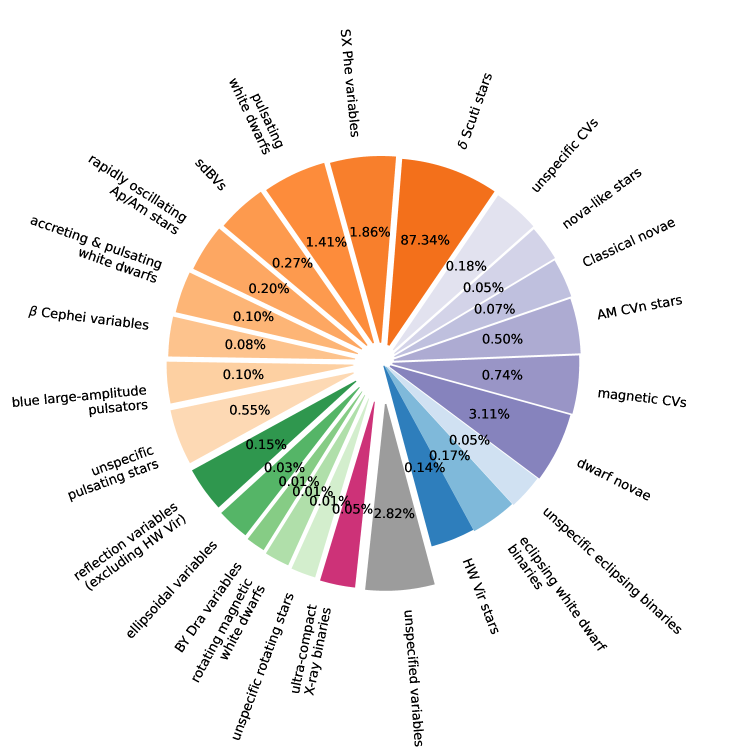
- The high-cadence mode is predicted to yield 20,000 high-amplitude variable stars (HADS) and 15 tidal disruption events (TDEs) over five years.
- The medium-cadence survey is expected to detect 1,500 supernovae and 12 ultracompact binaries, with a yield of 58 near-Earth objects and comets.
- The low-cadence survey will detect distant trans-Neptunian objects and other outer solar system bodies, contributing to the study of the solar system's outer regions.
Read this paper
Open the full text in the Nubint reader and ask about any passage as you read.
Read this paper on NubintThis review was generated by AI from the original paper. Please check the paper before citing it.