
[Paper Review] Tight Auditing of Differentially Private Machine Learning
The paper introduces a tight auditing scheme for DP-SGD that yields near-theoretical privacy guarantees on natural datasets using only two training runs, by leveraging f-DP/GDP and mechanism-specific tail reasoning. It also shows how this approach can reveal implementation bugs in private ML code.
Auditing mechanisms for differential privacy use probabilistic means to empirically estimate the privacy level of an algorithm. For private machine learning, existing auditing mechanisms are tight: the empirical privacy estimate (nearly) matches the algorithm's provable privacy guarantee. But these auditing techniques suffer from two limitations. First, they only give tight estimates under implausible worst-case assumptions (e.g., a fully adversarial dataset). Second, they require thousands or millions of training runs to produce non-trivial statistical estimates of the privacy leakage. This work addresses both issues. We design an improved auditing scheme that yields tight privacy estimates for natural (not adversarially crafted) datasets -- if the adversary can see all model updates during training. Prior auditing works rely on the same assumption, which is permitted under the standard differential privacy threat model. This threat model is also applicable, e.g., in federated learning settings. Moreover, our auditing scheme requires only two training runs (instead of thousands) to produce tight privacy estimates, by adapting recent advances in tight composition theorems for differential privacy. We demonstrate the utility of our improved auditing schemes by surfacing implementation bugs in private machine learning code that eluded prior auditing techniques.
Motivation & Objective
- Motivate the need for tighter, more practical empirical privacy estimates beyond worst-case auditing.
- Develop an auditing scheme that yields tight privacy estimates for natural datasets under DP-SGD.
- Reduce the computational burden of auditing from thousands of trainings to a small, feasible number.
- Enable direct inspection of DP-SGD implementations to detect privacy-relevant bugs.
Proposed method
- Frame auditing in the f-DP/GDP setting to capture the true privacy trade-off of the mechanism.
- Adapt privacy loss distribution (PLD) and Gaussian DP to obtain tight lower bounds on privacy parameters.
- Use Clopper-Pearson and Bayesian techniques to bound the privacy parameter from observed false positive/false negative rates.
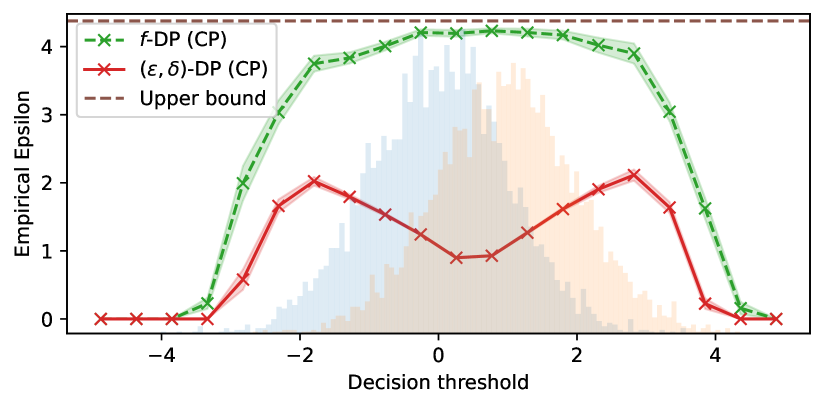
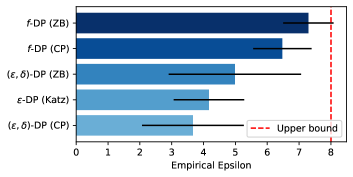
- Compare GDP-based auditing to standard (epsilon,delta)-DP auditing and show tighter bounds with fewer observations.
- Examine threat models ranging from white-box to black-box to assess audit effectiveness under realistic attacker capabilities.
Experimental results
Research questions
- RQ1Can DP-SGD’s empirical privacy leakage be tightly estimated on natural datasets, not just worst-case ones?
- RQ2How many training runs are required to obtain tight empirical privacy bounds for DP-SGD?
- RQ3Does tailoring auditing to the specific privacy mechanism (via f-DP/GDP) outperform universal DP auditing approaches?
- RQ4Can auditing expose bugs in DP-SGD implementations that prior methods miss?
- RQ5How do different attacker threat models affect the tightness and practicality of privacy audits?
Key findings
- Auditing with GDP yields much tighter empirical privacy bounds than traditional epsilon-delta auditing, achieving near-theoretical values with far fewer observations.
- The proposed scheme requires as few as two training runs to produce tight privacy estimates for DP-SGD on natural datasets.
- Tailoring auditing to the Gaussian/functional DP framework and using PLD enables accurate bounds for DP-SGD's privacy loss under composition and subsampling.
- Auditing can surface implementation bugs in DP-SGD that were missed by prior auditing techniques.
- Threat-model-aware auditing (including white-box and black-box settings) demonstrates how access to updates or data influences the tightness of the empirical privacy estimates.
Read this paper
Open the full text in the Nubint reader and ask about any passage as you read.
Read this paper on NubintThis review was generated by AI from the original paper. Please check the paper before citing it.