
[Paper Review] Time Lens++: Event-based Frame Interpolation with Parametric Non-linear Flow and Multi-scale Fusion
Time Lens++ proposes a novel event-based video frame interpolation method using parametric non-linear motion estimation and multi-scale feature-level fusion to improve reconstruction quality and temporal consistency. By estimating continuous, reusable flow from both events and images, it reduces computational cost and mitigates artifacts from image-level fusion and event sparsity, achieving up to 0.2 dB PSNR gain and 15% LPIPS improvement over prior methods.
Recently, video frame interpolation using a combination of frame- and event-based cameras has surpassed traditional image-based methods both in terms of performance and memory efficiency. However, current methods still suffer from (i) brittle image-level fusion of complementary interpolation results, that fails in the presence of artifacts in the fused image, (ii) potentially temporally inconsistent and inefficient motion estimation procedures, that run for every inserted frame and (iii) low contrast regions that do not trigger events, and thus cause events-only motion estimation to generate artifacts. Moreover, previous methods were only tested on datasets consisting of planar and faraway scenes, which do not capture the full complexity of the real world. In this work, we address the above problems by introducing multi-scale feature-level fusion and computing one-shot non-linear inter-frame motion from events and images, which can be efficiently sampled for image warping. We also collect the first large-scale events and frames dataset consisting of more than 100 challenging scenes with depth variations, captured with a new experimental setup based on a beamsplitter. We show that our method improves the reconstruction quality by up to 0.2 dB in terms of PSNR and up to 15% in LPIPS score.
Motivation & Objective
- Address brittle image-level fusion in event-based frame interpolation, which propagates artifacts from synthesis-based results.
- Overcome temporally inconsistent and inefficient motion estimation in existing methods that process each frame independently.
- Mitigate motion estimation failures in low-contrast regions where events are sparse or absent.
- Develop a temporally consistent, one-shot non-linear flow estimator using both images and events for efficient multi-frame interpolation.
- Create a large-scale, diverse dataset with depth variations and complex dynamics to better evaluate real-world performance.
Proposed method
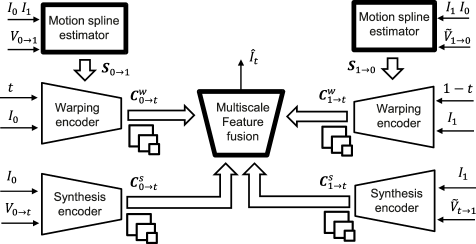
- Introduce a parametric non-linear motion spline estimator that predicts continuous flow fields from events and images, enabling O(1) computation for N intermediate frames instead of O(N).
- Use a double encoder architecture in the motion module—separate encoders for events and images—allowing independent feature learning and improved robustness.
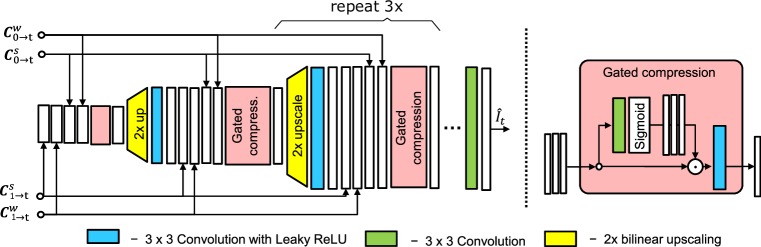
- Implement a multi-scale feature fusion module with shared synthesis encoders and a gated compression mechanism to select informative features at each scale.
- Apply multi-stage training to prevent network from ignoring one modality (e.g., images) by first training encoders separately before joint optimization.
- Leverage a novel beamsplitter-based setup to synchronize RGB and event cameras, enabling precise temporal alignment and physical calibration of multi-modal data.
- Use event integration and image difference cross-correlation to correct residual pixel misalignment in close-range scenes.
Experimental results
Research questions
- RQ1Can a one-shot, continuous non-linear flow estimator from events and images improve temporal consistency and reduce computational cost in frame interpolation?
- RQ2Does multi-scale feature-level fusion outperform image-level fusion in reducing ghosting and artifact propagation from synthesis-based interpolation?
- RQ3How does incorporating image data improve motion estimation in low-contrast regions where event activity is minimal?
- RQ4To what extent does multi-stage training prevent modality collapse and improve fusion of complementary event and image signals?
- RQ5How does the proposed method perform on a diverse, large-scale dataset with depth variations and complex dynamics beyond planar scenes?
Key findings
- The proposed method improves PSNR by up to 0.2 dB and reduces LPIPS by up to 15% compared to prior state-of-the-art methods on benchmark and new datasets.
- The multi-stage training procedure boosts PSNR by 0.69 dB in the motion estimation module and 1.06 dB in the fusion module, demonstrating its effectiveness in preventing modality neglect.
- The multi-scale fusion module with gated compression achieves a 0.13 dB PSNR gain over shared synthesis encoders and 1.06 dB improvement with multi-stage training.
- Attention maps show that the fusion network preferentially uses synthesis features on coarse scales and warping features on fine scales, aligning with expected complementary strengths.
- The new dataset of 123 scenes with depth variations, liquids, fire, and moving backgrounds reveals significant performance gains in complex, real-world scenarios.
- The motion spline estimator enables efficient, temporally consistent flow sampling, reducing computational cost from O(N) to O(1) for N inserted frames.
Read this paper
Open the full text in the Nubint reader and ask about any passage as you read.
Read this paper on NubintThis review was generated by AI from the original paper. Please check the paper before citing it.