
[Paper Review] Time-LLM: Time Series Forecasting by Reprogramming Large Language Models
Time-LLM reprograms input time series as text prototypes and uses a frozen LLM with Prompt-as-Prefix to forecast, achieving strong few-shot, zero-shot, and overall state-of-the-art performance without backbone fine-tuning.
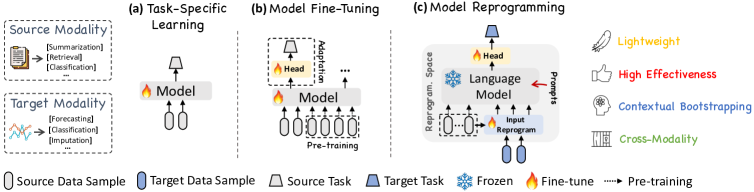
Time series forecasting holds significant importance in many real-world dynamic systems and has been extensively studied. Unlike natural language process (NLP) and computer vision (CV), where a single large model can tackle multiple tasks, models for time series forecasting are often specialized, necessitating distinct designs for different tasks and applications. While pre-trained foundation models have made impressive strides in NLP and CV, their development in time series domains has been constrained by data sparsity. Recent studies have revealed that large language models (LLMs) possess robust pattern recognition and reasoning abilities over complex sequences of tokens. However, the challenge remains in effectively aligning the modalities of time series data and natural language to leverage these capabilities. In this work, we present Time-LLM, a reprogramming framework to repurpose LLMs for general time series forecasting with the backbone language models kept intact. We begin by reprogramming the input time series with text prototypes before feeding it into the frozen LLM to align the two modalities. To augment the LLM's ability to reason with time series data, we propose Prompt-as-Prefix (PaP), which enriches the input context and directs the transformation of reprogrammed input patches. The transformed time series patches from the LLM are finally projected to obtain the forecasts. Our comprehensive evaluations demonstrate that Time-LLM is a powerful time series learner that outperforms state-of-the-art, specialized forecasting models. Moreover, Time-LLM excels in both few-shot and zero-shot learning scenarios.
Motivation & Objective
- Motivate time series forecasting as a domain that could benefit from generalizable, data-efficient LLM capabilities.
- Propose Time-LLM to reprogram time series inputs into text prototypes and augment with prompts to guide LLM reasoning.
- Demonstrate that Time-LLM outperforms state-of-the-art specialized forecasting models across benchmarks and in few-shot/zero-shot settings.
Proposed method
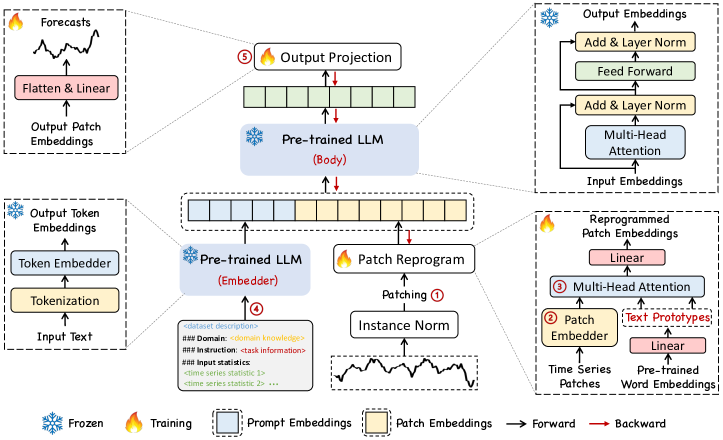
- Patch-based input transformation: normalize, patch, and embed multivariate time series; partition into patches and create embeddings.
- Patch reprogramming: use a small text-prototype vocabulary and cross-attention to map patch embeddings into the LLM’s input space without updating the backbone (E, E′, W^Q, W^K, W^V).
- Prompt-as-Prefix (PaP): add task instructions, dataset context, and input statistics as prefixes to enrich the LLM’s reasoning and guide patch transformation.
- Output projection: feed reprogrammed patches through the frozen LLM, then flatten and linearly project the produced representations to obtain forecasts.
- Backbone: keep pre-trained LLM frozen (e.g., Llama-7B) and only train lightweight input transformation and output projection modules.
- Optimization: minimize mean squared error between forecasts and ground truth, with optional integrations of quantization and other efficiency techniques.
Experimental results
Research questions
- RQ1Can Time-LLM forecast time series effectively without fine-tuning the backbone LLM?
- RQ2How does reprogramming time series inputs into text prototypes interact with prompting to enhance reasoning for forecasting?
- RQ3What is Time-LLM’s performance relative to state-of-the-art specialized forecasting models in long-term, short-term, few-shot, and zero-shot settings?
Key findings
- Time-LLM consistently outperforms state-of-the-art forecasting methods across benchmarks, especially in few-shot and zero-shot scenarios.
- Reprogramming time series as text prototypes, combined with Prompt-as-Prefix, enables strong cross-modality alignment and improves forecasting accuracy.
- Time-LLM achieves notable gains over GPT4TS and TimesNet in long-term forecasting and remains competitive with or superior to task-specific transformers on short-term data.
- Ablation studies show that patch reprogramming, Prompt-as-Prefix, and input statistics substantially contribute to performance, with input statistics being particularly impactful.
Read this paper
Open the full text in the Nubint reader and ask about any passage as you read.
Read this paper on NubintThis review was generated by AI from the original paper. Please check the paper before citing it.