
[Paper Review] TimelyFL: Heterogeneity-aware Asynchronous Federated Learning with Adaptive Partial Training
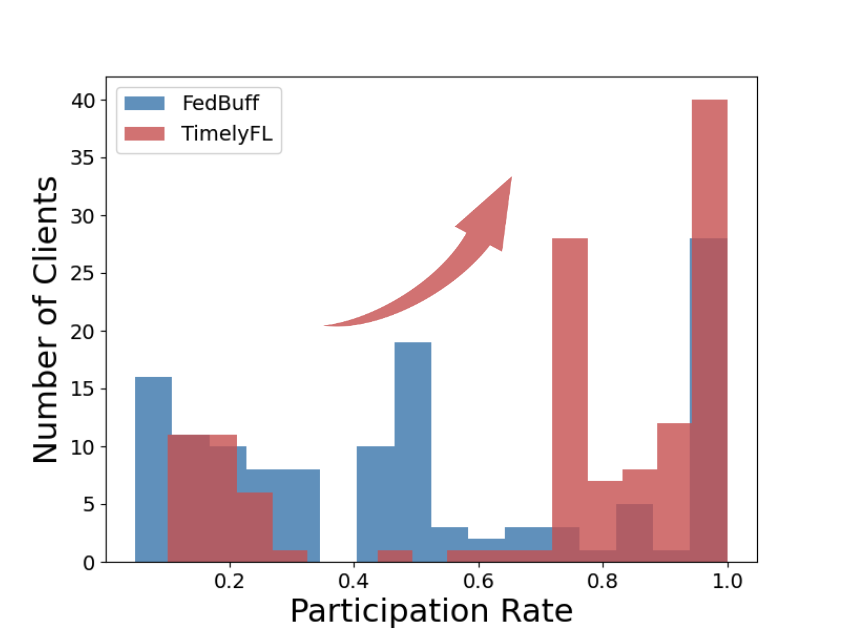
TimelyFL proposes a heterogeneity-aware asynchronous federated learning framework that dynamically adjusts local training workloads based on real-time client capabilities, enabling more timely and inclusive global model updates. By replacing fixed buffer sizes with time-constrained aggregation intervals and adaptive partial training, TimelyFL improves convergence speed by 1.28×–2.89× and test accuracy by 6.25% over FedBuff, while increasing participation rate by 21.13%.
In cross-device Federated Learning (FL) environments, scaling synchronous FL methods is challenging as stragglers hinder the training process. Moreover, the availability of each client to join the training is highly variable over time due to system heterogeneities and intermittent connectivity. Recent asynchronous FL methods (e.g., FedBuff) have been proposed to overcome these issues by allowing slower users to continue their work on local training based on stale models and to contribute to aggregation when ready. However, we show empirically that this method can lead to a substantial drop in training accuracy as well as a slower convergence rate. The primary reason is that fast-speed devices contribute to many more rounds of aggregation while others join more intermittently or not at all, and with stale model updates. To overcome this barrier, we propose TimelyFL, a heterogeneity-aware asynchronous FL framework with adaptive partial training. During the training, TimelyFL adjusts the local training workload based on the real-time resource capabilities of each client, aiming to allow more available clients to join in the global update without staleness. We demonstrate the performance benefits of TimelyFL by conducting extensive experiments on various datasets (e.g., CIFAR-10, Google Speech, and Reddit) and models (e.g., ResNet20, VGG11, and ALBERT). In comparison with the state-of-the-art (i.e., FedBuff), our evaluations reveal that TimelyFL improves participation rate by 21.13%, harvests 1.28x - 2.89x more efficiency on convergence rate, and provides a 6.25% increment on test accuracy.
Motivation & Objective
- Address the scalability limitations of synchronous federated learning due to straggler clients and variable device availability.
- Overcome the accuracy degradation and slow convergence in existing asynchronous FL methods like FedBuff, which suffer from staleness and biased client participation.
- Improve inclusiveness by enabling more devices—especially low-capacity or intermittent ones—to contribute timely updates to global model aggregation.
- Design a system resilient to system heterogeneity by dynamically adjusting local training workloads based on real-time client resource availability.
- Achieve faster convergence and higher test accuracy without sacrificing model quality, especially under non-iid data distributions.
Proposed method
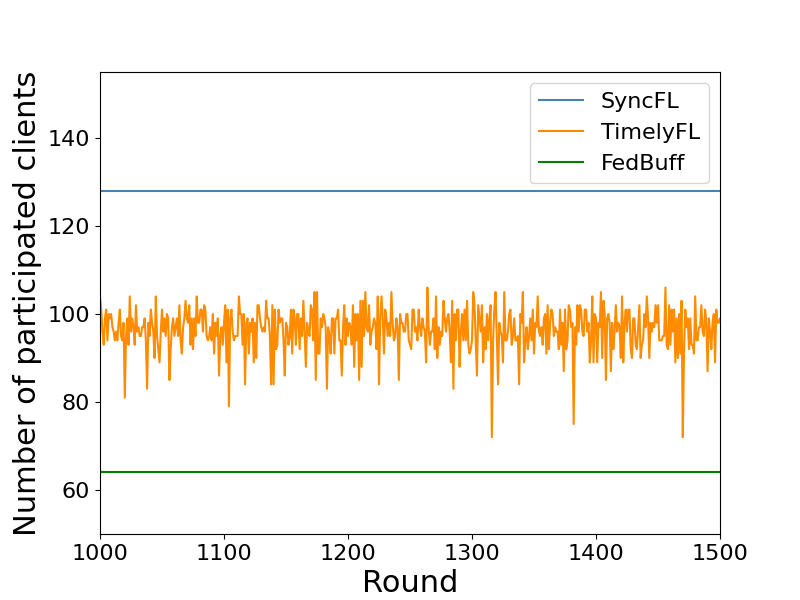
- Replace fixed buffer size in FedBuff with a wall-clock time limit per aggregation interval, allowing any client that completes training within that window to contribute.
- Define the aggregation interval as the k-th fastest local update time, where k is a tunable parameter, ensuring timely inclusion of available clients.
- Introduce adaptive partial training for low-capacity devices, where only a fraction of the full model is trained per round based on real-time device capability.
- Dynamically schedule training workloads (e.g., partial training ratio and local epochs) based on real-time device performance to maintain efficiency and reduce staleness.
- Use a flexible aggregation mechanism that accepts variable numbers of updates per round, avoiding the bottleneck of fixed buffer sizes.
- Integrate the framework with standard FL optimizers (e.g., FedOpt, FedAvg) and evaluate across diverse datasets and model architectures.
Experimental results
Research questions
- RQ1Can a time-constrained aggregation mechanism improve client participation and reduce staleness in asynchronous federated learning?
- RQ2How does adaptive partial training for low-capacity devices affect convergence speed and final model accuracy in heterogeneous FL environments?
- RQ3To what extent does TimelyFL outperform FedBuff in terms of convergence rate and test accuracy under non-iid data distributions?
- RQ4How does real-time workload adaptation enhance system resilience to device heterogeneity and intermittent connectivity?
- RQ5Can TimelyFL maintain high performance across diverse model architectures and datasets, including lightweight models?
Key findings
- TimelyFL increases the participation rate by 21.13% compared to FedBuff, significantly improving inclusiveness in global model updates.
- The framework achieves a 1.28× to 2.89× improvement in convergence rate over FedBuff across multiple datasets and models.
- Test accuracy improves by 6.25% compared to FedBuff, particularly benefiting from more timely and diverse client contributions.
- With adaptive workload scheduling, TimelyFL reduces convergence time to 50% accuracy by 4.09× and increases test accuracy by 10.89% on CIFAR-10.
- On the lightweight Google Speech Commands dataset, TimelyFL maintains faster convergence than both SyncFL and FedBuff, confirming effectiveness on small models.
- The performance gap between TimelyFL and FedBuff widens under non-iid data settings, demonstrating superior robustness to data heterogeneity.
Read this paper
Open the full text in the Nubint reader and ask about any passage as you read.
Read this paper on NubintThis review was generated by AI from the original paper. Please check the paper before citing it.