
[Paper Review] TimeMixer: Decomposable Multiscale Mixing for Time Series Forecasting
TimeMixer leverages multiscale past information with Past-Decomposable-Mixing and Future-Multipredictor-Mixing to achieve state-of-the-art long- and short-term time series forecasting with efficient MLP-based design.
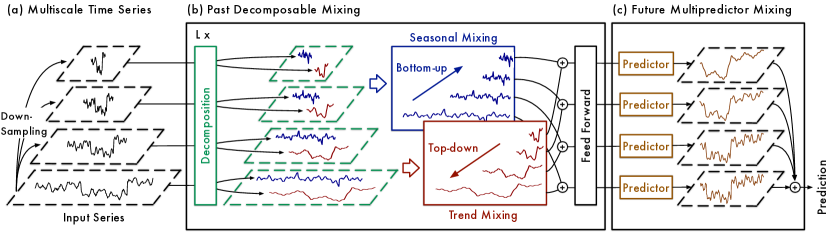
Time series forecasting is widely used in extensive applications, such as traffic planning and weather forecasting. However, real-world time series usually present intricate temporal variations, making forecasting extremely challenging. Going beyond the mainstream paradigms of plain decomposition and multiperiodicity analysis, we analyze temporal variations in a novel view of multiscale-mixing, which is based on an intuitive but important observation that time series present distinct patterns in different sampling scales. The microscopic and the macroscopic information are reflected in fine and coarse scales respectively, and thereby complex variations can be inherently disentangled. Based on this observation, we propose TimeMixer as a fully MLP-based architecture with Past-Decomposable-Mixing (PDM) and Future-Multipredictor-Mixing (FMM) blocks to take full advantage of disentangled multiscale series in both past extraction and future prediction phases. Concretely, PDM applies the decomposition to multiscale series and further mixes the decomposed seasonal and trend components in fine-to-coarse and coarse-to-fine directions separately, which successively aggregates the microscopic seasonal and macroscopic trend information. FMM further ensembles multiple predictors to utilize complementary forecasting capabilities in multiscale observations. Consequently, TimeMixer is able to achieve consistent state-of-the-art performances in both long-term and short-term forecasting tasks with favorable run-time efficiency.
Motivation & Objective
- Investigate how multiscale sampling reveals distinct micro- and macro-patterns in time series.
- Develop a fully MLP-based model that exploits past multiscale information through decomposed seasonal and trend components.
- Forecast future values by ensembling multiscale predictors to capture complementary forecasting capabilities.
Proposed method
- Construct multiscale observations via average downsampling of the past series.
- Apply Past-Decomposable-Mixing (PDM) to separately mix decomposed seasonal and trend components across scales in bottom-up and top-down directions.
- Use Future-Multipredictor-Mixing (FMM) to ensemble multiple predictors from each scale for final future forecasts.
- Embed multiscale series and progressively mix through L PDM blocks to obtain X^L across scales.
- Forecast by summing predictions from scale-specific predictors in FMM: x_hat = sum_m Predictor_m(x_m^L).
Experimental results
Research questions
- RQ1Can multiscale downsampling reveal distinct micro- and macro-patterns beneficial for forecasting?
- RQ2Does decomposing series into seasonal and trend components and mixing them across scales improve past information extraction?
- RQ3Does ensembling predictors from multiple scales yield better future forecasts than single-scale predictors?
Key findings
- TimeMixer achieves consistent state-of-the-art performance on long-term benchmarks across diverse datasets (Weather, Solar-Energy, Electricity, Traffic, ETTh1/ETTh2/ETTm1/ETTm2).
- The model attains notable MSE improvements over baselines (e.g., Weather and Solar-Energy) and remains effective on datasets with low forecastability.
- Ablations show that Future-Multipredictor-Mixing, seasonal mixing, and trend mixing each contribute to performance, with the full Past-Decomposable-Mixing architecture providing the strongest results.
- Visualization indicates distinct mixing behavior for seasonal vs. trend components, supporting the design choice of bottom-up seasonal mixing and top-down trend mixing.
- TimeMixer demonstrates strong short-term forecasting performance on multivariate PeMS data and univariate M4 data across frequencies.

Read this paper
Open the full text in the Nubint reader and ask about any passage as you read.
Read this paper on NubintThis review was generated by AI from the original paper. Please check the paper before citing it.