
[Paper Review] TimeSeriesBench: An Industrial-Grade Benchmark for Time Series Anomaly Detection Models
TimeSeriesBench introduces an industrial-grade benchmark for time series anomaly detection (TSAD) that evaluates models under realistic conditions, including All-in-One training and Zero-Shot inference on unseen time series. It features 168 evaluation settings across 7 datasets, 8 metrics, and 3 paradigms, with FITS achieving state-of-the-art performance on most benchmarks, especially under zero-shot and unified training settings.
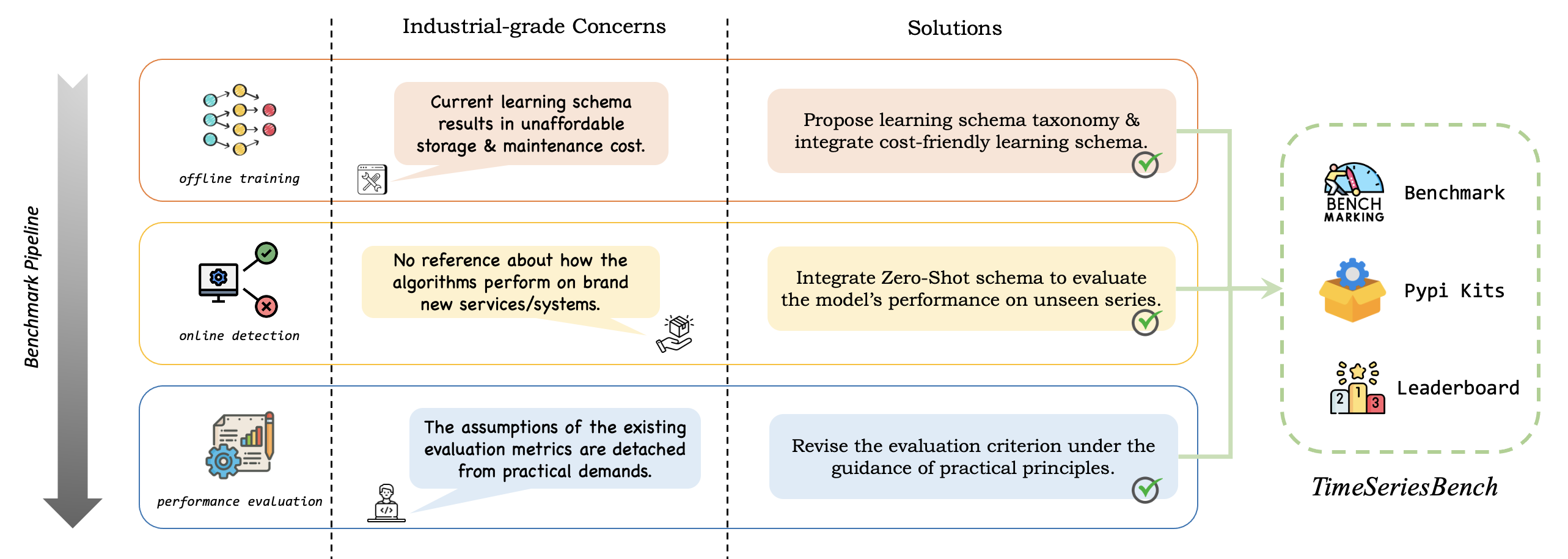
Time series anomaly detection (TSAD) has gained significant attention due to its real-world applications to improve the stability of modern software systems. However, there is no effective way to verify whether they can meet the requirements for real-world deployment. Firstly, current algorithms typically train a specific model for each time series. Maintaining such many models is impractical in a large-scale system with tens of thousands of curves. The performance of using merely one unified model to detect anomalies remains unknown. Secondly, most TSAD models are trained on the historical part of a time series and are tested on its future segment. In distributed systems, however, there are frequent system deployments and upgrades, with new, previously unseen time series emerging daily. The performance of testing newly incoming unseen time series on current TSAD algorithms remains unknown. Lastly, the assumptions of the evaluation metrics in existing benchmarks are far from practical demands. To solve the above-mentioned problems, we propose an industrial-grade benchmark TimeSeriesBench. We assess the performance of existing algorithms across more than 168 evaluation settings and provide comprehensive analysis for the future design of anomaly detection algorithms. An industrial dataset is also released along with TimeSeriesBench.
Motivation & Objective
- To address the gap between academic TSAD models and industrial deployment needs, particularly high maintenance costs from per-series model training.
- To evaluate model performance on previously unseen time series without retraining, simulating real-world system upgrades and new deployments.
- To unify and standardize evaluation across diverse metrics and training paradigms, enabling fair comparison of TSAD algorithms.
- To establish a continuously updated online leaderboard to track the state-of-the-art in TSAD, similar to GLUE in NLP.
- To release a new industrial-scale dataset and a toolkit (EasyTSAD) to support reproducible and scalable evaluation.
Proposed method
- Proposes an All-in-One training paradigm where a single model is trained on multiple time series, simulating industrial scalability.
- Introduces a novel data-splitting strategy to enable Zero-Shot inference, evaluating models on entirely unseen time series curves.
- Combines 3 training paradigms (single-series, all-in-one, zero-shot), 8 evaluation metrics, and 7 datasets into 168 distinct evaluation settings.
- Develops an event-based evaluation metric to better align with industrial needs, focusing on anomaly detection precision and recall.
- Builds an online leaderboard at https://adeval.cstcloud.cn to continuously rank models across all settings.
- Releases a new industrial dataset and the EasyTSAD toolkit for standardized, reproducible evaluation of TSAD models.
Experimental results
Research questions
- RQ1How does model performance vary when training a single unified model across all time series (All-in-One) versus training per-series models?
- RQ2What is the detection performance of existing TSAD models on previously unseen time series curves without fine-tuning (Zero-Shot inference)?
- RQ3Which evaluation metrics best reflect real-world industrial performance in time series anomaly detection?
- RQ4How do different deep learning architectures compare across diverse training paradigms and datasets?
- RQ5What is the current state-of-the-art in time series anomaly detection under realistic, industrial deployment constraints?
Key findings
- FITS achieves the highest average performance across all 168 evaluation settings, with an average F1-score of 0.9469, outperforming all other models.
- Under the All-in-One training paradigm, FITS achieves an F1-score of 0.9469 on the NEK dataset, significantly outperforming the second-best method (OFA at 0.8083).
- In Zero-Shot inference, FITS maintains strong performance with an F1-score of 0.9233 on the NEK dataset, indicating robust generalization to unseen curves.
- The All-in-One training paradigm consistently improves generalization, with 8 out of 12 models showing performance gains of over 5% compared to single-series training.
- The event-based metric reveals that models like FITS and OFA achieve higher precision and recall on critical anomaly events, suggesting better alignment with industrial priorities.
- The online leaderboard demonstrates that no single model dominates across all settings, highlighting the importance of evaluating under diverse, realistic conditions.
Read this paper
Open the full text in the Nubint reader and ask about any passage as you read.
Read this paper on NubintThis review was generated by AI from the original paper. Please check the paper before citing it.