
[Paper Review] Tiny and Efficient Model for the Edge Detection Generalization
This paper proposes TEED, a lightweight convolutional neural network with only 58K parameters for edge detection, trained from scratch on the BIPED dataset using a novel, efficient training procedure. Despite its minimal size, TEED achieves state-of-the-art generalization performance, producing crisp, high-quality edge maps and outperforming larger models in both quantitative metrics and downstream sketch-based image retrieval tasks.
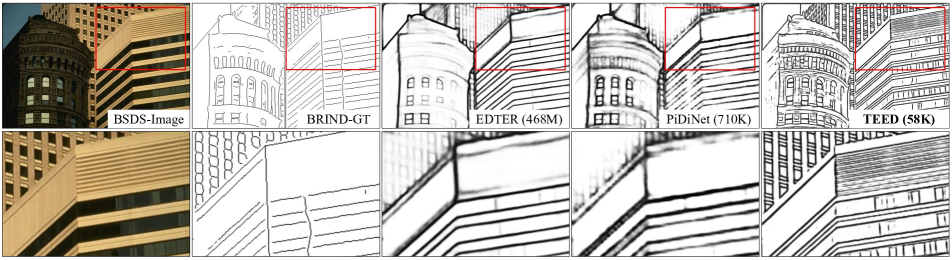
Most high-level computer vision tasks rely on low-level image operations as their initial processes. Operations such as edge detection, image enhancement, and super-resolution, provide the foundations for higher level image analysis. In this work we address the edge detection considering three main objectives: simplicity, efficiency, and generalization since current state-of-the-art (SOTA) edge detection models are increased in complexity for better accuracy. To achieve this, we present Tiny and Efficient Edge Detector (TEED), a light convolutional neural network with only $58K$ parameters, less than $0.2$% of the state-of-the-art models. Training on the BIPED dataset takes $less than 30 minutes$, with each epoch requiring $less than 5 minutes$. Our proposed model is easy to train and it quickly converges within very first few epochs, while the predicted edge-maps are crisp and of high quality. Additionally, we propose a new dataset to test the generalization of edge detection, which comprises samples from popular images used in edge detection and image segmentation. The source code is available in https://github.com/xavysp/TEED.
Motivation & Objective
- Address the need for lightweight, efficient, and generalizable edge detection models in low-level computer vision tasks.
- Overcome the limitations of current SOTA models, which are computationally expensive and require extensive hyperparameter tuning or transfer learning.
- Develop a new benchmark dataset, UDED, to fairly evaluate edge detection generalization across diverse, real-world images.
- Enable rapid training and convergence with minimal computational cost while maintaining high edge detection quality.
- Demonstrate that small models can achieve superior generalization by evaluating on downstream tasks like sketch-based image retrieval.
Proposed method
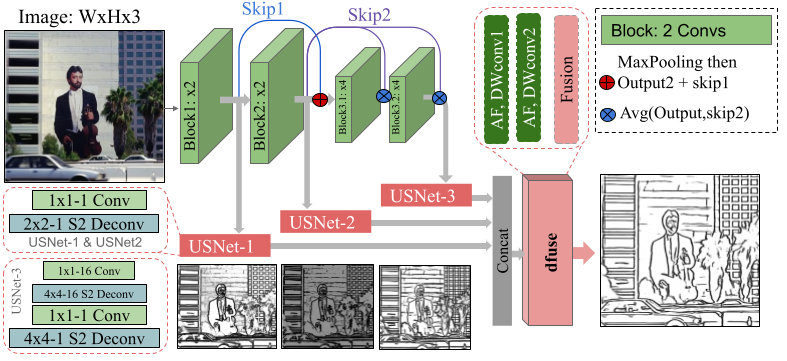
- Propose TEED, a compact CNN architecture with only 58K parameters, designed for minimal inference and training cost.
- Introduce the dfuse module—a lightweight, efficient feature fusion mechanism with under 1K parameters, inspired by CoFusion but significantly smaller.
- Design a custom dloss function to accelerate training convergence and improve optimization stability.
- Train TEED from scratch on the BIPED dataset, avoiding transfer learning and reducing training time to under 30 minutes with each epoch taking less than 5 minutes.
- Construct the Unified Dataset for Edge Detection (UDED) by selecting images based on frequency criteria from multiple edge detection and segmentation datasets, ensuring diverse and perceptually relevant test cases.
- Validate performance using both standard metrics and a downstream sketch-based image retrieval task on QMUL datasets to assess real-world generalization.
Experimental results
Research questions
- RQ1Can a small, lightweight CNN achieve state-of-the-art generalization performance in edge detection without transfer learning or hyperparameter tuning?
- RQ2How does a model trained on a curated dataset like BIPED generalize to unseen, diverse images not in the training distribution?
- RQ3What is the impact of a novel, efficient loss function and lightweight fusion module on training speed and edge detection quality?
- RQ4Can a minimal model outperform larger SOTA models in downstream tasks like sketch-based image retrieval?
- RQ5How effective is the proposed UDED dataset in evaluating the true generalization capability of edge detectors?
Key findings
- TEED achieves a top-10 accuracy of 0.9565 and top-1 accuracy of 0.5565 on the QMUL-ShoeV2 dataset, outperforming models with significantly more parameters.
- On the QMUL-ChairV2 dataset, TEED achieves a top-1 accuracy of 0.8865 and top-10 accuracy of 1.0, matching or exceeding larger models.
- TEED converges in fewer than 6 epochs with training time under 30 minutes, demonstrating rapid convergence and low training cost.
- The model produces sharper and cleaner edge maps than SOTA models like PiDiNet and EDTER, even on complex scenes with dense edges.
- TEED generalizes well to unseen datasets, achieving superior performance on sketch-based image retrieval despite being trained only on BIPED.
- The UDED dataset effectively captures perceptual edge diversity and enables fair evaluation of generalization, revealing that performance on standard benchmarks does not guarantee downstream success.
Read this paper
Open the full text in the Nubint reader and ask about any passage as you read.
Read this paper on NubintThis review was generated by AI from the original paper. Please check the paper before citing it.