
[Paper Review] TinyVLA: Towards Fast, Data-Efficient Vision-Language-Action Models for Robotic Manipulation
TinyVLA introduces a compact, fast, and data-efficient vision-language-action model for robotic manipulation by leveraging small pre-trained multimodal models and a diffusion policy decoder, achieving superior inference speed and comparable or better performance than OpenVLA—especially in real-world and zero-shot generalization settings—without requiring large-scale pre-training data.
Vision-Language-Action (VLA) models have shown remarkable potential in visuomotor control and instruction comprehension through end-to-end learning processes. However, current VLA models face significant challenges: they are slow during inference and require extensive pre-training on large amounts of robotic data, making real-world deployment difficult. In this paper, we introduce a new family of compact vision-language-action models, called TinyVLA, which offers two key advantages over existing VLA models: (1) faster inference speeds, and (2) improved data efficiency, eliminating the need for pre-training stage. Our framework incorporates two essential components to build TinyVLA: (1) initializing the policy backbone with robust, high-speed multimodal models, and (2) integrating a diffusion policy decoder during fine-tuning to enable precise robot actions. We conducted extensive evaluations of TinyVLA in both simulation and on real robots, demonstrating that our approach significantly outperforms the state-of-the-art VLA model, OpenVLA, in terms of speed and data efficiency, while delivering comparable or superior performance. Additionally, TinyVLA exhibits strong generalization capabilities across various dimensions, including language instructions, novel objects, unseen positions, changes in object appearance, background variations, and environmental shifts, often matching or exceeding the performance of OpenVLA. We believe that \methodname offers an interesting perspective on utilizing pre-trained multimodal models for policy learning. Our project is at https://tiny-vla.github.io.
Motivation & Objective
- Address the high inference latency and data inefficiency of existing Vision-Language-Action (VLA) models in robotic manipulation.
- Reduce reliance on large-scale robotic datasets for pre-training while maintaining strong generalization and performance.
- Enable real-time, responsive robot control by accelerating inference speed through model compression and non-autoregressive action generation.
- Improve robustness to distractors, lighting changes, and spatial/object appearance variations without data augmentation.
Proposed method
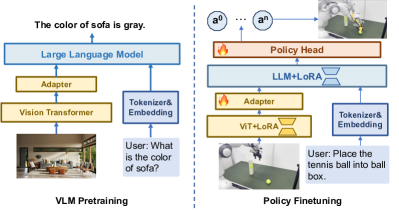
- Initialize the policy backbone with small, high-speed multimodal models (under 1B parameters) pre-trained on vision-language data, enabling fast inference.
- Replace autoregressive action token prediction with a diffusion policy decoder during fine-tuning to generate continuous robot actions directly.
- Fine-tune the entire model end-to-end on a small amount of task-specific robot data, eliminating the need for large-scale pre-training on datasets like OpenX.
- Leverage the pre-trained multimodal model’s generalization capacity to handle unseen objects, positions, and visual variations without additional data augmentation.
- Use a single-stage training pipeline that combines vision-language understanding with direct policy head prediction, reducing computational overhead.
- Evaluate performance across diverse generalization benchmarks, including language, spatial, appearance, and distractor generalization, under varying lighting and background conditions.
Experimental results
Research questions
- RQ1Can a compact VLA model achieve comparable or better performance than state-of-the-art models like OpenVLA while drastically reducing inference latency?
- RQ2To what extent can a vision-language model pre-trained on non-robotic data generalize to robotic manipulation tasks without large-scale robot dataset pre-training?
- RQ3How well does the model generalize to unseen object shapes, colors, positions, and environmental variations such as lighting and distractors?
- RQ4Does replacing autoregressive action generation with a diffusion-based decoder significantly improve inference speed without sacrificing accuracy?
Key findings
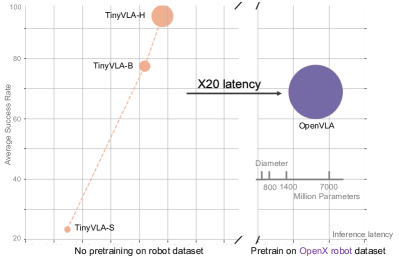
- TinyVLA-H achieves 25.7% higher success rate than OpenVLA on real-world single-arm tasks while using only 5.5 times fewer parameters.
- TinyVLA-H reduces inference latency by 20 times compared to OpenVLA on the same A6000 GPU, demonstrating superior speed for real-time deployment.
- TinyVLA generalizes robustly to distractors, withstanding the presence of irrelevant objects like books and cups without performance degradation, unlike OpenVLA and standard diffusion policies.
- The model maintains high performance under low-light conditions (L1 and L2), where OpenVLA fails, indicating strong robustness to illumination changes.
- TinyVLA generalizes effectively to novel object shapes and colors in appearance generalization tasks, achieving performance on par with OpenVLA without data augmentation.
- In bimanual manipulation tasks, TinyVLA-H outperforms OpenVLA, which struggles due to its reliance on single-arm OpenX pre-training data.
Read this paper
Open the full text in the Nubint reader and ask about any passage as you read.
Read this paper on NubintThis review was generated by AI from the original paper. Please check the paper before citing it.