
[Paper Review] TitaNet: Neural Model for speaker representation with 1D Depth-wise separable convolutions and global context
TitaNet is a lightweight, scalable neural network for speaker representation that uses 1D depth-wise separable convolutions with squeeze-and-excitation (SE) modules and channel attention pooling to extract fixed-length t-vectors from variable-length utterances. It achieves state-of-the-art performance with an EER of 0.68% on VoxCeleb1 and DER of 1.11% on CH109, while the small TitaNet-S variant (6M parameters) achieves near-SOTA results with minimal computational cost.
In this paper, we propose TitaNet, a novel neural network architecture for extracting speaker representations. We employ 1D depth-wise separable convolutions with Squeeze-and-Excitation (SE) layers with global context followed by channel attention based statistics pooling layer to map variable-length utterances to a fixed-length embedding (t-vector). TitaNet is a scalable architecture and achieves state-of-the-art performance on speaker verification task with an equal error rate (EER) of 0.68% on the VoxCeleb1 trial file and also on speaker diarization tasks with diarization error rate (DER) of 1.73% on AMI-MixHeadset, 1.99% on AMI-Lapel and 1.11% on CH109. Furthermore, we investigate various sizes of TitaNet and present a light TitaNet-S model with only 6M parameters that achieve near state-of-the-art results in diarization tasks.
Motivation & Objective
- To develop a scalable, efficient neural network for speaker representation learning that outperforms existing models in both speaker verification and diarization tasks.
- To integrate global context via squeeze-and-excitation (SE) modules with global average pooling into a speaker embedding architecture, improving representation quality.
- To reduce model size without sacrificing performance by using depth-wise separable convolutions and width scaling, enabling deployment in low-resource settings.
- To eliminate the need for external models like PLDA or AHC by training end-to-end with angular softmax loss and cosine similarity as the backend.
Proposed method
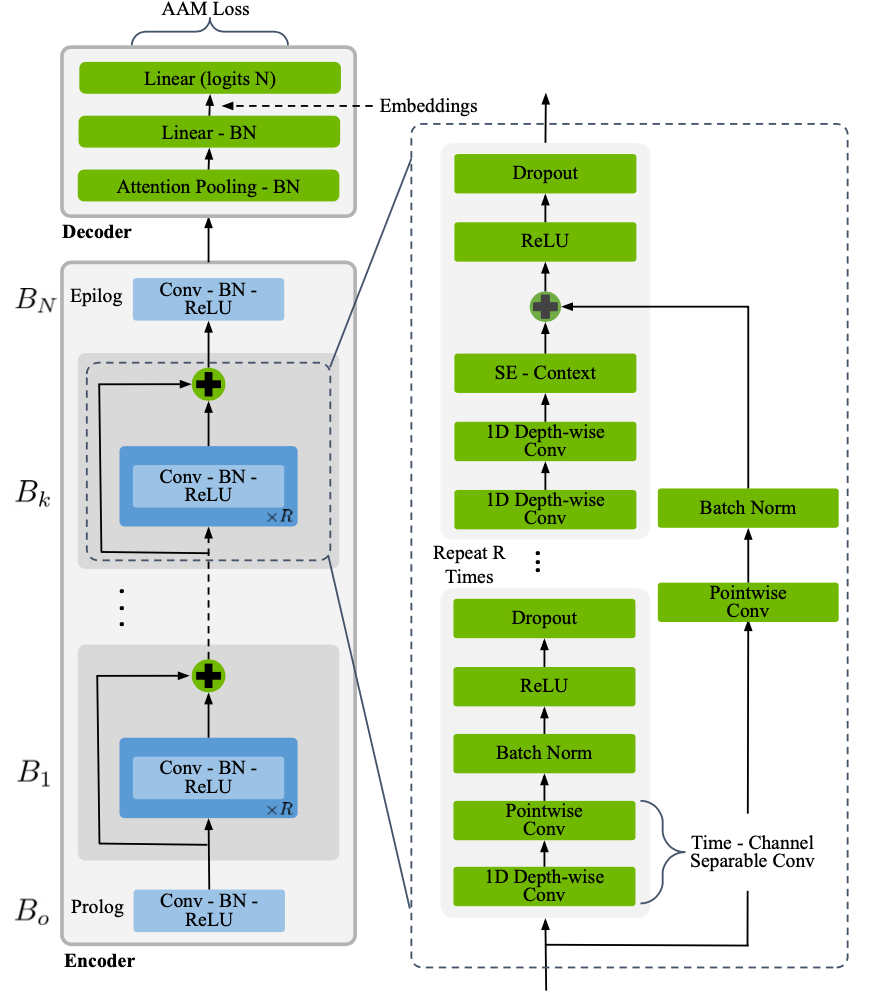
- The model employs 1D depth-wise separable convolutions to reduce parameter count while maintaining local feature extraction capability.
- Squeeze-and-excitation (SE) modules are applied after each residual block, using global average pooling to compute a global context vector that recalibrates channel-wise feature responses.
- A channel attention-based statistics pooling layer computes utterance-level embeddings by aggregating time-distributed features across channels with learned attention weights.
- The architecture is based on ContextNet, with a prologue block, multiple mega blocks (each with repeated depth-wise and pointwise convolutions), and an epilogue block, all with residual connections.
- Model depth and width are controlled by the number of repeated sub-blocks (R) and filter channels (C), enabling easy scaling.
- End-to-end training is performed using angular softmax margin loss, and inference uses cosine similarity for speaker comparison.
Experimental results
Research questions
- RQ1Can 1D depth-wise separable convolutions with global context modeling improve speaker embedding quality compared to standard TDNN or full convolutional layers?
- RQ2Does integrating squeeze-and-excitation modules with global average pooling enhance speaker representation by capturing long-range dependencies?
- RQ3Can a lightweight TitaNet-S model with only 6 million parameters achieve near state-of-the-art performance in speaker diarization tasks?
- RQ4To what extent does end-to-end training with angular softmax loss eliminate the need for external models like PLDA or AHC in speaker verification and diarization pipelines?
- RQ5How does model scaling (width vs. depth) affect performance and parameter efficiency in speaker representation learning?
Key findings
- TitaNet-L achieves a state-of-the-art equal error rate (EER) of 0.68% on the VoxCeleb1 cleaned trial file, outperforming prior models.
- TitaNet-M, with half the size of ECAPA-TDNN, achieves a diarization error rate (DER) of 1.73% on AMI-MixHeadset, 1.99% on AMI-Lapel, and 1.11% on CH109.
- The small TitaNet-S model (6M parameters) achieves DER of 1.42% on NIST-SRE-2000 and 1.97% on AMI-MixHeadset, demonstrating strong efficiency-accuracy trade-off.
- The model shows minimal performance drop when scaled down—TitaNet-S and TitaNet-M show only minor differences in DER despite 2x and 4x parameter reduction, respectively.
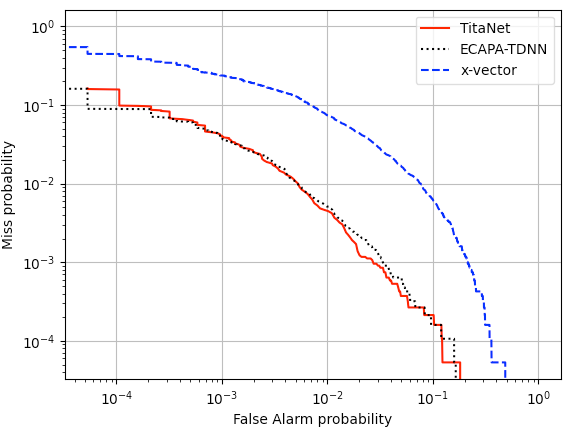
- TitaNet outperforms x-vector and ECAPA-TDNN baselines across all diarization datasets, including in the unknown speaker count setting with NME-SC clustering.
- The model eliminates the need for external PLDA or AHC models by using end-to-end training with angular softmax and cosine similarity, simplifying the pipeline.
Read this paper
Open the full text in the Nubint reader and ask about any passage as you read.
Read this paper on NubintThis review was generated by AI from the original paper. Please check the paper before citing it.