
[Paper Review] To which reference class do you belong? Measuring racial fairness of reference classes with normative modeling
The paper investigates racial fairness in normative models of brain structure, showing racial bias in pre-trained and race-unaware models and that including race can reduce bias, while race can still be predicted from deviation scores. It emphasizes representativeness of reference classes and cautious interpretation of deviations.
Reference classes in healthcare establish healthy norms, such as pediatric growth charts of height and weight, and are used to chart deviations from these norms which represent potential clinical risk. How the demographics of the reference class influence clinical interpretation of deviations is unknown. Using normative modeling, a method for building reference classes, we evaluate the fairness (racial bias) in reference models of structural brain images that are widely used in psychiatry and neurology. We test whether including race in the model creates fairer models. We predict self-reported race using the deviation scores from three different reference class normative models, to better understand bias in an integrated, multivariate sense. Across all of these tasks, we uncover racial disparities that are not easily addressed with existing data or commonly used modeling techniques. Our work suggests that deviations from the norm could be due to demographic mismatch with the reference class, and assigning clinical meaning to these deviations should be done with caution. Our approach also suggests that acquiring more representative samples is an urgent research priority.
Motivation & Objective
- Quantify racial bias in existing pre-trained normative models of cortical thickness.
- Assess the impact of including race as a predictor in normative models.
- Compare three normative-model configurations across two large datasets (HCP, UKB).
- Determine whether deviation scores reveal race-specific biases and whether race can be predicted from deviations.
Proposed method
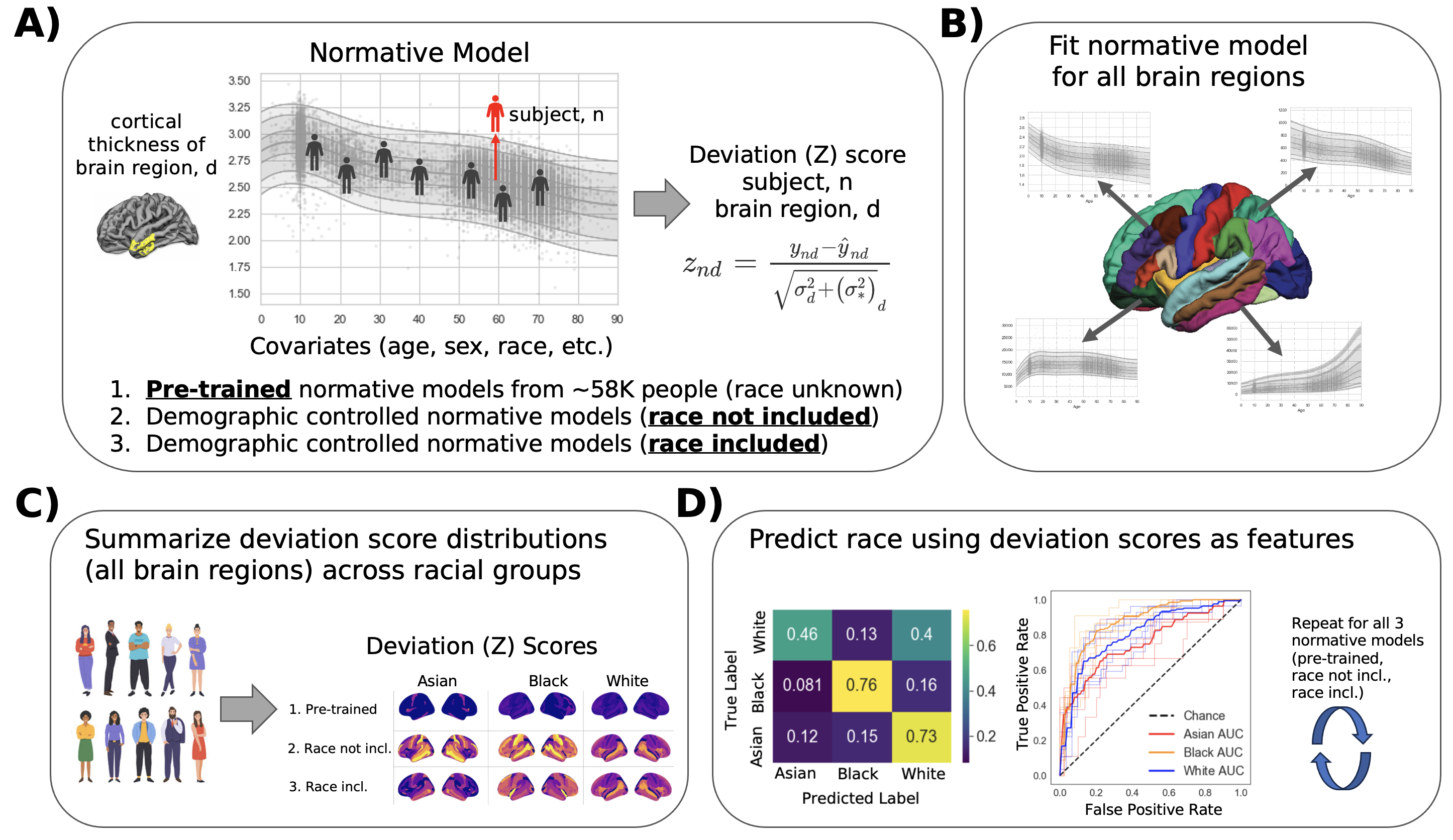
- Fit three Bayesian normative models (pre-trained, race not included, race included) using cortical thickness from Freesurfer Destrieux atlas regions.
- Use B-spline basis expansion for age effects and likelihood warping to map non-Gaussian responses to Gaussian latent space.
- Compute deviation scores Z_nd and residual errors E_nd for each region and subject.
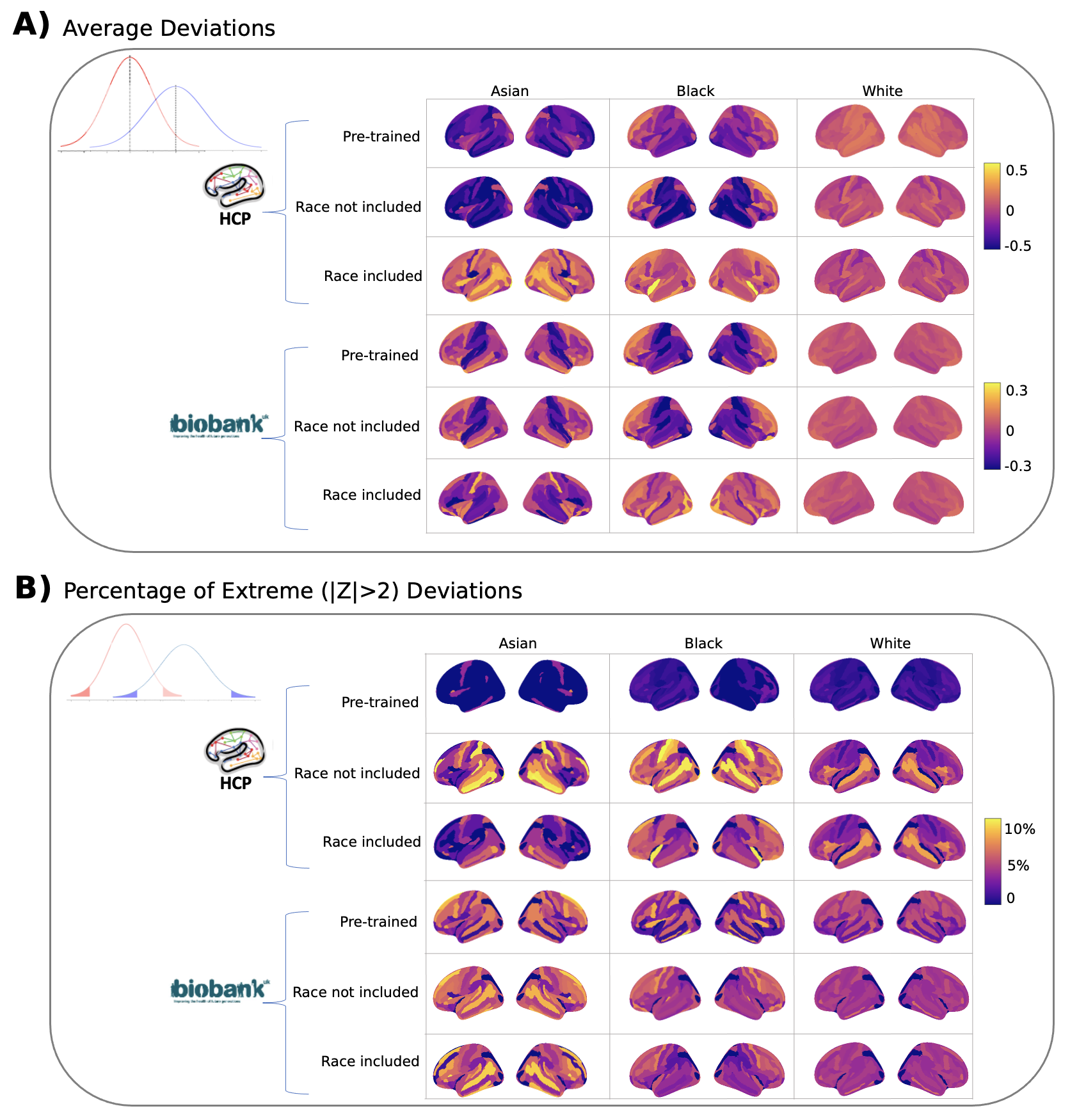
- Qualitatively summarize average deviations and extreme deviations by race.
- Quantitatively test group differences in deviations and residual errors with FDR-corrected t-tests.
- Predict self-reported race from deviation scores using penalized logistic regression with 80/20 train/test split and 5-fold cross-validation.
Experimental results
Research questions
- RQ1Does racial bias exist in pre-trained normative models when race data are unknown?
- RQ2Does including self-reported race in the normative model reduce racial bias in deviation scores and residual errors?
- RQ3Can deviation scores from normative models predict self-reported race in a multivariate setting?
- RQ4How does race-based modeling affect fairness across brain regions and datasets (HCP, UKB)?
Key findings
- Racial bias is present in normative models, with White individuals often centered around zero and Asian/Black groups showing overestimation or underestimation of cortical thickness depending on model type.
- Including race in the normative model largely reduces group differences in average deviations, though some regional underestimations persist for certain groups.
- Quantitative tests show significant group differences in residual errors and deviation scores across models, with the race-included model generally showing fewer differences.
- In UKB, White groups often show larger residual errors, potentially due to sample size imbalances; in HCP, lateralization effects emerge in residual errors for some groups.
- Across models, deviations and residual errors differ by race, indicating demographic mismatch with the reference class can drive clinical interpretation of deviations.
- Race can be identified from deviation scores with notable accuracy, demonstrating that race information leaks into the normative model outputs.
Read this paper
Open the full text in the Nubint reader and ask about any passage as you read.
Read this paper on NubintThis review was generated by AI from the original paper. Please check the paper before citing it.