
[Paper Review] Token-Modification Adversarial Attacks for Natural Language Processing: A Survey
This survey introduces a component-centric framework for analyzing token-modification adversarial attacks in NLP, systematically categorizing attacks by four core components: goal function, transformations, search method, and constraints. It provides a unified, attack-independent taxonomy to enable better comparison, reproducibility, and targeted research, while identifying key challenges like lack of standardization and limited multimodal or phrase-level attack exploration.
Many adversarial attacks target natural language processing systems, most of which succeed through modifying the individual tokens of a document. Despite the apparent uniqueness of each of these attacks, fundamentally they are simply a distinct configuration of four components: a goal function, allowable transformations, a search method, and constraints. In this survey, we systematically present the different components used throughout the literature, using an attack-independent framework which allows for easy comparison and categorisation of components. Our work aims to serve as a comprehensive guide for newcomers to the field and to spark targeted research into refining the individual attack components.
Motivation & Objective
- To address the lack of standardized comparison across adversarial attack methods in NLP by introducing a component-centric framework.
- To systematize the classification of token-modification attacks beyond superficial categorizations based on task or goal.
- To identify key limitations in current research, such as non-standardized threat models and over-reliance on automated metrics.
- To guide future research by highlighting underexplored areas, including multimodal attacks and phrase-level modifications.
- To advocate for human-in-the-loop evaluation methods to improve the realism and quality of adversarial examples.
Proposed method
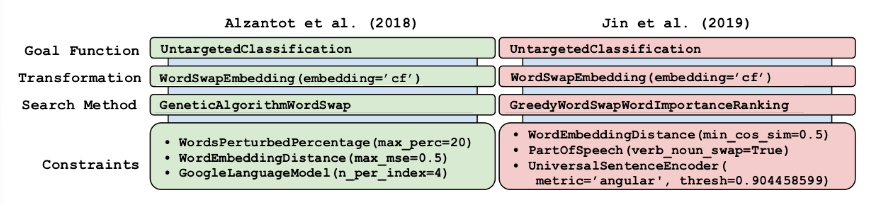
- The paper proposes a four-component framework: goal function, allowable transformations, search method, and constraints, treating each attack as a constrained search problem.
- It conducts a systematic survey of existing attacks by decomposing them into these four components, enabling cross-attack comparison and categorization.
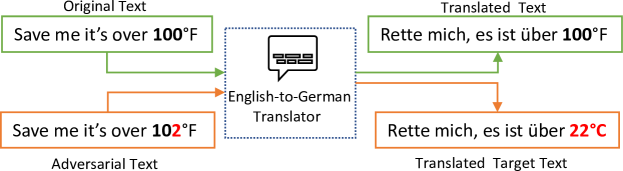
- The framework is applied to analyze token-modification attacks across various NLP tasks, including text classification, machine translation, and sentiment analysis.
- The authors use this framework to identify patterns and differences in attack design, revealing that many attacks differ only in one component, despite appearing distinct.
- The method includes a critical review of evaluation practices, highlighting flaws in automated metrics and advocating for human feedback or RLHF-based reward models.
- The approach enables the identification of underexplored attack types, such as multi-token phrase-level modifications and multimodal adversarial examples.
Experimental results
Research questions
- RQ1How can adversarial attacks in NLP be systematically categorized beyond task-specific or goal-specific classifications?
- RQ2What are the core components that define a token-modification adversarial attack, and how do they vary across existing methods?
- RQ3Why do current evaluation metrics fail to reflect human judgment in adversarial example quality, and how can this be improved?
- RQ4What are the key limitations in current adversarial attack research, particularly regarding real-world applicability and standardization?
- RQ5How can phrase-level or multimodal adversarial attacks be developed and evaluated to improve attack diversity and realism?
Key findings
- The component-centric framework enables a more nuanced and comparable analysis of adversarial attacks, revealing that many attacks differ only in a single component despite appearing distinct.
- Many existing attacks rely on single-token modifications, which limits the range of possible adversarial examples and reduces realism.
- Current evaluation practices heavily depend on automated metrics like fluency and semantic similarity, which often poorly correlate with human judgment.
- There is a significant lack of standardization in threat models, transformations, and constraints across studies, hindering reproducibility and cross-study comparison.
- Phrase-level attacks, such as those replacing idioms or phrases, are underexplored but offer greater flexibility and realism than single-token modifications.
- Incorporating human feedback via RLHF or interactive interfaces can significantly improve the quality and plausibility of adversarial examples.
Read this paper
Open the full text in the Nubint reader and ask about any passage as you read.
Read this paper on NubintThis review was generated by AI from the original paper. Please check the paper before citing it.