
[Paper Review] TokenFlow: Consistent Diffusion Features for Consistent Video Editing
TokenFlow enforces temporal consistency for video edits by propagating diffusion features across frames using inter-frame correspondences, enabling high-quality, text-driven video editing without training. It achieves state-of-the-art temporal coherence vs. frame-wise editing baselines.
The generative AI revolution has recently expanded to videos. Nevertheless, current state-of-the-art video models are still lagging behind image models in terms of visual quality and user control over the generated content. In this work, we present a framework that harnesses the power of a text-to-image diffusion model for the task of text-driven video editing. Specifically, given a source video and a target text-prompt, our method generates a high-quality video that adheres to the target text, while preserving the spatial layout and motion of the input video. Our method is based on a key observation that consistency in the edited video can be obtained by enforcing consistency in the diffusion feature space. We achieve this by explicitly propagating diffusion features based on inter-frame correspondences, readily available in the model. Thus, our framework does not require any training or fine-tuning, and can work in conjunction with any off-the-shelf text-to-image editing method. We demonstrate state-of-the-art editing results on a variety of real-world videos. Webpage: https://diffusion-tokenflow.github.io/
Motivation & Objective
- Motivate improving video editing quality and temporal consistency using a pre-trained image diffusion model.
- Leverage diffusion feature space to enforce inter-frame consistency during edits.
- Provide a training-free framework compatible with off-the-shelf image editing methods.
- Demonstrate state-of-the-art temporal coherence on diverse real-world videos.
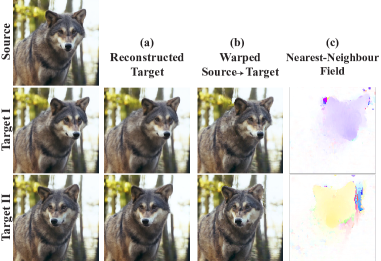
- Analyze diffusion feature properties and their relation to video redundancy.
Proposed method
- Extract diffusion tokens from DDIM-inverted video frames across layers.
- Sample and jointly edit a set of keyframes to induce a shared global appearance via extended-attention across multiple frames.
- Propagate edited tokens to non-keyframes using nearest-neighbor correspondences in the original diffusion feature space.
- Combine keyframe edits with TokenFlow propagation at each denoising step to maintain frame-to-frame consistency.
- Support propagation with any image-editing diffusion method (PnP, Meng et al., Zhang & Agrawala, etc.).
- Evaluate temporal consistency via warp-error and user studies, and fidelity via CLIP similarity.
Experimental results
Research questions
- RQ1Can diffusion feature space consistency yield more temporally coherent video edits when using a pre-trained image diffusion model?
- RQ2Does joint keyframe editing plus feature-space propagation outperform frame-wise editing baselines in preserving structure and motion?
- RQ3How do diffusion features reflect temporal redundancies in natural videos, and can that be leveraged for better edits?
Key findings
- TokenFlow achieves higher temporal coherence than baselines, with lower warp-error and strong user preference.
- Ours w joint attention and with randomized keyframes outperform frame-wise editing baselines in temporal consistency.
- Our method attains the highest CLIP score among compared methods, indicating good alignment with target prompts.
- Qualitative results show edits preserving the original motion and semantic layout across diverse videos.
- Ablation shows TokenFlow outperforms extended attention alone and random keyframes improve robustness.
- Table-based quantitative results show clear gains in warp-error, CLIP similarity, and user preference.

Read this paper
Open the full text in the Nubint reader and ask about any passage as you read.
Read this paper on NubintThis review was generated by AI from the original paper. Please check the paper before citing it.