
[Paper Review] Top Leaderboard Ranking = Top Coding Proficiency, Always? EvoEval: Evolving Coding Benchmarks via LLM
This paper introduces EvoEval, a method to evolve existing code synthesis benchmarks using LLMs to create diverse, targeted problem sets that reveal limitations in current LLMs. By transforming problems from benchmarks like HumanEval into new domains via instruction prompts, EvoEval exposes a 39.4% average drop in LLM performance, indicating overfitting to standard benchmarks and highlighting critical gaps in instruction-following and tool-use capabilities.
LLMs have become the go-to choice for code generation tasks, with an exponential increase in the training, development, and usage of LLMs specifically for code generation. To evaluate the ability of LLMs on code, both academic and industry practitioners rely on popular handcrafted benchmarks. However, prior benchmarks contain only a very limited set of problems, both in quantity and variety. Further, due to popularity and age, many benchmarks are prone to data leakage where example solutions can be readily found on the web and thus potentially in training data. Such limitations inevitably lead us to inquire: Is the leaderboard performance on existing benchmarks reliable and comprehensive enough to measure the program synthesis ability of LLMs? To address this, we introduce EvoEval -- a program synthesis benchmark suite created by evolving existing benchmarks into different targeted domains for a comprehensive evaluation of LLM coding abilities. Our study on 51 LLMs shows that compared to the high performance obtained on standard benchmarks like HumanEval, there is a significant drop in performance (on average 39.4%) when using EvoEval. Additionally, the decrease in performance can range from 19.6% to 47.7%, leading to drastic ranking changes amongst LLMs and showing potential overfitting of existing benchmarks. Furthermore, we showcase various insights, including the brittleness of instruction-following models when encountering rewording or subtle changes as well as the importance of learning problem composition and decomposition. EvoEval not only provides comprehensive benchmarks, but can be used to further evolve arbitrary problems to keep up with advances and the ever-changing landscape of LLMs for code. We have open-sourced our benchmarks, tools, and complete LLM generations at https://github.com/evo-eval/evoeval
Motivation & Objective
- To address the limitations of existing code synthesis benchmarks, which suffer from low diversity, limited problem variety, and data leakage.
- To investigate whether high leaderboard performance on standard benchmarks truly reflects genuine coding proficiency in LLMs.
- To develop a scalable, automated method for evolving benchmarks that reflect real-world coding complexity and diversity.
- To expose hidden weaknesses in LLMs—such as brittleness to rewording and poor tool-use capabilities—through targeted problem evolution.
- To provide a comprehensive, open-source benchmark suite that evolves with LLM advancements and enables more reliable evaluation.
Proposed method
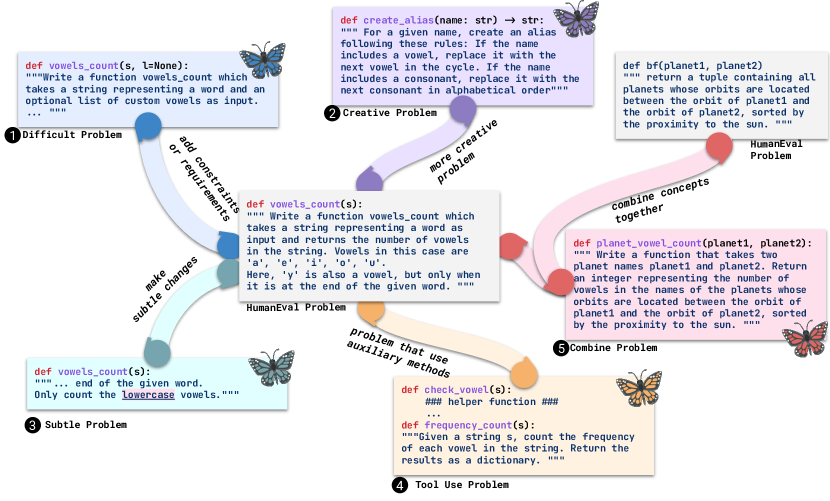
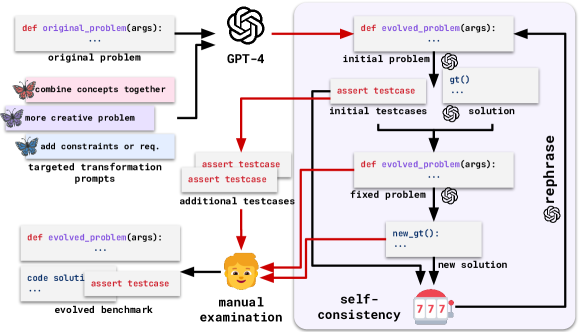
- EvoEval uses GPT-4 to automatically evolve problems from existing benchmarks like HumanEval using five targeted transformation prompts: Difficult, Creative, Subtle, Combine, and Tool Use.
- Each transformation prompt rewrites a base problem into a new variant within a specific domain, increasing problem diversity and complexity.
- The evolved problems are designed to test specific capabilities such as function composition, decomposition, and interaction with external tools.
- The benchmark suite comprises 828 problems across seven distinct sub-benchmarks, each targeting a different aspect of program synthesis.
- Performance is evaluated using pass@1 scores on test cases, enabling direct comparison with standard benchmarks.
- The method enables continuous evolution of benchmarks by reapplying transformation prompts to new problems, ensuring relevance amid LLM advancements.
Experimental results
Research questions
- RQ1To what extent does high performance on standard benchmarks like HumanEval reflect genuine coding proficiency rather than memorization or data leakage?
- RQ2How do LLMs perform when evaluated on evolved problems that require deeper reasoning, composition, or tool usage compared to standard benchmarks?
- RQ3What are the key failure modes of current instruction-following LLMs when faced with reworded or structurally altered problem descriptions?
- RQ4How does the performance of LLMs vary across different problem types (e.g., creative, subtle, combined) compared to baseline benchmarks?
- RQ5Can LLM-evolved benchmarks reveal previously hidden limitations in LLM capabilities such as function reuse and tool integration?
Key findings
- On average, LLMs show a 39.4% drop in performance when evaluated on EvoEval compared to standard benchmarks like HumanEval, indicating significant overfitting to existing benchmarks.
- Performance drops ranged from 19.6% to 47.7% across different models, leading to drastic changes in leaderboard rankings.
- Many LLMs, especially instruction-tuned models, are brittle to rewording or subtle changes in problem descriptions, suggesting poor robustness in instruction following.
- Models exhibit poor performance on Tool_Use and Tool_Use_Main_Only benchmarks, revealing a critical gap in leveraging external functions or tools.
- The study demonstrates that current benchmarks fail to assess key capabilities like problem decomposition and function composition, which are essential for real-world coding.
- EvoEval successfully exposes limitations in current LLMs and provides a scalable, open-source framework for evolving benchmarks to keep pace with LLM development.
Read this paper
Open the full text in the Nubint reader and ask about any passage as you read.
Read this paper on NubintThis review was generated by AI from the original paper. Please check the paper before citing it.