
[Paper Review] Topic Segmentation Model Focusing on Local Context
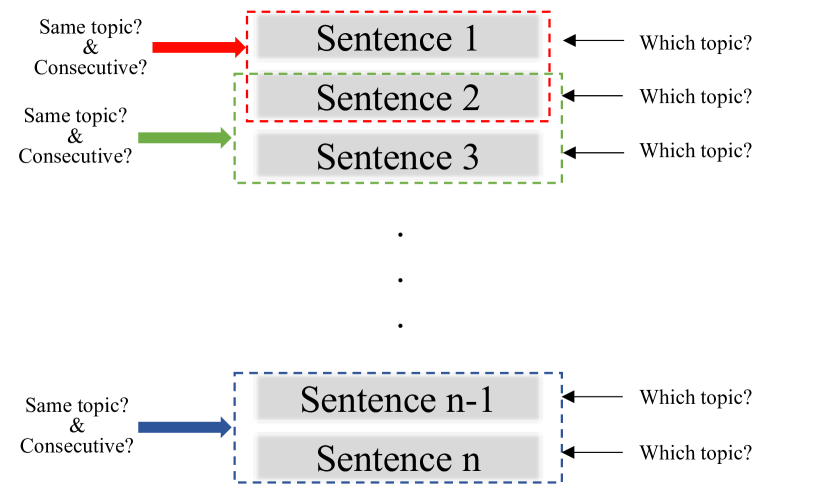
This paper proposes a siamese sentence embedding model with multi-task learning (Same Topic Prediction, Topic Classification, and Next Sentence Prediction) to improve topic segmentation by focusing on local sentence-level context. By processing sentences independently, the model preserves local coherence and achieves state-of-the-art performance on the WikiSection dataset, outperforming models that use broader context.
Topic segmentation is important in understanding scientific documents since it can not only provide better readability but also facilitate downstream tasks such as information retrieval and question answering by creating appropriate sections or paragraphs. In the topic segmentation task, topic coherence is critical in predicting segmentation boundaries. Most of the existing models have tried to exploit as many contexts as possible to extract useful topic-related information. However, additional context does not always bring promising results, because the local context between sentences becomes incoherent despite more sentences being supplemented. To alleviate this issue, we propose siamese sentence embedding layers which process two input sentences independently to get appropriate amount of information without being hampered by excessive information. Also, we adopt multi-task learning techniques including Same Topic Prediction (STP), Topic Classification (TC) and Next Sentence Prediction (NSP). When these three classification layers are combined in a multi-task manner, they can make up for each other's limitations, improving performance in all three tasks. We experiment different combinations of the three layers and report how each layer affects other layers in the same combination as well as the overall segmentation performance. The model we proposed achieves the state-of-the-art result in the WikiSection dataset.
Motivation & Objective
- To address the degradation in topic segmentation performance caused by excessive global context in existing models.
- To improve local context preservation by processing sentence pairs independently using siamese sentence embeddings.
- To enhance topic segmentation performance through multi-task learning with auxiliary tasks: Same Topic Prediction, Topic Classification, and Next Sentence Prediction.
- To empirically validate the importance of local context over extended global context in topic segmentation.
- To demonstrate state-of-the-art results on the WikiSection dataset using a localized, context-aware approach.
Proposed method
- Utilizes a siamese network architecture to encode two input sentences independently using Sentence Transformer embeddings, preserving local semantic context.
- Integrates three classification heads in a multi-task learning framework: Same Topic Prediction (STP), Topic Classification (TC), and Next Sentence Prediction (NSP).
- Employs consecutive sampling to train the model on adjacent sentence pairs, ensuring local sequential relationships are preserved.
- Uses miniLM as the backbone model for sentence encoding, with ablation studies on SPECTER for scientific domain adaptation.
- Applies cross-encoder style context modeling but avoids it by isolating sentence processing to prevent information leakage between inputs.
- Evaluates performance using standard metrics: Pk and WindowDiff on the WikiSection dataset.
Experimental results
Research questions
- RQ1Does focusing on local sentence-level context improve topic segmentation performance compared to models using broader context?
- RQ2How do the three auxiliary tasks (STP, TC, NSP) interact and collectively improve segmentation performance in a multi-task setting?
- RQ3What is the impact of increasing context size on segmentation performance, and does it lead to performance degradation due to noise?
- RQ4Can a siamese network architecture better preserve local context than standard cross-encoder models?
- RQ5How does domain-specific pretraining (e.g., SPECTER) affect performance on scientific documents like those in the en_disease subset?
Key findings
- The proposed model achieves state-of-the-art performance on the WikiSection dataset, outperforming existing models that use broader context.
- Increasing context size beyond a local window leads to performance degradation, indicating that excessive context introduces noise and harms local coherence understanding.
- The multi-task learning setup with STP, TC, and NSP significantly improves segmentation performance, with each task complementing the others.
- The model's performance on the en_disease subset improves by 1.6 in Pk and 1.8 in WindowDiff when using SPECTER instead of miniLM, demonstrating the benefit of domain-specific pretraining.
- Despite having twice the number of parameters, SPECTER does not improve performance on the general en_city subset, confirming that domain alignment is more critical than model size.
- The siamese architecture effectively preserves local context, preventing information leakage between sentences and improving segmentation accuracy.

Read this paper
Open the full text in the Nubint reader and ask about any passage as you read.
Read this paper on NubintThis review was generated by AI from the original paper. Please check the paper before citing it.