
[Paper Review] TorchAudio: Building Blocks for Audio and Speech Processing
TorchAudio is a PyTorch-native, open-source toolkit providing GPU-accelerated, differentiable, and production-ready building blocks for audio and speech processing. It enables end-to-end machine learning workflows with validated performance on key tasks like text-to-speech and speech separation, matching or exceeding state-of-the-art implementations in speed and quality.
This document describes version 0.10 of TorchAudio: building blocks for machine learning applications in the audio and speech processing domain. The objective of TorchAudio is to accelerate the development and deployment of machine learning applications for researchers and engineers by providing off-the-shelf building blocks. The building blocks are designed to be GPU-compatible, automatically differentiable, and production-ready. TorchAudio can be easily installed from Python Package Index repository and the source code is publicly available under a BSD-2-Clause License (as of September 2021) at https://github.com/pytorch/audio. In this document, we provide an overview of the design principles, functionalities, and benchmarks of TorchAudio. We also benchmark our implementation of several audio and speech operations and models. We verify through the benchmarks that our implementations of various operations and models are valid and perform similarly to other publicly available implementations.
Motivation & Objective
- To accelerate the development and deployment of audio and speech machine learning applications within the PyTorch ecosystem.
- To provide a unified, production-ready toolkit with GPU compatibility and automatic differentiation for end-to-end training.
- To serve as a foundational dependency for higher-level audio/speech toolkits by offering canonical, high-quality implementations of core operations.
- To ensure broad compatibility and maintainability by minimizing external dependencies beyond PyTorch.
- To establish a stable, community-driven open-source foundation for audio/speech ML with strong performance benchmarks.
Proposed method
- Implementing audio I/O, spectrogram computation, and dataset loading as PyTorch-compatible, GPU-accelerated operations.
- Designing all core operations to be automatically differentiable using PyTorch’s autograd system.
- Compiling key components into TorchScript to ensure production readiness and deployment on mobile and embedded platforms.
- Benchmarking core operations and models (e.g., WaveRNN, Tacotron2, Conv-TasNet) against reference implementations in runtime and output quality.
- Using standardized datasets (LJSpeech, Libri2Mix) and metrics (MCD, Si-SDRi, MOS) for objective evaluation.
- Leveraging distributed training via DistributedDataParallel for scalable model training on multiple GPUs.
Experimental results
Research questions
- RQ1Can a PyTorch-native toolkit provide GPU-compatible, differentiable, and production-ready audio processing building blocks that match or exceed existing implementations?
- RQ2How does TorchAudio’s performance in audio operation execution and model inference compare to reference implementations in terms of speed and output quality?
- RQ3To what extent can TorchAudio serve as a foundational dependency for higher-level audio/speech toolkits in the PyTorch ecosystem?
- RQ4Does TorchAudio’s implementation of end-to-end models like Tacotron2 and WaveRNN achieve comparable or superior performance to published models?
- RQ5How scalable and maintainable is TorchAudio in real-world development, as indicated by community adoption and contribution metrics?
Key findings
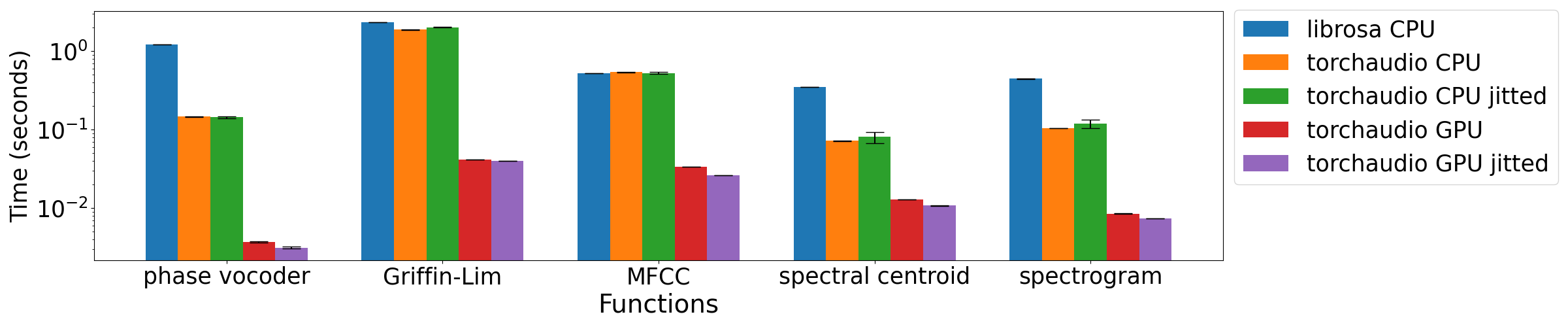
- TorchAudio’s implementations of audio operations achieve or exceed the runtime performance of public reference implementations.
- The Tacotron2 implementation achieves a mel cepstral distortion (MCD) of 2.305, compared to Nvidia’s 2.294, demonstrating near-parity in output quality.
- The WaveRNN implementation achieves comparable subjective quality to both fatchord’s and Nvidia’s models, with a mean opinion score (MOS) indicating high perceptual similarity to human speech.
- The Conv-TasNet implementation on Libri2Mix outperforms the Asteroid baseline, achieving 15.3 dB Si-SDRi and 15.6 dB SDRi, compared to 14.7 dB and 15.1 dB respectively.
- TorchAudio’s use of DistributedDataParallel enables faster training than fatchord’s implementation, demonstrating performance gains from modern PyTorch training patterns.
- As of September 2021, TorchAudio had over 5,420 public repositories depending on it, more than 350 forks, and over 1,250 merged pull requests, indicating strong community adoption and active development.
Read this paper
Open the full text in the Nubint reader and ask about any passage as you read.
Read this paper on NubintThis review was generated by AI from the original paper. Please check the paper before citing it.