
[Paper Review] Toward a Theory of Causation for Interpreting Neural Code Models
This paper introduces do code, a causal inference-based post-hoc interpretability framework for Neural Code Models (NCMs) that explains model predictions by modeling code syntax and structure as causal variables. By applying structural causal models (SCMs) and counterfactual interventions, do code reveals that NCMs are sensitive to syntactic changes and learn to predict code blocks (e.g., brackets, semicolons) with reduced confounding bias, offering a robust method for detecting model biases and limitations.
Neural Language Models of Code, or Neural Code Models (NCMs), are rapidly progressing from research prototypes to commercial developer tools. As such, understanding the capabilities and limitations of such models is becoming critical. However, the abilities of these models are typically measured using automated metrics that often only reveal a portion of their real-world performance. While, in general, the performance of NCMs appears promising, currently much is unknown about how such models arrive at decisions. To this end, this paper introduces $do_{code}$, a post hoc interpretability method specific to NCMs that is capable of explaining model predictions. $do_{code}$ is based upon causal inference to enable programming language-oriented explanations. While the theoretical underpinnings of $do_{code}$ are extensible to exploring different model properties, we provide a concrete instantiation that aims to mitigate the impact of spurious correlations by grounding explanations of model behavior in properties of programming languages. To demonstrate the practical benefit of $do_{code}$, we illustrate the insights that our framework can provide by performing a case study on two popular deep learning architectures and ten NCMs. The results of this case study illustrate that our studied NCMs are sensitive to changes in code syntax. All our NCMs, except for the BERT-like model, statistically learn to predict tokens related to blocks of code (\eg brackets, parenthesis, semicolon) with less confounding bias as compared to other programming language constructs. These insights demonstrate the potential of $do_{code}$ as a useful method to detect and facilitate the elimination of confounding bias in NCMs.
Motivation & Objective
- To address the lack of interpretability in Neural Code Models (NCMs), which are increasingly used in commercial tools but remain black-box systems.
- To move beyond automated metrics like BLEU and ROUGE, which fail to capture model limitations and biases.
- To develop a systematic, causality-driven methodology for explaining how NCMs make predictions, focusing on linguistic and syntactic properties of code.
- To provide a debugging tool that identifies spurious correlations and confounding biases in NCMs through counterfactual reasoning.
- To establish a reusable framework for causal interpretability in software engineering applications of deep learning.
Proposed method
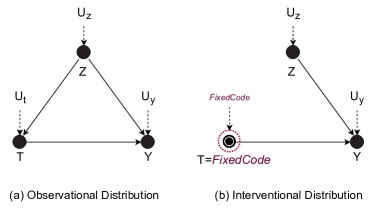
- The method is built on Pearl’s structural causal model (SCM) framework, modeling code constructs as treatments, model predictions as outcomes, and shared code patterns as confounders.
- It applies the do-operator to simulate interventions—such as replacing code blocks or altering syntax—while observing changes in model predictions.
- The framework uses average treatment effects (ATE) to quantify the causal impact of syntactic and structural changes on model behavior.
- It incorporates refutation methods to validate the robustness of causal estimates and detect spurious associations.
- The approach is instantiated using real-world code distributions collected at scale, avoiding adversarial or synthetic perturbations.
- A five-step checklist guides researchers through constructing interpretability functions, defining SCMs, collecting data, estimating causal effects, and validating assumptions.
Experimental results
Research questions
- RQ1How do Neural Code Models respond to controlled changes in code syntax and structure, and what causal effects do these changes induce?
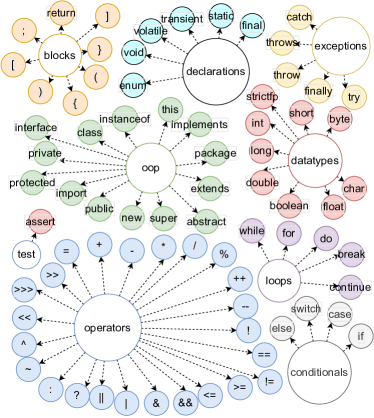
- RQ2To what extent do NCMs rely on syntactic markers (e.g., brackets, semicolons) versus semantic constructs (e.g., conditionals, loops) in their predictions?
- RQ3Can causal inference methods detect and quantify confounding bias in NCMs when predicting code tokens?
- RQ4How do different architectures (e.g., RNNs, Transformers) differ in their sensitivity to syntactic perturbations?
- RQ5Can counterfactual explanations derived from SCMs reveal hidden biases or limitations in NCMs not exposed by standard metrics?
Key findings
- NCMs exhibit significant sensitivity to changes in code syntax, particularly in the prediction of syntactic tokens such as brackets, parentheses, and semicolons.
- The models demonstrate reduced confounding bias when learning to predict code blocks, indicating a more robust understanding of structural patterns.
- Through average treatment effects, do code quantifies that syntactic perturbations lead to measurable shifts in model predictions, revealing underlying biases.
- Refutation methods successfully detect spurious correlations, validating the reliability of the causal estimates produced by the framework.
- The case study on RNNs, GRUs, and Transformers confirms that do code can expose erroneous code concept predictions, especially in conditionals and loops.
- The framework enables systematic debugging of NCMs by isolating causal influences of specific code constructs, offering a path toward more reliable and interpretable code generation.
Read this paper
Open the full text in the Nubint reader and ask about any passage as you read.
Read this paper on NubintThis review was generated by AI from the original paper. Please check the paper before citing it.