
[Paper Review] Toward Autonomous Cooperation in Heterogeneous Nanosatellite Constellations Using Dynamic Graph Neural Networks
This paper proposes a dynamic graph neural network (DGNN)-based approach to autonomously optimize contact plans in large, heterogeneous nanosatellite constellations. By modeling satellite networks as dynamic graphs and using a DGNN to predict network delay with 3.6-minute mean absolute error, the method accelerates objective function evaluation 20x faster than traditional contact graph routing while improving average best delivery time by 29.1%.
The upcoming landscape of Earth Observation missions will defined by networked heterogeneous nanosatellite constellations required to meet strict mission requirements, such as revisit times and spatial resolution. However, scheduling satellite communications in these satellite networks through efficiently creating a global satellite Contact Plan (CP) is a complex task, with current solutions requiring ground-based coordination or being limited by onboard computational resources. The paper proposes a novel approach to overcome these challenges by modeling the constellations and CP as dynamic networks and employing graph-based techniques. The proposed method utilizes a state-of-the-art dynamic graph neural network to evaluate the performance of a given CP and update it using a heuristic algorithm based on simulated annealing. The trained neural network can predict the network delay with a mean absolute error of 3.6 minutes. Simulation results show that the proposed method can successfully design a contact plan for large satellite networks, improving the delay by 29.1%, similar to a traditional approach, while performing the objective evaluations 20x faster.
Motivation & Objective
- Address the challenge of scheduling satellite communications in large, heterogeneous nanosatellite constellations with dynamic topologies.
- Overcome limitations of ground-based coordination and high computational costs in existing contact plan design (CPD) methods.
- Enable onboard, autonomous decision-making for contact plan optimization under resource and connectivity constraints.
- Improve scalability and computational efficiency for large-scale Earth observation missions requiring real-time data delivery.
- Develop a learning-based framework that generalizes across diverse network configurations without assuming periodicity or homogeneity.
Proposed method
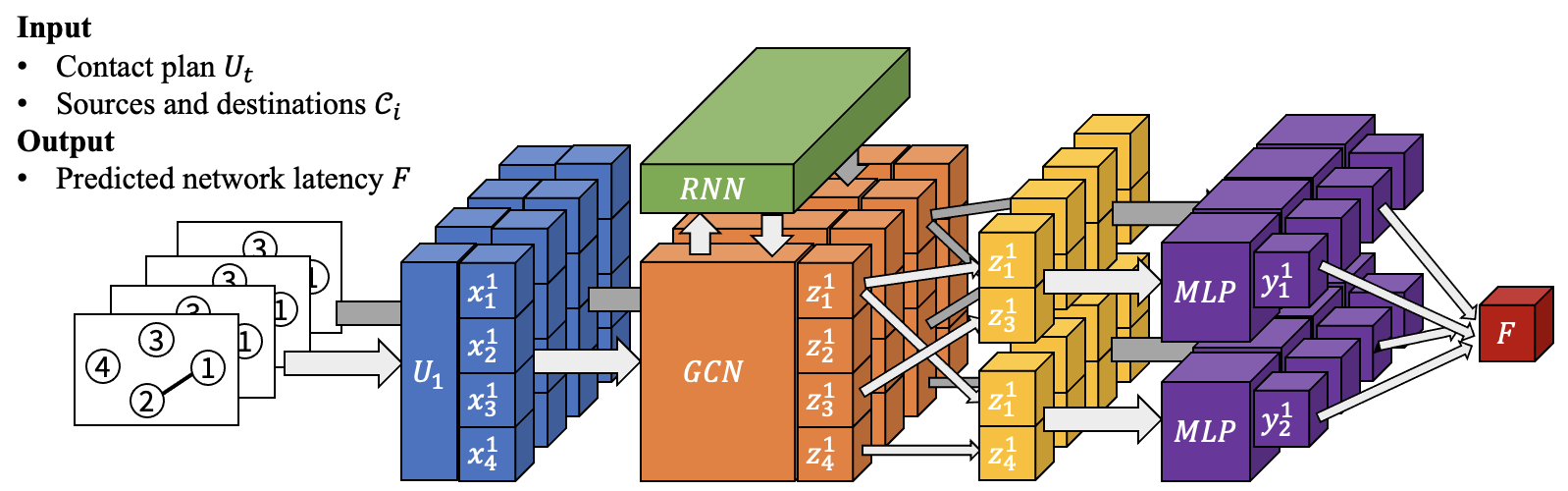
- Model the satellite constellation and contact plan as a dynamic graph, capturing spatial and temporal evolution of inter-satellite links.
- Employ a hybrid DGNN architecture combining graph convolutional layers and a recurrent neural network to encode temporal dynamics and network structure.
- Train the DGNN to predict the average best delivery time (BDT) of data delivery across the network, using simulated contact plans as labels.
- Integrate the trained DGNN into a simulated annealing metaheuristic to iteratively improve the contact plan by evaluating candidate solutions rapidly.
- Use the DGNN as a surrogate for the computationally expensive contact graph routing (CGR) algorithm to evaluate objective function values.
- Leverage adjacency matrices of time-varying satellite contacts as input to the DGNN at each time step, enabling real-time adaptation.
Experimental results
Research questions
- RQ1Can a dynamic graph neural network effectively approximate the network delay (BDT) in large, heterogeneous nanosatellite constellations with evolving topologies?
- RQ2To what extent can a learned DGNN surrogate reduce the computational cost of contact plan optimization compared to traditional routing-based evaluation?
- RQ3How well does the DGNN generalize across diverse satellite configurations and network states without prior assumptions about periodicity?
- RQ4Can the integration of DGNN with simulated annealing achieve performance comparable to exact CGR-based optimization while being significantly faster?
- RQ5What is the trade-off between prediction accuracy and computational speed in autonomous contact plan design using deep learning?
Key findings
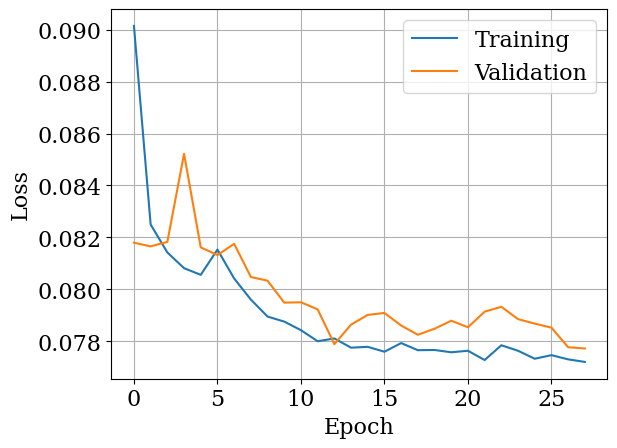
- The proposed DGNN achieves a mean absolute error of 3.6 minutes in predicting the average best delivery time (BDT) across the network.
- The DGNN-based optimization improves the BDT by 29.1% compared to the initial contact plan, matching the performance of traditional contact graph routing (CGR).
- Objective function evaluations using the DGNN are 20x faster than using the CGR algorithm, significantly enhancing computational efficiency.
- Despite limited generalization across the full range of delay values, the DGNN provides a reliable approximation that enables effective optimization via simulated annealing.
- The method successfully scales to large satellite networks and supports autonomous, onboard contact plan updates without centralized coordination.
- The approach demonstrates feasibility for real-time, distributed decision-making in delay/disruption-tolerant networks typical of Earth observation constellations.
Read this paper
Open the full text in the Nubint reader and ask about any passage as you read.
Read this paper on NubintThis review was generated by AI from the original paper. Please check the paper before citing it.