
[Paper Review] Toward Grounded Commonsense Reasoning
This paper proposes a framework for grounded social reasoning in robotics that combines large language models (LLMs) and vision-language models (VLMs) to enable robots to actively perceive environments through targeted close-up observations, improving socially appropriate decision-making. The approach achieves a 12.9% average improvement on the MessySurfaces benchmark and 15% on real-robot experiments over baselines without active perception.
Consider a robot tasked with tidying a desk with a meticulously constructed Lego sports car. A human may recognize that it is not appropriate to disassemble the sports car and put it away as part of the "tidying." How can a robot reach that conclusion? Although large language models (LLMs) have recently been used to enable commonsense reasoning, grounding this reasoning in the real world has been challenging. To reason in the real world, robots must go beyond passively querying LLMs and actively gather information from the environment that is required to make the right decision. For instance, after detecting that there is an occluded car, the robot may need to actively perceive the car to know whether it is an advanced model car made out of Legos or a toy car built by a toddler. We propose an approach that leverages an LLM and vision language model (VLM) to help a robot actively perceive its environment to perform grounded commonsense reasoning. To evaluate our framework at scale, we release the MessySurfaces dataset which contains images of 70 real-world surfaces that need to be cleaned. We additionally illustrate our approach with a robot on 2 carefully designed surfaces. We find an average 12.9% improvement on the MessySurfaces benchmark and an average 15% improvement on the robot experiments over baselines that do not use active perception. The dataset, code, and videos of our approach can be found at https://minaek.github.io/grounded_commonsense_reasoning.
Motivation & Objective
- To enable robots to perform socially appropriate cleaning decisions in real-world environments without human intervention.
- To address the limitation of passive LLM and VLM reasoning by introducing active perception to gather missing perceptual context.
- To develop a system that identifies what information is missing for social reasoning and actively acquires it via targeted observations.
- To evaluate the framework at scale using a new real-world dataset and real-robot experiments.
- To release the MessySurfaces dataset, code, and videos to support reproducibility and future research in grounded social reasoning.
Proposed method
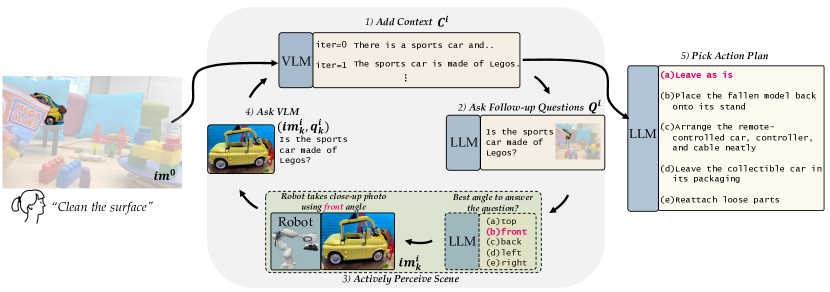
- The framework uses an LLM to analyze a scene image and generate follow-up questions about objects that require clarification for social reasoning.
- The robot takes targeted close-up images of objects from angles suggested by the LLM to resolve ambiguity.
- A vision-language model (VLM) processes the close-up images to provide detailed, context-rich descriptions for decision-making.
- The LLM iteratively refines its understanding by requesting additional observations until it can make a socially appropriate action decision.
- The final action—such as leaving a Lego car intact or discarding food waste—is translated into executable robot API calls using in-context learning.
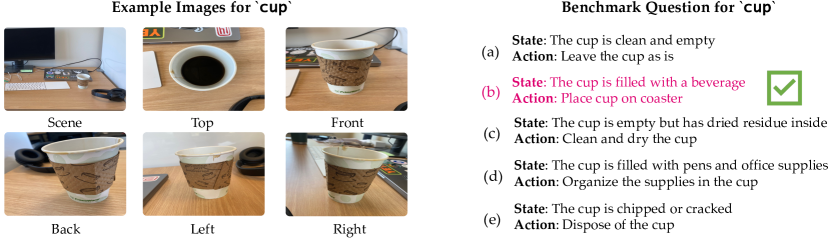
- The system is evaluated on both a new benchmark dataset (MessySurfaces) and real-world robotic platforms with controlled desk environments.
Experimental results
Research questions
- RQ1Can active perception significantly improve the accuracy of socially appropriate robot decision-making compared to passive LLM and VLM querying?
- RQ2How effective is an LLM-VLM loop in identifying and resolving perceptual ambiguities in real-world scenes for social reasoning?
- RQ3To what extent can a robot’s active perception strategy—guided by LLM-generated questions—improve downstream decision quality on real-world cleaning tasks?
- RQ4How does the framework perform across diverse, real-world cluttered surfaces with varying object types and social norms?
- RQ5Can the proposed method generalize across unseen objects and scenarios without human-in-the-loop feedback?
Key findings
- The framework achieved a 12.9% average improvement on the MessySurfaces benchmark over baselines that do not use active perception.
- In real-world robot experiments, the framework showed a 15% average improvement in socially appropriate decision-making compared to passive baselines.
- The LLM-generated follow-up questions were effective in identifying key ambiguities, such as whether an object is a valuable model or a toy.
- The robot’s active perception strategy—taking close-up images from LLM-suggested angles—significantly improved the VLM’s ability to detect critical details like Lego pieces or food spoilage.
- The system successfully preserved intricate objects like Lego cars and discarded only inappropriate items like half-eaten bananas.
- The released MessySurfaces dataset, along with code and videos, enables reproducible evaluation of grounded social reasoning in real-world settings.
Read this paper
Open the full text in the Nubint reader and ask about any passage as you read.
Read this paper on NubintThis review was generated by AI from the original paper. Please check the paper before citing it.