
[Paper Review] Towards a Flexible Embedding Learning Framework
This paper proposes a flexible embedding learning framework that uses multiple entity-relation-matrices as input to capture heterogeneous relationships across diverse data types. By employing a sampling mechanism inspired by kernel normalization and enabling direct integration of domain knowledge, the framework outperforms state-of-the-art methods in clustering, classification, and visualization tasks across text and transaction datasets.
Representation learning is a fundamental building block for analyzing entities in a database. While the existing embedding learning methods are effective in various data mining problems, their applicability is often limited because these methods have pre-determined assumptions on the type of semantics captured by the learned embeddings, and the assumptions may not well align with specific downstream tasks. In this work, we propose an embedding learning framework that 1) uses an input format that is agnostic to input data type, 2) is flexible in terms of the relationships that can be embedded into the learned representations, and 3) provides an intuitive pathway to incorporate domain knowledge into the embedding learning process. Our proposed framework utilizes a set of entity-relation-matrices as the input, which quantifies the affinities among different entities in the database. Moreover, a sampling mechanism is carefully designed to establish a direct connection between the input and the information captured by the output embeddings. To complete the representation learning toolbox, we also outline a simple yet effective post-processing technique to properly visualize the learned embeddings. Our empirical results demonstrate that the proposed framework, in conjunction with a set of relevant entity-relation-matrices, outperforms the existing state-of-the-art approaches in various data mining tasks.
Motivation & Objective
- Address the limitation of existing embedding methods that assume a single relationship type and are rigid in capturing heterogeneous semantics.
- Enable representation learning that is agnostic to input data type by using entity-relation-matrices as input.
- Provide an intuitive pathway to incorporate domain knowledge through customizable matrix construction.
- Improve embedding quality by jointly modeling multiple relationship types from the same database.
- Develop a post-processing technique for accurate 2D/3D visualization of learned embeddings across different entity types.
Proposed method
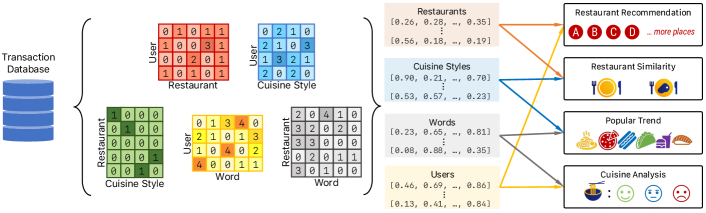
- Represent relationships between entities using entity-relation-matrices, where each matrix quantifies affinity between entities based on a specific relationship type.
- Design a sampling mechanism during optimization that draws from multiple matrices, inspired by kernel normalization in multiple kernel learning to balance contributions.
- Optimize the embedding space by minimizing a loss function that encourages high similarity between related entities and low similarity between unrelated ones.
- Use a shared embedding space for all entities across different entity-types, enabling joint representation learning.
- Apply a post-processing technique to project high-dimensional embeddings into 2D or 3D space for meaningful visualization, avoiding failure of standard methods like t-SNE or MDS.
- Construct entity-relation-matrices from diverse sources, such as co-occurrence in transactions, shared users, or name similarity, to reflect heterogeneous relationships.
Experimental results
Research questions
- RQ1Can a unified embedding framework effectively learn from multiple heterogeneous relationship types without assuming a single underlying semantic structure?
- RQ2How does the proposed sampling mechanism based on kernel normalization improve embedding quality compared to standard matrix factorization approaches?
- RQ3To what extent can domain knowledge be intuitively injected into the learning process through the design of entity-relation-matrices?
- RQ4Does the framework outperform existing state-of-the-art methods in downstream tasks like clustering and classification across diverse data types?
- RQ5Can the proposed post-processing technique produce more accurate and interpretable visualizations of learned embeddings than off-the-shelf dimensionality reduction methods?
Key findings
- The proposed framework outperforms state-of-the-art methods on all three evaluation metrics—clustering, classification, and visualization—across the 20news and RCV1 text datasets.
- Using multiple entity-relation-matrices (e.g., co-occurrence, user sharing, name similarity) leads to more informative embeddings than relying on a single matrix type.
- The framework achieves superior performance even when using matrices derived from external datasets, such as Wikipedia embeddings, demonstrating its flexibility and generalization ability.
- The post-processing technique successfully visualizes embeddings in 2D/3D space, revealing meaningful clusters and semantic groupings, unlike standard methods like t-SNE or MDS which fail to preserve structure.
- Subjective analysis of word clouds generated from learned embeddings confirms that document embeddings are semantically aligned with relevant words, indicating effective capture of contextual meaning.
- Hyperparameter sensitivity analysis shows stable performance across different configurations, reinforcing the robustness of the framework.
Read this paper
Open the full text in the Nubint reader and ask about any passage as you read.
Read this paper on NubintThis review was generated by AI from the original paper. Please check the paper before citing it.