
[Paper Review] Towards a Modular Architecture for Science Factories
This paper proposes a modular architecture for science factories—autonomous, AI- and HPC-integrated laboratories—using reconfigurable hardware modules, manipulators, and software workflows. The system enables scalable, reusable, and composable scientific experimentation across diverse domains, demonstrated through five real-world applications in biology and materials science with 15 robotic systems and digital twin integration.
Advances in robotic automation, high-performance computing (HPC), and artificial intelligence (AI) encourage us to conceive of science factories: large, general-purpose computation- and AI-enabled self-driving laboratories (SDLs) with the generality and scale needed both to tackle large discovery problems and to support thousands of scientists. Science factories require modular hardware and software that can be replicated for scale and (re)configured to support many applications. To this end, we propose a prototype modular science factory architecture in which reconfigurable modules encapsulating scientific instruments are linked with manipulators to form workcells, that can themselves be combined to form larger assemblages, and linked with distributed computing for simulation, AI model training and inference, and related tasks. Workflows that perform sets of actions on modules can be specified, and various applications, comprising workflows plus associated computational and data manipulation steps, can be run concurrently. We report on our experiences prototyping this architecture and applying it in experiments involving 15 different robotic apparatus, five applications (one in education, two in biology, two in materials), and a variety of workflows, across four laboratories. We describe the reuse of modules, workcells, and workflows in different applications, the migration of applications between workcells, and the use of digital twins, and suggest directions for future work aimed at yet more generality and scalability. Code and data are available at https://ad-sdl.github.io/wei2023 and in the Supplementary Information
Motivation & Objective
- Address the lack of general-purpose, scalable, and reconfigurable platforms for autonomous scientific discovery.
- Overcome limitations in current autonomous labs, which are often rigid, non-portable, and not easily extensible.
- Enable large-scale, parallel, and programmable scientific workflows across diverse experimental domains.
- Support interoperability between physical modules, computational resources, and AI/ML pipelines through standardized interfaces.
- Facilitate reuse, migration, and digital twin-based simulation of workflows across different laboratory configurations.
Proposed method
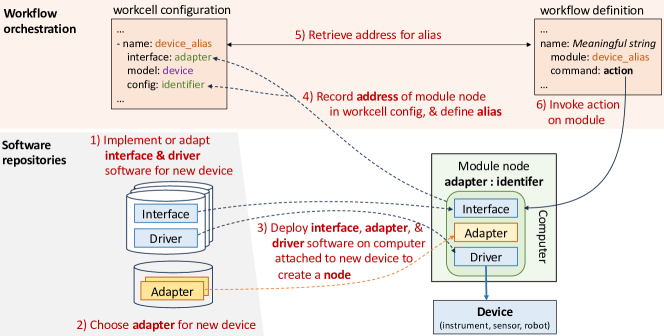
- Design a six-function programmatic interface for modular scientific instruments to standardize hardware-software interaction.
- Introduce a physical form factor (the 'cart') to standardize mechanical and electrical integration of modules.
- Define workcells as assemblies of modules and manipulators, enabling modular, reconfigurable experimental units.
- Develop notation systems for specifying module and workcell configurations, enabling reproducibility and composition.
- Implement a workflow engine to orchestrate sequences of actions across modules, with support for concurrent execution.
- Integrate digital twins to simulate and validate workflows before physical execution, improving reliability and reducing trial-and-error.
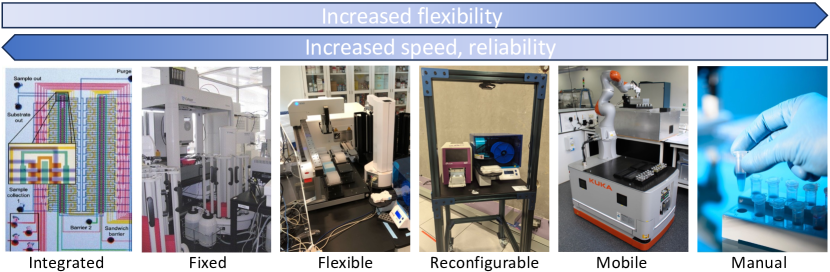
Experimental results
Research questions
- RQ1How can a modular architecture enable scalable and reusable deployment of autonomous scientific laboratories across diverse scientific domains?
- RQ2To what extent can standardized interfaces and form factors support interoperability and reconfiguration of heterogeneous robotic instruments?
- RQ3How effective is the integration of AI, simulation, and physical experimentation within a unified, composable workflow system?
- RQ4Can digital twins and workflow migration between workcells improve experimental efficiency and reduce development time?
- RQ5What are the practical challenges and benefits of deploying a modular science factory across multiple laboratories and applications?
Key findings
- The modular architecture successfully supported five distinct scientific applications—two in biology, two in materials science, and one in education—across four laboratories.
- Fifteen different robotic apparatus were integrated into the system, demonstrating broad hardware compatibility and reconfigurability.
- Workflows and applications were successfully reused and migrated between different workcells, validating the composability of the architecture.
- Digital twins enabled simulation and validation of workflows prior to physical execution, reducing experimental risk and iteration time.
- The system demonstrated concurrent execution of multiple applications, with full integration of AI model training, inference, and HPC-based simulation.
- Public code and data repositories were established, including tagged releases for reproducibility, with core workflow execution software available at https://github.com/AD-SDL/rpl_wei.
Better researchstarts right now
From reading papers to final review, dramatically reduce your research time.
No credit card · Free plan available
This review was created by AI and reviewed by human editors.