
[Paper Review] Towards A Unified Agent with Foundation Models
The paper presents a language-centric reinforcement learning framework that uses vision-language models and large language models to solve sparse-reward robotic stacking tasks, enabling efficient exploration, data reuse, skill scheduling, and learning from observation without task-specific hand-crafted curricula.
Language Models and Vision Language Models have recently demonstrated unprecedented capabilities in terms of understanding human intentions, reasoning, scene understanding, and planning-like behaviour, in text form, among many others. In this work, we investigate how to embed and leverage such abilities in Reinforcement Learning (RL) agents. We design a framework that uses language as the core reasoning tool, exploring how this enables an agent to tackle a series of fundamental RL challenges, such as efficient exploration, reusing experience data, scheduling skills, and learning from observations, which traditionally require separate, vertically designed algorithms. We test our method on a sparse-reward simulated robotic manipulation environment, where a robot needs to stack a set of objects. We demonstrate substantial performance improvements over baselines in exploration efficiency and ability to reuse data from offline datasets, and illustrate how to reuse learned skills to solve novel tasks or imitate videos of human experts.
Motivation & Objective
- Explore how foundation models can serve as a unified reasoning backbone for reinforcement learning agents.
- Demonstrate improvements in exploration efficiency in sparse-reward environments.
- Show how offline data can be reused to bootstrap sequential task learning.
- Illustrate skill scheduling and learning from observation through language-grounded goals.
Proposed method
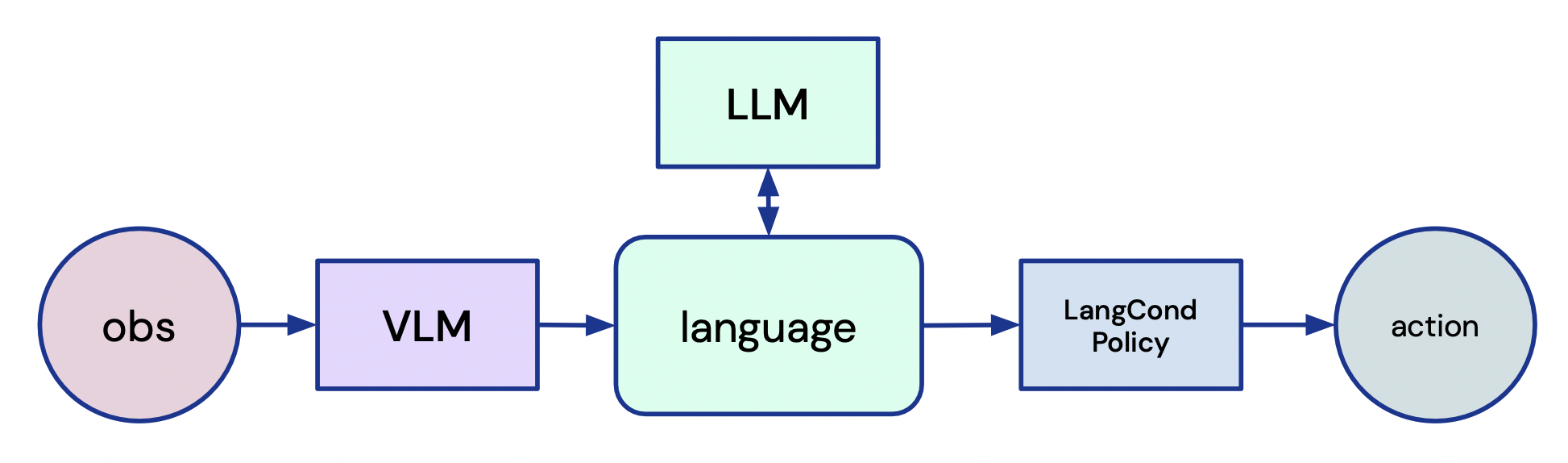
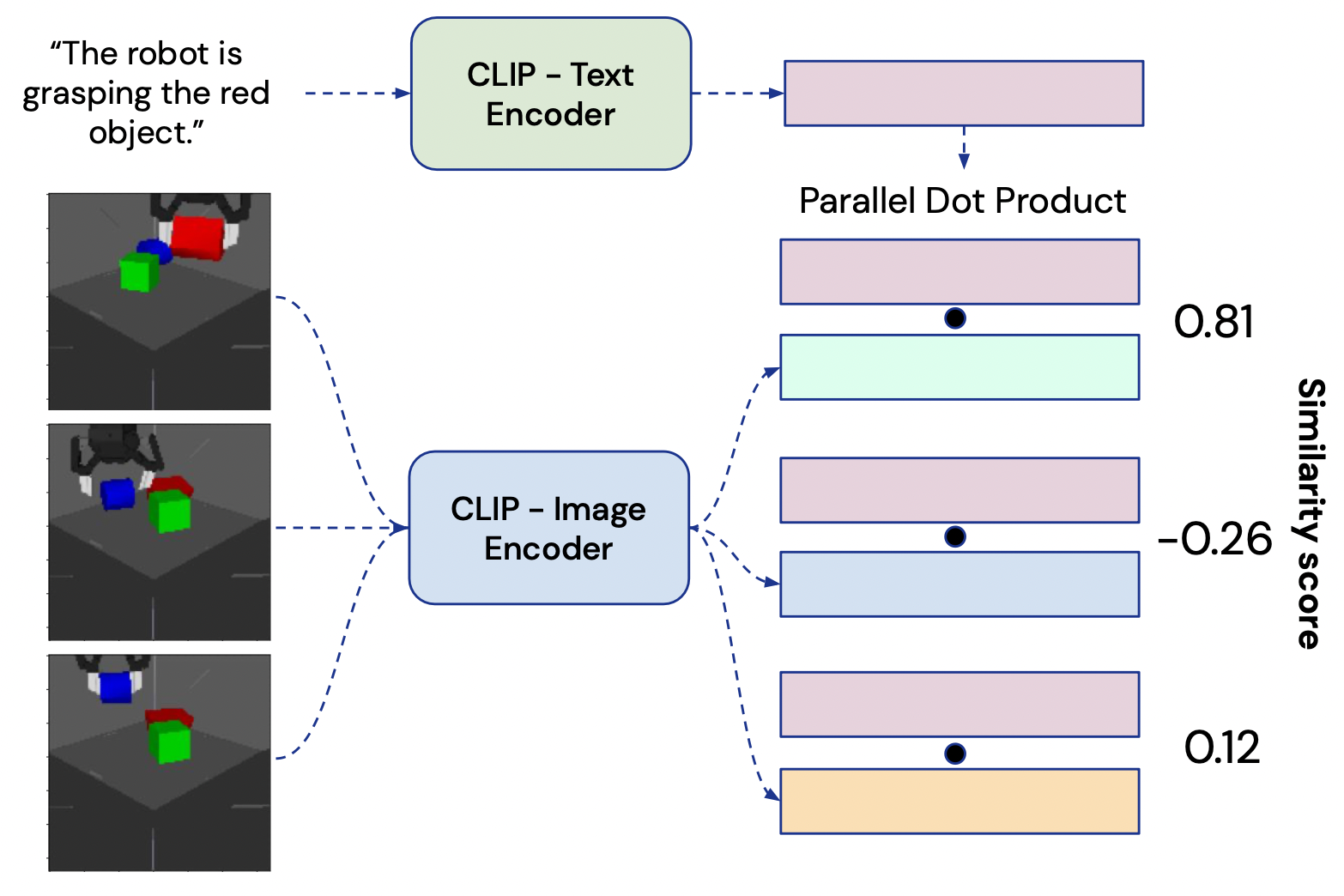
- Bridge vision and language by describing observations with CLIP-style embeddings to map visuals to text.
- Use a finetuned LLM (FLAN-T5) to decompose tasks into text-subgoals without additional in-domain training.
- Ground language sub-goals into actions via a transformer-based language-conditioned policy learned from scratch in RL.
- Adopt a Collect & Infer loop where VLMs provide internal rewards by validating sub-goal completion against observations.
- Operate multiple distributed agents (N=1000) that collect data into a shared buffer and perform behavioral cloning after episodes.
- Enable offline data reuse by grounding past experiences to new tasks using VLM-based reward relabeling and CLIP-style grounding.
- Support learning from observation by mapping expert video frames to sub-goals via VLMs and executing the corresponding skills.
Experimental results
Research questions
- RQ1Can foundation models (LLMs/VLMs) provide a unified approach to core RL challenges in sparse-reward settings?
- RQ2How effectively can language-generated sub-goals guide exploration and curriculum generation without hand-crafted rewards?
- RQ3To what extent can offline experience be reused to bootstrap learning of sequential tasks in robotic manipulation?
- RQ4Can learned skills be scheduled and reused to solve novel tasks and enable learning from observation?
Key findings
- The framework yields substantially faster learning than a baseline environment-reward-only agent on Stack Red on Blue and Triple Stack tasks.
- The Triple Stack task shows rapid learning where the baseline remains stuck due to extreme sparsity (sparseness > 10^6).
- A single framework enables exploration via language-driven curricula without domain-specific reward engineering.
- Offline data from previous tasks can be relabeled and reused to bootstrap new tasks, speeding up sequential task learning.
- Learning from observation via videos allows grounding learned skills to sub-goals and executing them in new contexts.
- Distributed data collection (N=1000 agents) with self-imitation improves sample efficiency and stability of learning.
Read this paper
Open the full text in the Nubint reader and ask about any passage as you read.
Read this paper on NubintThis review was generated by AI from the original paper. Please check the paper before citing it.