
[Paper Review] Towards a universal analytical model for Population III star formation: interplay between feedback and fragmentation
This paper presents a universal analytical model for Population III star formation that self-consistently couples feedback and fragmentation across scales, predicting final stellar masses from cloud properties. It shows that massive Pop III clusters (≥10⁴ M☉) hosting supermassive stars form in ~20–70% of high-redshift quasar progenitor haloes, providing viable seeds for luminous z≈6 quasars.
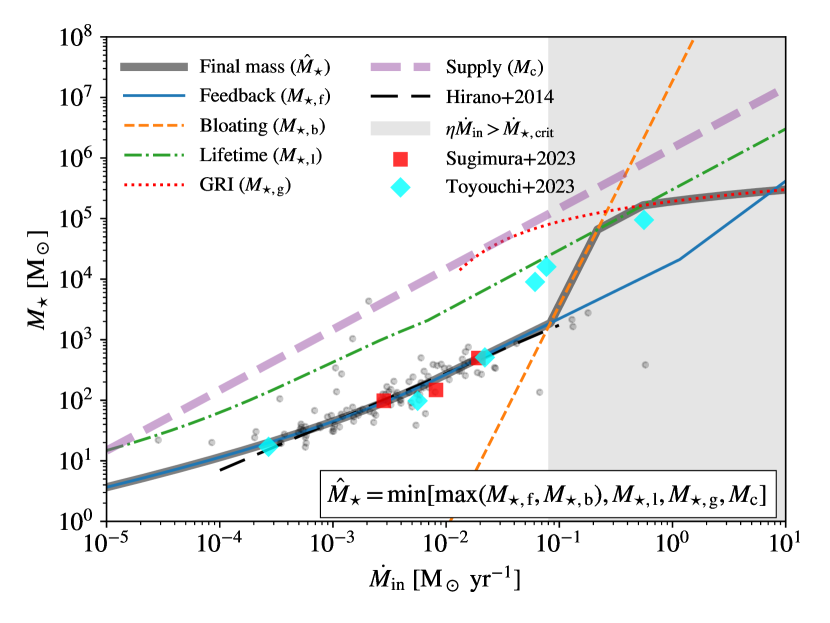
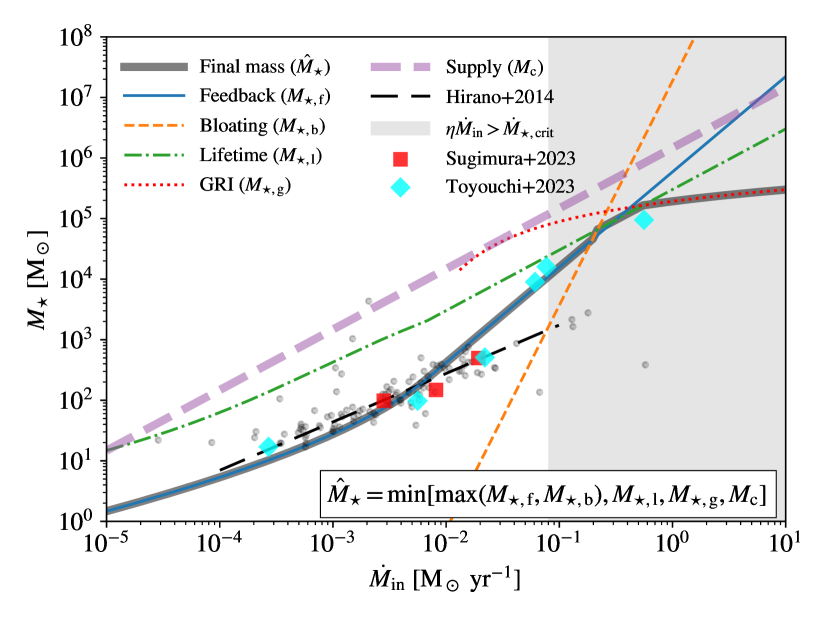
JWST has brought us new insights into Cosmic Dawn with tentative detection of the unique signatures of metal-free Population III (Pop III) stars, such as strong HeII emission, extremely blue UV spectrum, and enhanced nitrogen abundance. Self-consistent theoretical predictions of the formation rates, sites, and masses of Pop III stars are crucial for interpreting the observations, but are challenging due to complex physical processes operating over the large range of length scales involved. One solution is to combine analytical models for the small-scale star formation process with cosmological simulations that capture the large-scale physics such as structure formation, radiation backgrounds, and baryon-dark matter streaming motion that regulate the conditions of Pop III star formation. We build an analytical model to predict the final masses of Pop III stars/clusters from the properties of star-forming clouds, based on the key results of small-scale star formation simulations and stellar evolution models. Our model for the first time considers the interplay between feedback and fragmentation and covers different modes of Pop III star formation ranging from ordinary small ($\sim 10-2000\ m M_\odot$) clusters in molecular-cooling clouds to massive ($\gtrsim 10^{4}\ m M_\odot$) clusters containing supermassive ($\sim 10^{4}-3 imes 10^{5}\ m M_\odot$) stars under violent collapse of atomic-cooling clouds. As an example, the model is applied to the Pop III star-forming clouds in the progenitors of typical haloes hosting high-$z$ luminous quasars, which shows that formation of Pop III massive clusters is common ($\sim 20-70\%$) in such biased ($\sim4σ$) regions, and the resulting heavy black hole seeds from supermassive stars can account for a significant fraction of observed luminous ($\gtrsim 10^{46}\ m erg\ s^{-1}$) quasars at $z\sim 6$.
Motivation & Objective
- To develop a unified analytical framework for predicting Pop III star and cluster masses across diverse formation environments.
- To resolve the challenge of modeling multi-scale physics—from small-scale fragmentation and feedback to large-scale cosmological conditions—critical for interpreting JWST-era observations.
- To quantify the formation probability and mass distribution of Pop III stars and clusters in haloes hosting high-redshift luminous quasars.
- To assess the viability of Pop III supermassive stars as seeds for massive black holes powering z≈6 quasars.
- To enable integration into cosmological simulations and semi-analytical models for self-consistent, large-scale predictions of early cosmic evolution.
Proposed method
- Combines small-scale hydrodynamic simulations and stellar evolution models to inform an analytical model of protostar accretion and fragmentation.
- Introduces a feedback-regulated fragmentation criterion that depends on gas accretion rate and cloud properties, linking feedback to cluster mass function.
- Uses a multiplicity parameter N and protostar mass distribution slope α to model fragmentation efficiency and cluster mass distribution.
- Applies the model to cosmologically representative haloes (M_h ≈ 10¹² M☉ at z ≈ 6) with biased density fields to assess formation probabilities.
- Incorporates accretion history data from high-resolution simulations (e.g., Sharda et al. 2020) to calibrate protostar growth and feedback effects.
- Scales the model to predict the overall initial mass function (IMF) of Pop III stars, showing its dependence on both large-scale inflow and small-scale fragmentation.
Experimental results
Research questions
- RQ1How does the interplay between feedback and fragmentation regulate the final masses of Pop III stars and clusters across different accretion regimes?
- RQ2What fraction of high-redshift quasar host haloes (M_h ≈ 10¹² M☉ at z ≈ 6) form massive Pop III clusters (≥10⁴ M☉) via violent collapse of atomic-cooling clouds?
- RQ3To what extent can Pop III supermassive stars (10⁴–3×10⁵ M☉) formed in these clusters account for the observed population of luminous z≈6 quasars (L > 10⁴⁶ erg s⁻¹)?
- RQ4How does the overall Pop III IMF depend on the balance between large-scale gas inflow and small-scale fragmentation and feedback?
- RQ5What are the key missing physical ingredients—such as magnetic fields, stochastic accretion, or complex multiplicity—that could improve the model’s predictive power?
Key findings
- The model predicts that massive Pop III clusters (≥10⁴ M☉) form in 20–70% of high-density (4σ biased) regions hosting z≈6 luminous quasars.
- Supermassive Pop III stars (10⁴–3×10⁵ M☉) formed in these clusters can account for a significant fraction (>7%) of observed luminous quasars at z≈6 with bolometric luminosities ≥10⁴⁶ erg s⁻¹.
- The final Pop III IMF is regulated by both large-scale inflow rates and small-scale fragmentation/feedback, with fragmentation efficiency (N ≲ 3) determining whether cluster mass or protostar mass distribution dominates.
- In the limit of inefficient fragmentation (N ≲ 3), the model predicts a top-heavy IMF consistent with observations of massive Pop III clusters and supermassive star formation.
- The model demonstrates that the overall Pop III IMF becomes nearly universal when fragmentation is efficient, but remains sensitive to environmental conditions in the primordial regime.
- The model is designed to be integrated into cosmological simulations and semi-analytical frameworks to enable self-consistent, multi-scale modeling of early star and black hole formation.
Read this paper
Open the full text in the Nubint reader and ask about any passage as you read.
Read this paper on NubintThis review was generated by AI from the original paper. Please check the paper before citing it.