
[Paper Review] Towards Answering Climate Questionnaires from Unstructured Climate Reports
This paper introduces two large-scale climate questionnaire datasets, Clima-CDP and Clima-Ins, to train self-supervised models that map unstructured climate reports to structured questionnaire answers. The models generalize across stakeholder types and show strong performance in a human pilot study, where 71.0% of predicted question-text alignments were judged relevant by a climate expert, demonstrating feasibility for automating climate report structuring.
The topic of Climate Change (CC) has received limited attention in NLP despite its urgency. Activists and policymakers need NLP tools to effectively process the vast and rapidly growing unstructured textual climate reports into structured form. To tackle this challenge we introduce two new large-scale climate questionnaire datasets and use their existing structure to train self-supervised models. We conduct experiments to show that these models can learn to generalize to climate disclosures of different organizations types than seen during training. We then use these models to help align texts from unstructured climate documents to the semi-structured questionnaires in a human pilot study. Finally, to support further NLP research in the climate domain we introduce a benchmark of existing climate text classification datasets to better evaluate and compare existing models.
Motivation & Objective
- To address the lack of NLP tools for transforming unstructured climate reports into structured, comparable formats for policymakers and researchers.
- To reduce the manual effort required to map climate disclosures (e.g., from cities, corporations) to standardized questionnaires like CDP.
- To evaluate whether self-supervised models trained on structured questionnaires can generalize across different stakeholder types (e.g., cities vs. corporations).
- To establish a benchmark, ClimaBench, to evaluate and compare existing and future climate-specific NLP models.
- To demonstrate the real-world applicability of trained models in aligning real unstructured climate action plans to CDP questionnaire categories.
Proposed method
- Construct two new datasets—Clima-CDP (corporate and city disclosures) and Clima-Ins (insurer disclosures)—based on publicly available semi-structured climate questionnaires.
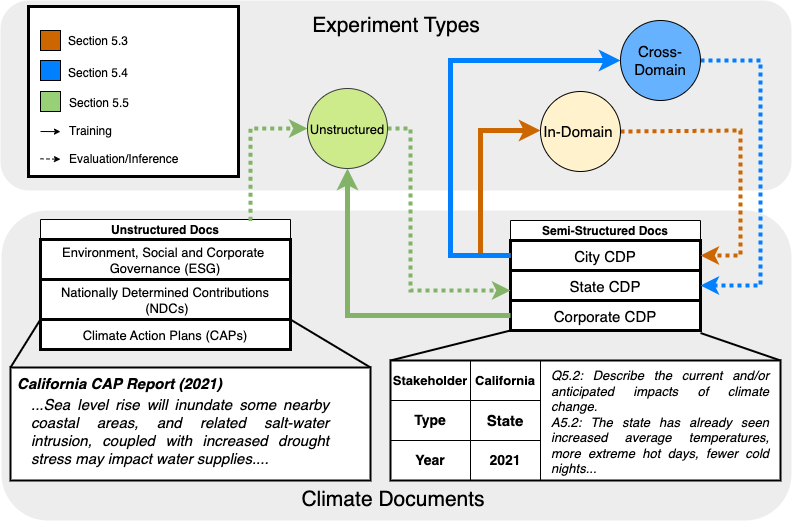
- Train self-supervised text classification models using the internal structure of the questionnaires, treating each question-answer pair as a classification task.
- Apply in-domain and cross-domain training and evaluation protocols to assess generalization across stakeholder types.
- Use a fine-tuned MiniLM cross-encoder model to compute relevance scores between text segments from unstructured climate action plans (CAPs) and CDP questionnaire questions.
- Conduct a human evaluation pilot where a climate expert rates the top-5 model-predicted question-text alignments on a three-point relevance scale.
- Compile ClimaBench, a benchmark of five existing and two new climate text classification datasets, to evaluate model performance across diverse tasks.
Experimental results
Research questions
- RQ1Can self-supervised models trained on structured climate questionnaires generalize to new stakeholder types not seen during training?
- RQ2How effective are these models at aligning unstructured text passages from real-world climate action plans to corresponding questions in standardized questionnaires?
- RQ3Do general-purpose NLP models outperform domain-specific models like ClimateBERT on climate text classification tasks?
- RQ4What is the human-level performance of model-generated alignments in a realistic, expert-evaluated setting?
- RQ5Can a unified benchmark improve evaluation and comparison of NLP models in the climate NLP domain?
Key findings
- The model achieved a 71.0% relevance rate in a human evaluation, with 35.6% of predictions rated as 'Highly Relevant', indicating strong alignment between unstructured text and questionnaire questions.
- The model demonstrated cross-domain generalization, successfully mapping text from one stakeholder type (e.g., states) to questionnaires from another (e.g., corporations), suggesting transferability across organizational types.
- In the ClimaBench benchmark, general-purpose models outperformed domain-specific models like ClimateBERT across multiple climate text classification tasks, challenging assumptions about domain-specific model superiority.
- The human evaluation revealed a key limitation: more specific, highly relevant questions were often ranked lower than general ones, suggesting a need for improved reranking or model calibration.
- The study demonstrates the feasibility of using self-supervised models to automate the mapping of unstructured climate disclosures to structured questionnaires, significantly reducing manual effort.
- The authors released ClimaBench and trained models (e.g., miniLM-cdp-all) to support future research and model development in climate NLP.
Read this paper
Open the full text in the Nubint reader and ask about any passage as you read.
Read this paper on NubintThis review was generated by AI from the original paper. Please check the paper before citing it.