
[Paper Review] Towards black-box parameter estimation
This paper proposes two black-box deep learning frameworks for parameter estimation in statistical models with intractable likelihoods. The first uses iterative simulation refinement guided by a parametric bootstrap to target true parameters; the second leverages a pre-trained neural network on a large simulated database to enable fast, scalable estimation across multiple data sizes, achieving accuracy comparable to INLA with orders-of-magnitude faster inference.
Deep learning algorithms have recently shown to be a successful tool in estimating parameters of statistical models for which simulation is easy, but likelihood computation is challenging. But the success of these approaches depends on simulating parameters that sufficiently reproduce the observed data, and, at present, there is a lack of efficient methods to produce these simulations. We develop new black-box procedures to estimate parameters of statistical models based only on weak parameter structure assumptions. For well-structured likelihoods with frequent occurrences, such as in time series, this is achieved by pre-training a deep neural network on an extensive simulated database that covers a wide range of data sizes. For other types of complex dependencies, an iterative algorithm guides simulations to the correct parameter region in multiple rounds. These approaches can successfully estimate and quantify the uncertainty of parameters from non-Gaussian models with complex spatial and temporal dependencies. The success of our methods is a first step towards a fully flexible automatic black-box estimation framework.
Motivation & Objective
- To address the challenge of parameter estimation in statistical models where likelihood computation is infeasible but simulation is possible.
- To eliminate reliance on expensive, model-specific preliminary steps or expert-designed summary statistics in likelihood-free inference.
- To develop a general-purpose, automated framework that requires only weak assumptions about the data-generating process.
- To enable fast, scalable parameter estimation across diverse data sizes without retraining for each new dataset.
- To quantify uncertainty in parameter estimates using deep neural networks in a simulation-based inference setting.
Proposed method
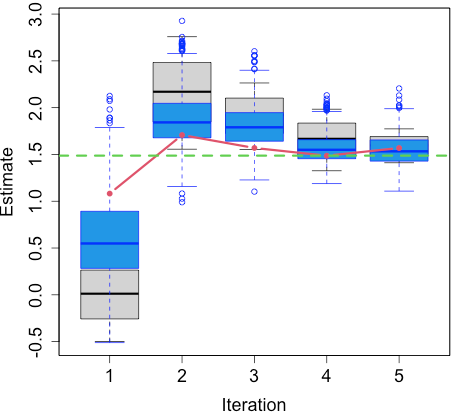
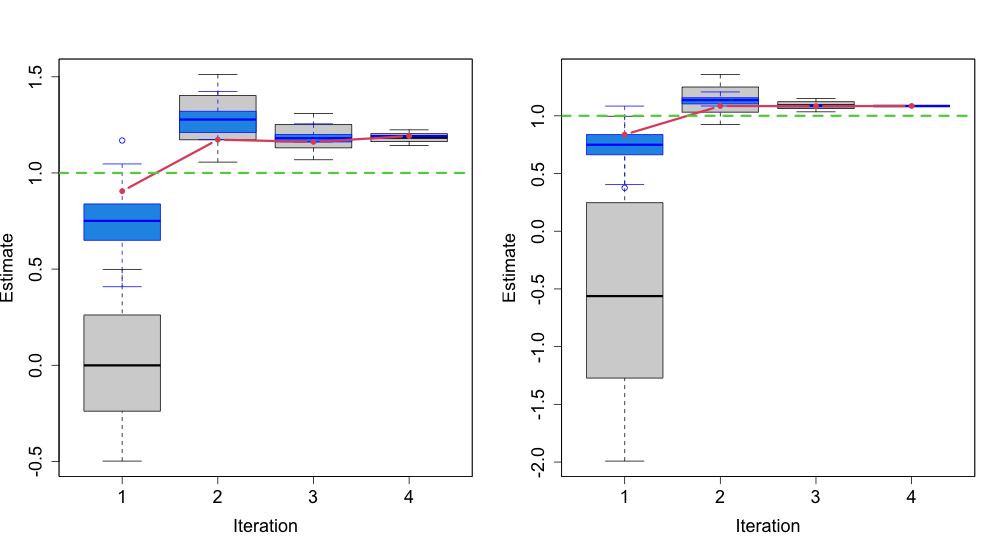
- Employs a fully automatic iterative procedure that dynamically adjusts simulation parameters using a modified parametric bootstrap to guide simulations toward the true parameter region.
- Utilizes a pre-trained 1D convolutional neural network (CNN) on a large, diverse database of simulated time series to estimate parameters directly from observed data.
- Trains the CNN using maximum likelihood estimates (MLEs) from approximate likelihood methods (e.g., ABC) on simulated data covering a wide range of parameter values and data sizes.
- Applies a transformation to parameters (e.g., logit or probit) to improve neural network training stability and ensure bounded parameter space coverage.
- Uses bootstrapping on the trained CNN to quantify uncertainty by sampling from the fitted model and feeding samples into the network to generate empirical posterior intervals.
- Validates performance against INLA using synthetic data from a stochastic volatility (SVOL) model, comparing bias, variance, and coverage of 95% credible intervals.
Experimental results
Research questions
- RQ1Can a deep neural network be trained once on a large simulated database to enable fast, accurate parameter estimation across multiple data sizes without retraining?
- RQ2Can an iterative simulation-based framework automatically guide simulations toward the true parameter values without prior knowledge or expensive initialization?
- RQ3How does the performance of the proposed black-box deep learning estimator compare to established methods like INLA in terms of bias, variance, and uncertainty quantification?
- RQ4To what extent can the method generalize to models with complex temporal and spatial dependencies where likelihoods are intractable?
- RQ5Can uncertainty in parameter estimates be reliably quantified using bootstrapped inference from a trained deep neural network?
Key findings
- The 1D CNN estimator achieves lower bias and variance than INLA for small to moderate data sizes (T = 500–2000), with performance converging as data size increases.
- For larger data sizes (T ≥ 4000), both the 1D CNN and INLA produce similar posterior intervals, with INLA showing slightly more concentrated intervals for θ₀,₁.
- The 95% central intervals from the bootstrapped CNN closely match those from INLA across all data sizes, indicating reliable uncertainty quantification.
- The pre-trained database approach enables fast inference across different data lengths at no additional computational cost per new dataset, unlike traditional methods requiring repeated simulation.
- The iterative method successfully guides simulations toward the true parameter region through multiple rounds, demonstrating robustness without requiring prior parameter space coverage.
- Changing INLA priors to penalize values far from the mode could further improve estimation accuracy, suggesting potential for tuning in future applications.
Read this paper
Open the full text in the Nubint reader and ask about any passage as you read.
Read this paper on NubintThis review was generated by AI from the original paper. Please check the paper before citing it.