
[Paper Review] Towards Efficient Generative Large Language Model Serving: A Survey from Algorithms to Systems
The paper surveys efficient serving of generative LLMs, covering algorithmic innovations and system optimizations from decoding techniques to hardware-aware architectures and quantization, and outlines future research directions.
In the rapidly evolving landscape of artificial intelligence (AI), generative large language models (LLMs) stand at the forefront, revolutionizing how we interact with our data. However, the computational intensity and memory consumption of deploying these models present substantial challenges in terms of serving efficiency, particularly in scenarios demanding low latency and high throughput. This survey addresses the imperative need for efficient LLM serving methodologies from a machine learning system (MLSys) research perspective, standing at the crux of advanced AI innovations and practical system optimizations. We provide in-depth analysis, covering a spectrum of solutions, ranging from cutting-edge algorithmic modifications to groundbreaking changes in system designs. The survey aims to provide a comprehensive understanding of the current state and future directions in efficient LLM serving, offering valuable insights for researchers and practitioners in overcoming the barriers of effective LLM deployment, thereby reshaping the future of AI.
Motivation & Objective
- Provide a comprehensive overview of advances in LLM serving and inference.
- Categorize techniques by underlying approaches (algorithmic vs system) and analyze their strengths and limitations.
- Examine decoding, architecture design, model compression, low-bit quantization, parallel computation, memory management, and kernel optimization.
- Survey representative LLM serving frameworks and benchmarks to guide future research and practice.
Proposed method
- Develop a taxonomy of efficient LLM serving approaches separating algorithmic innovations and system optimizations.
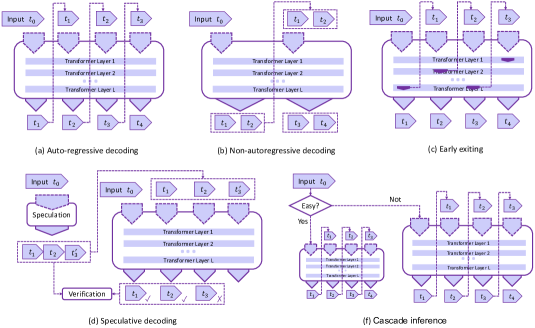
- Analyze decoding algorithms (non-autoregressive decoding, speculative decoding, early exiting, cascade inference) and their trade-offs.
- Describe architectural design options (configuration downsizing, attention simplification, activation sharing, conditional computing, recurrent units).
- Review model compression techniques (knowledge distillation, pruning) and their applicability to LLMs.
- Summarize low-bit quantization (QAT and PTQ) and its hardware implications for inference.
- Discuss system-level optimizations including parallel computation and memory management for efficient deployment.
Experimental results
Research questions
- RQ1What are the main algorithmic and system-level techniques proposed to improve LLM serving efficiency?
- RQ2How do decoding strategies, architecture choices, and compression/quantization impact inference speed and resource usage?
- RQ3What are the principal challenges and trade-offs in deploying efficient LLM inference across hardware platforms?
- RQ4What directions seem most promising for future LLM serving research and system design?
Key findings
- The survey provides a two-part taxonomy: algorithmic innovations and system optimizations for LLM serving.
- Decoding algorithms explored include non-autoregressive decoding, speculative decoding, early exiting, and cascade inference, with discussion of trade-offs and verification guarantees.
- Architectural design approaches cover configuration downsizing, attention simplification, activation sharing, conditional computing, and recurrent-unit options for efficiency.
- Model compression techniques such as knowledge distillation and pruning are examined for their applicability and practical gains in LLM inference.
- Low-bit quantization (QAT vs PTQ) and its hardware implications are analyzed, including potential latency and throughput benefits and scaling effects.
- The paper also discusses system-level strategies like parallel computation, memory management, and kernel optimizations as crucial to realizing efficiency gains in practice.
Read this paper
Open the full text in the Nubint reader and ask about any passage as you read.
Read this paper on NubintThis review was generated by AI from the original paper. Please check the paper before citing it.