
[Paper Review] Towards Expressive Spectral-Temporal Graph Neural Networks for Time Series Forecasting
This paper establishes a theoretical framework for spectral-temporal graph neural networks (SPTGNNs) in time series forecasting, proving that linear SPTGNNs are universal under mild assumptions and bounded by a temporal 1-WL test. It proposes TGC (Temporal Graph GegenConv), a simple, efficient instantiation using orthogonal spectral filters and individual frequency-domain modules that outperforms existing models with only linear components.
Time series forecasting has remained a focal point due to its vital applications in sectors such as energy management and transportation planning. Spectral-temporal graph neural network is a promising abstraction underlying most time series forecasting models that are based on graph neural networks (GNNs). However, more is needed to know about the underpinnings of this branch of methods. In this paper, we establish a theoretical framework that unravels the expressive power of spectral-temporal GNNs. Our results show that linear spectral-temporal GNNs are universal under mild assumptions, and their expressive power is bounded by our extended first-order Weisfeiler-Leman algorithm on discrete-time dynamic graphs. To make our findings useful in practice on valid instantiations, we discuss related constraints in detail and outline a theoretical blueprint for designing spatial and temporal modules in spectral domains. Building on these insights and to demonstrate how powerful spectral-temporal GNNs are based on our framework, we propose a simple instantiation named Temporal Graph Gegenbauer Convolution (TGGC), which significantly outperforms most existing models with only linear components and shows better model efficiency. Our findings pave the way for devising a broader array of provably expressive GNN-based models for time series.
Motivation & Objective
- To understand the theoretical expressive power of spectral-temporal GNNs (SPTGNNs) in time series forecasting.
- To address fundamental questions about SPTGNNs' universality, limitations, and design principles.
- To develop a provably expressive, efficient SPTGNN architecture based on theoretical insights.
- To demonstrate that linear SPTGNNs with proper spectral filtering can outperform complex nonlinear models.
Proposed method
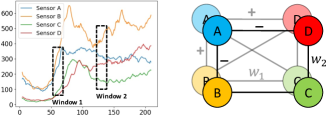
- Formulates a general framework for SPTGNNs based on discrete-time dynamic graphs (DTDGs) and spectral GNNs.
- Proves universality of linear SPTGNNs under mild assumptions using the lens of DTDGs.
- Introduces a temporal 1-WL test to bound the expressive power of SPTGNNs.
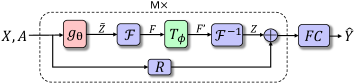
- Proposes TGC (Temporal Graph GegenConv), using orthogonal function bases and individual spectral filters in graph and temporal frequency domains.
- Employs Gegenbauer polynomials for spectral filtering and reduces model complexity via low-rank projections.
- Validates design principles through ablation and comparison on synthetic and real-world datasets.
Experimental results
Research questions
- RQ1What is the general form of spectral-temporal GNNs (SPTGNNs)?
- RQ2How expressive are SPTGNNs in modeling complex, evolving time series dependencies?
- RQ3Under what conditions do SPTGNNs fail to generalize well?
- RQ4How can we design provably expressive SPTGNNs with linear components?
Key findings
- Linear SPTGNNs are universal for time series representation under mild assumptions, capable of modeling arbitrary time series patterns.
- The expressive power of SPTGNNs is theoretically bounded by the proposed temporal 1-WL test, which identifies non-isomorphic nodes in dynamic graphs.
- TGC, a simple linear SPTGNN instantiation, achieves state-of-the-art performance on multiple benchmarks with significantly improved efficiency.
- Orthogonal function bases and individual spectral filtering are crucial for strong performance, as shown by ablation studies.
- TGC outperforms MP-STGNNs like STGCN and Graph WaveNet in learning diverse spatial correlations, including negative and positive relations.
- The model generalizes well across short-term and long-term forecasting tasks, with consistent improvements on PeMS, Electricity, Weather, and Solar datasets.
Read this paper
Open the full text in the Nubint reader and ask about any passage as you read.
Read this paper on NubintThis review was generated by AI from the original paper. Please check the paper before citing it.