
[Paper Review] Towards Federated RLHF with Aggregated Client Preference for LLMs
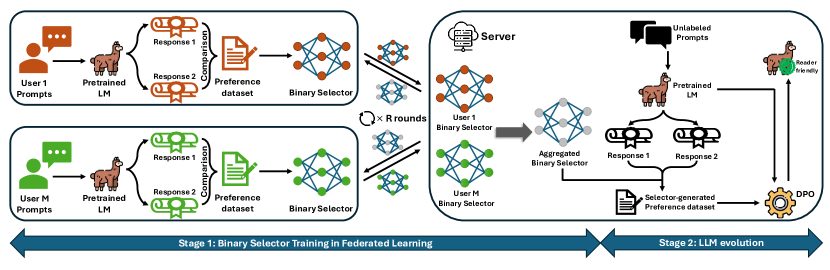
This paper proposes FedBiscuit, a federated learning framework for reinforcement learning with human feedback (RLHF) in large language models (LLMs), using aggregated client preference data without sharing raw data. It introduces FedBis for training a global binary selector via client-level model aggregation, and FedBiscuit, which clusters clients by preference similarity to improve robustness and performance, outperforming both FedBis and centralized training on heterogeneous preference data.
Reinforcement learning with human feedback (RLHF) fine-tunes a pretrained large language model (LLM) using user preference data, enabling it to generate content aligned with human preferences. However, due to privacy concerns, users may be reluctant to share sensitive preference data. To address this, we propose utilizing Federated Learning (FL) techniques, allowing large-scale preference collection from diverse real-world users without requiring them to transmit data to a central server. Our federated RLHF methods (i.e., FedBis and FedBiscuit) encode each client's preferences into binary selectors and aggregate them to capture common preferences. In particular, FedBiscuit overcomes key challenges, such as preference heterogeneity and reward hacking, through innovative solutions like grouping clients with similar preferences to reduce heterogeneity and using multiple binary selectors to enhance LLM output quality. To evaluate the performance of the proposed methods, we establish the first federated RLHF benchmark with a heterogeneous human preference dataset. Experimental results show that by integrating the LLM with aggregated client preferences, FedBis and FedBiscuit significantly enhance the professionalism and readability of the generated content.
Motivation & Objective
- To address privacy concerns in collecting client-specific preference data for RLHF fine-tuning of LLMs.
- To reduce computational overhead in training reward models by replacing scalar reward regression with binary selection.
- To mitigate performance degradation due to data heterogeneity across clients in federated RLHF.
- To improve generalization and robustness of preference modeling by clustering clients with similar preferences.
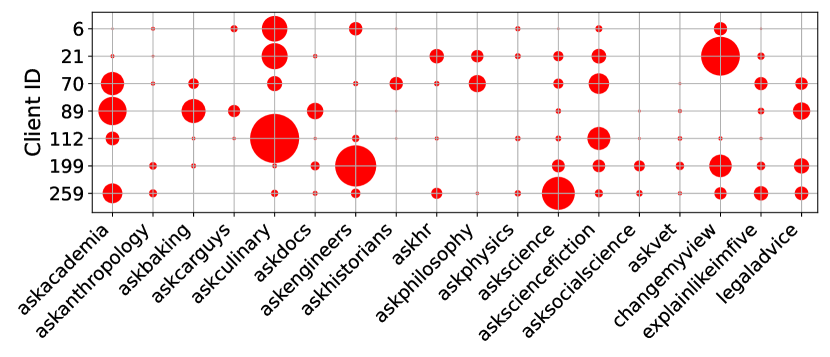
- To establish a benchmark for federated human preference datasets with heterogeneous client data partitioning.
Proposed method
- Proposes FedBis, a federated binary selector training framework where each client trains a binary classifier on local preference data, and the server aggregates these into a global selector.
- Introduces FedBiscuit, which organizes clients into disjoint, preference-based clusters to train multiple localized binary selectors.
- Uses client loss values on all selectors as a proxy for preference similarity to form clusters without sharing raw data.
- Employs direct preference optimization (DPO) to fine-tune the LLM using predictions from the global binary selector as a preference signal.
- Applies a cluster-wise aggregation strategy where the final selection is made by the majority vote of the most accurate local selectors in each cluster.
- Utilizes a public, task-specific preference dataset to benchmark performance across FL and centralized training settings.
Experimental results
Research questions
- RQ1Can a federated binary selector trained across clients with private preference data effectively simulate human preference ranking?
- RQ2How does client preference heterogeneity affect the performance and convergence of federated reward model training?
- RQ3Can clustering clients by preference similarity improve the robustness and generalization of the binary selector in federated RLHF?
- RQ4Does FedBiscuit outperform both FedBis and centralized training in terms of preference selection accuracy and LLM alignment?
- RQ5To what extent does the proposed framework mitigate reward hacking and computational overhead compared to traditional RLHF?
Key findings
- FedBiscuit outperforms FedBis and even surpasses centralized training on the proposed federated human preference benchmark, demonstrating superior robustness to data heterogeneity.
- The performance of FedBiscuit improves continuously over communication rounds, while centralized training and FedBis exhibit early performance degradation due to reward hacking.
- FedBiscuit avoids the inflection point in performance decline seen in FedBis and centralized training, indicating better generalization and resistance to overfitting.
- The method achieves better generalization on out-of-distribution data (e.g., responses from a supervised fine-tuned LLM) than centralized training, which overfits to the specific data distribution.
- Client clustering based on loss values enables effective preference-based grouping without sharing raw data, enhancing model stability and performance.
- The binary selector framework significantly reduces computational overhead compared to traditional scalar reward modeling, enabling efficient federated training.
Read this paper
Open the full text in the Nubint reader and ask about any passage as you read.
Read this paper on NubintThis review was generated by AI from the original paper. Please check the paper before citing it.