
[Paper Review] Towards Generalist Biomedical AI
The paper introduces MultiMedBench, a 14-task multimodal biomedical benchmark, and Med-PaLM M, a single generalist multimodal model that achieves SOTA or near-SOTA performance across all tasks without task-specific fine-tuning. It also presents evidence of zero-shot generalization, task transfer, and radiologist-aligned evaluation of chest X-ray reports.
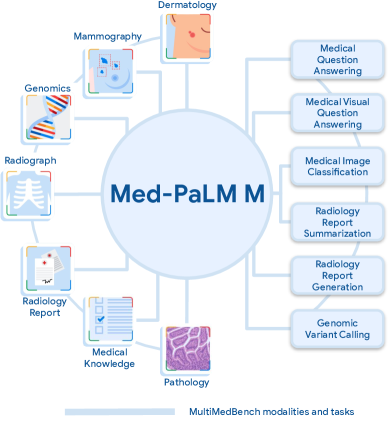
Medicine is inherently multimodal, with rich data modalities spanning text, imaging, genomics, and more. Generalist biomedical artificial intelligence (AI) systems that flexibly encode, integrate, and interpret this data at scale can potentially enable impactful applications ranging from scientific discovery to care delivery. To enable the development of these models, we first curate MultiMedBench, a new multimodal biomedical benchmark. MultiMedBench encompasses 14 diverse tasks such as medical question answering, mammography and dermatology image interpretation, radiology report generation and summarization, and genomic variant calling. We then introduce Med-PaLM Multimodal (Med-PaLM M), our proof of concept for a generalist biomedical AI system. Med-PaLM M is a large multimodal generative model that flexibly encodes and interprets biomedical data including clinical language, imaging, and genomics with the same set of model weights. Med-PaLM M reaches performance competitive with or exceeding the state of the art on all MultiMedBench tasks, often surpassing specialist models by a wide margin. We also report examples of zero-shot generalization to novel medical concepts and tasks, positive transfer learning across tasks, and emergent zero-shot medical reasoning. To further probe the capabilities and limitations of Med-PaLM M, we conduct a radiologist evaluation of model-generated (and human) chest X-ray reports and observe encouraging performance across model scales. In a side-by-side ranking on 246 retrospective chest X-rays, clinicians express a pairwise preference for Med-PaLM M reports over those produced by radiologists in up to 40.50% of cases, suggesting potential clinical utility. While considerable work is needed to validate these models in real-world use cases, our results represent a milestone towards the development of generalist biomedical AI systems.
Motivation & Objective
- Motivate the development of generalist biomedical AI systems that can integrally handle multiple data modalities and tasks.
- Create and release MultiMedBench, a diverse benchmark spanning text, imaging, and genomics with 14 tasks.
- Propose Med-PaLM M, a single model with a unified generative framework that solves multiple biomedical tasks without task-specific finetuning.
- Demonstrate strong performance against specialist models and explore emergent zero-shot generalization and clinical evaluation.
Proposed method
- Utilize a PaLM-E based generalist architecture pretrained on vision-language data and fine-tuned on biomedical data.
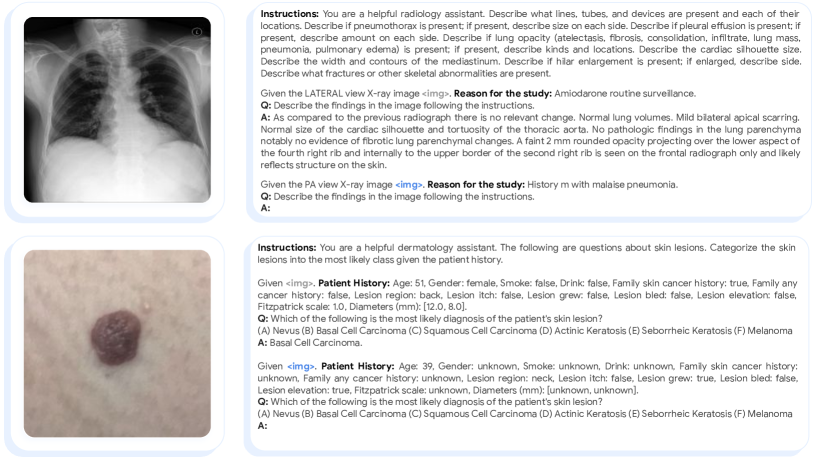
- Apply instruction tuning with task-specific prompts and one-shot exemplars to unify diverse tasks under a single output space.
- Interleave image tokens with text in a multimodal context and train end-to-end on MultiMedBench using mixture ratios proportional to task data size.
- Evaluate across model scales (12B, 84B, 562B) to study scaling effects on language-only and multimodal reasoning tasks.
- Conduct radiologist evaluation of AI-generated chest X-ray reports and compare with human references on MIMIC-CXR.
Experimental results
Research questions
- RQ1Can a single multimodal model trained on diverse biomedical tasks achieve competitive or superior performance to specialist models across these tasks?
- RQ2Does scaling the model size improve performance on language-heavy and multimodal reasoning tasks more than on static image classification tasks?
- RQ3What evidence exists for zero-shot generalization and emergent multimodal medical reasoning in a generalist biomedical AI?
- RQ4How do radiologist evaluations of AI-generated chest X-ray reports compare to human references across model scales?
- RQ5Can a generalist model demonstrate positive transfer across tasks within the biomedical domain?
Key findings
- Med-PaLM M matches or exceeds SOTA on all MultiMedBench tasks, often outperforming specialist models with a single weight set.
- Chest X-ray report generation improves over prior SOTA by more than 8% micro-F1 on MIMIC-CXR.
- On Slake-VQA, Med-PaLM M surpasses prior SOTA by over 10% on BLEU-1 and F1 metrics.
- Zero-shot and emergent capabilities observed, including zero-shot medical reasoning and generalization to novel concepts.
- Radiologist evaluation shows Med-PaLM M reports are preferred in up to 40.50% of cases and best model has 0.25 clinically significant errors per report.
- Model scaling shows notable gains for language-heavy and visual reasoning tasks, with diminishing returns for some image-centric tasks.
Read this paper
Open the full text in the Nubint reader and ask about any passage as you read.
Read this paper on NubintThis review was generated by AI from the original paper. Please check the paper before citing it.