
[Paper Review] Towards Generative Modeling of Urban Flow through Knowledge-enhanced Denoising Diffusion
This paper proposes KSTDiff, a knowledge-enhanced spatio-temporal diffusion model that generates dynamic urban flow for regions without historical data by leveraging a learnable volume estimator and a knowledge graph encoding urban environment and spatial relationships. The model achieves state-of-the-art performance in flow generation and generalizes well to long-term generation and prediction tasks, with generated data performing within 7.5% of real data on key metrics.
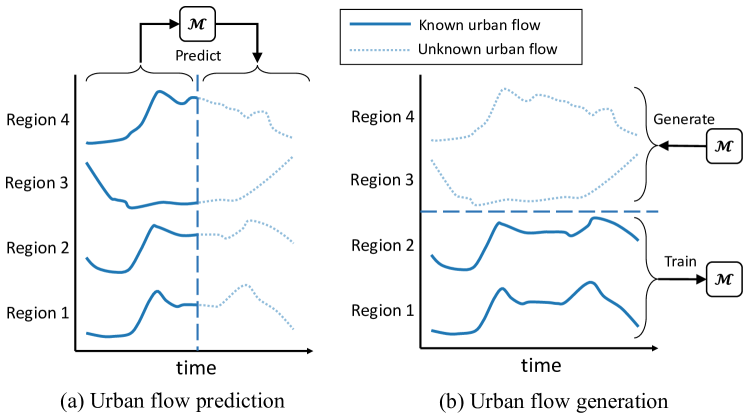
Although generative AI has been successful in many areas, its ability to model geospatial data is still underexplored. Urban flow, a typical kind of geospatial data, is critical for a wide range of urban applications. Existing studies mostly focus on predictive modeling of urban flow that predicts the future flow based on historical flow data, which may be unavailable in data-sparse areas or newly planned regions. Some other studies aim to predict OD flow among regions but they fail to model dynamic changes of urban flow over time. In this work, we study a new problem of urban flow generation that generates dynamic urban flow for regions without historical flow data. To capture the effect of multiple factors on urban flow, such as region features and urban environment, we employ diffusion model to generate urban flow for regions under different conditions. We first construct an urban knowledge graph (UKG) to model the urban environment and relationships between regions, based on which we design a knowledge-enhanced spatio-temporal diffusion model (KSTDiff) to generate urban flow for each region. Specifically, to accurately generate urban flow for regions with different flow volumes, we design a novel diffusion process guided by a volume estimator, which is learnable and customized for each region. Moreover, we propose a knowledge-enhanced denoising network to capture the spatio-temporal dependencies of urban flow as well as the impact of urban environment in the denoising process. Extensive experiments on four real-world datasets validate the superiority of our model over state-of-the-art baselines in urban flow generation. Further in-depth studies demonstrate the utility of generated urban flow data and the ability of our model for long-term flow generation and urban flow prediction. Our code is released at: https://github.com/tsinghua-fib-lab/KSTDiff-Urban-flow-generation.
Motivation & Objective
- To address the challenge of generating realistic urban flow in regions lacking historical data, such as newly planned or suburban areas.
- To model the dynamic, time-varying nature of urban flow influenced by region-specific features and urban environment.
- To develop a conditional generative model that can produce diverse, realistic flow patterns under varying conditions.
- To enable practical applications in urban planning and traffic management where real flow data is unavailable.
- To demonstrate the utility of generated data for downstream tasks like origin-destination (OD) flow estimation.
Proposed method
- Construct an Urban Knowledge Graph (UKG) to encode spatial relationships between regions and environmental features such as land use and infrastructure.
- Design a knowledge-enhanced denoising network that attends to both spatio-temporal flow patterns and UKG-encoded context during the reverse denoising process.
- Introduce a region-customized diffusion process guided by a learnable volume estimator that predicts flow volume and conditions the generation process per region.
- Use conditional diffusion modeling to generate multi-step dynamic urban flow by conditioning on region features, UKG context, and estimated volume.
- Train the model using a denoising objective that minimizes reconstruction error between noisy inputs and ground-truth flow sequences.
- Adapt the model for urban flow prediction by replacing the volume estimator with historical flow as input, enabling end-to-end prediction.
Experimental results
Research questions
- RQ1Can a diffusion-based generative model produce realistic, dynamic urban flow patterns for regions without historical flow data?
- RQ2How effectively can a knowledge-enhanced diffusion model capture spatio-temporal dependencies and environmental influences on urban flow?
- RQ3To what extent can generated urban flow data substitute for real data in downstream tasks like OD flow estimation?
- RQ4Can the model generalize to long-term flow generation and support predictive modeling of urban flow?
- RQ5How does the region-specific volume estimation component improve generation quality across regions with varying flow volumes?
Key findings
- KSTDiff outperforms SOTA baselines in urban flow generation, achieving a CPC of 0.715 on the NYC dataset and 0.554 on Beijing, close to real data (0.773 and 0.582 respectively).
- Generated data from KSTDiff achieved a 7.50% and 4.81% lower CPC than real data on NYC and Beijing, respectively, demonstrating strong utility for OD generation tasks.
- In urban flow prediction, KSTDiff reduced RMSE by 14.2% on the D.C. dataset and improved MAE by 5.5% compared to baselines, showing strong transferability.
- The model successfully generated long-term flow sequences that preserved realistic temporal dynamics and spatial patterns.
- The knowledge-enhanced denoising network significantly improved performance by integrating UKG context into the denoising process, outperforming models without such integration.
- The region-customized volume estimator effectively handled the high variance in flow volumes across regions, improving generation fidelity for both high- and low-volume areas.
Read this paper
Open the full text in the Nubint reader and ask about any passage as you read.
Read this paper on NubintThis review was generated by AI from the original paper. Please check the paper before citing it.