
[Paper Review] Towards Generic Anomaly Detection and Understanding: Large-scale Visual-linguistic Model (GPT-4V) Takes the Lead
The paper evaluates GPT-4V as a generic, multi-modal anomaly detector across image, video, point cloud, and time-series data, using prompting strategies and prompts with class, expert, and reference information to identify normal vs. abnormal patterns.
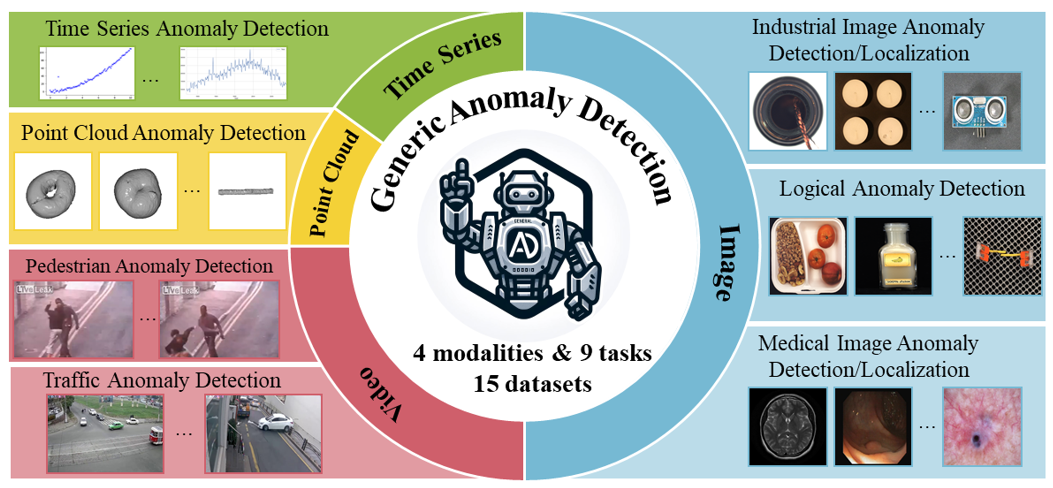
Anomaly detection is a crucial task across different domains and data types. However, existing anomaly detection models are often designed for specific domains and modalities. This study explores the use of GPT-4V(ision), a powerful visual-linguistic model, to address anomaly detection tasks in a generic manner. We investigate the application of GPT-4V in multi-modality, multi-domain anomaly detection tasks, including image, video, point cloud, and time series data, across multiple application areas, such as industrial, medical, logical, video, 3D anomaly detection, and localization tasks. To enhance GPT-4V's performance, we incorporate different kinds of additional cues such as class information, human expertise, and reference images as prompts.Based on our experiments, GPT-4V proves to be highly effective in detecting and explaining global and fine-grained semantic patterns in zero/one-shot anomaly detection. This enables accurate differentiation between normal and abnormal instances. Although we conducted extensive evaluations in this study, there is still room for future evaluation to further exploit GPT-4V's generic anomaly detection capacity from different aspects. These include exploring quantitative metrics, expanding evaluation benchmarks, incorporating multi-round interactions, and incorporating human feedback loops. Nevertheless, GPT-4V exhibits promising performance in generic anomaly detection and understanding, thus opening up a new avenue for anomaly detection.
Motivation & Objective
- Motivate a generic, high-level approach to anomaly detection beyond modality-specific methods.
- Investigate whether a large visual-linguistic model (GPT-4V) can detect anomalies across image, video, point cloud, and time-series data.
- Assess how prompting, auxiliary cues, and references influence zero-shot and one-shot anomaly detection performance.
- Provide qualitative demonstrations across industrial, medical, logical, and traffic scenarios to understand capabilities and limits.
Proposed method
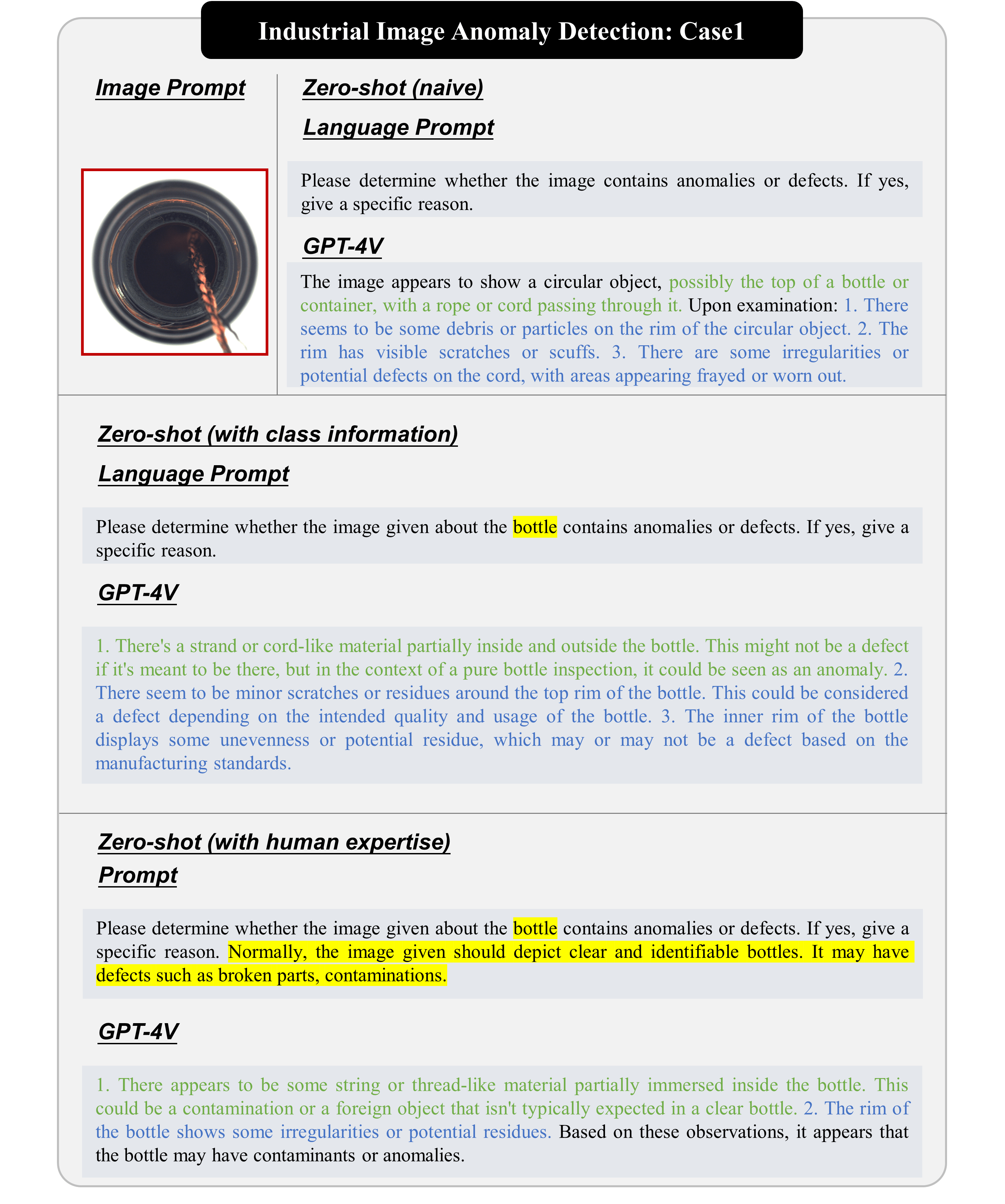
- Design four prompt types to guide GPT-4V: Task Information, Class Information, Normal Standard, and Reference Image prompts.
- Evaluate GPT-4V across modalities (image, video, point cloud, time series) and domains (industrial, medical, surveillance).
- Use zero-shot and one-shot settings with and without normal reference images to study robustness and prompts’ impact.
- Leverage visual prompting approaches for localization tasks by converting or guiding with masks and using SoM-like strategies to classify localized regions.
- In point clouds, transform data into multi-view depth images to align with image-based foundation-model prompting (CPMF-inspired).
- Include qualitative case demonstrations and analysis of strengths and limitations, with recommendations for future quantitative evaluation and human-in-the-loop improvements.
Experimental results
Research questions
- RQ1Can GPT-4V perform anomaly detection across multiple modalities (image, video, point cloud, time series) in zero-shot and one-shot settings?
- RQ2How do different prompts (task, class, normal standards, reference images) affect GPT-4V’s ability to detect and explain anomalies across diverse domains?
- RQ3What are GPT-4V’s capabilities and limitations in global vs. fine-grained anomaly understanding and localization?
- RQ4What practical guidance and future directions emerge for applying GPT-4V to industrial, medical, and surveillance anomaly tasks?
Key findings
- GPT-4V demonstrates robust anomaly detection capabilities across multi-modality and multi-domain tasks in zero-shot and one-shot regimes.
- GPT-4V can understand both global and fine-grained semantics to detect and localize anomalies, with examples of precise localization in industrial images.
- GPT-4V can automatically reason about complex normal standards and generate explanations for detected anomalies.
- Additional prompts (class information, human expertise, reference images) enhance anomaly-detection performance.
- Real-world application remains challenging due to qualitative nature of evaluation and domain-specific constraints, but GPT-4V shows promise across diverse scenarios.
Read this paper
Open the full text in the Nubint reader and ask about any passage as you read.
Read this paper on NubintThis review was generated by AI from the original paper. Please check the paper before citing it.