
[Paper Review] Towards Human-centered Proactive Conversational Agents
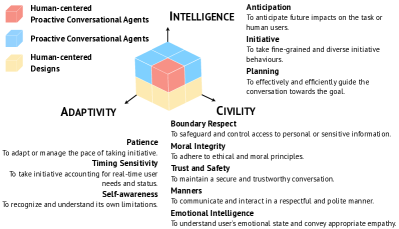
This paper proposes a human-centered framework for proactive conversational agents (PCAs) centered on three key dimensions: Intelligence, Adaptivity, and Civility. It introduces a taxonomy and research agenda across five system development stages—Task Formulation to System Deployment—emphasizing ethical design, user trust, and balanced human-agent interaction to prevent intrusiveness and overreliance.
Recent research on proactive conversational agents (PCAs) mainly focuses on improving the system's capabilities in anticipating and planning action sequences to accomplish tasks and achieve goals before users articulate their requests. This perspectives paper highlights the importance of moving towards building human-centered PCAs that emphasize human needs and expectations, and that considers ethical and social implications of these agents, rather than solely focusing on technological capabilities. The distinction between a proactive and a reactive system lies in the proactive system's initiative-taking nature. Without thoughtful design, proactive systems risk being perceived as intrusive by human users. We address the issue by establishing a new taxonomy concerning three key dimensions of human-centered PCAs, namely Intelligence, Adaptivity, and Civility. We discuss potential research opportunities and challenges based on this new taxonomy upon the five stages of PCA system construction. This perspectives paper lays a foundation for the emerging area of conversational information retrieval research and paves the way towards advancing human-centered proactive conversational systems.
Motivation & Objective
- To address the growing risk of proactive conversational agents being perceived as intrusive by shifting focus from technical capability to human-centered design.
- To establish a new taxonomy of three core dimensions—Intelligence, Adaptivity, and Civility—for guiding the development of human-centered proactive conversational agents.
- To identify and address critical challenges in human-agent trust, reliance, and control, particularly in mitigating overreliance and underreliance.
- To provide a structured research agenda across the five stages of PCA development: Task Formulation, Data Preparation, Model Learning, Evaluation, and System Deployment.
- To promote ethical and socially responsible AI by embedding explainability, reliability disclosure, and controllability into PCA design.
Proposed method
- Proposes a three-dimensional taxonomy—Intelligence (anticipatory planning and initiative), Adaptivity (dynamic response to user context and pacing), and Civility (respectful, non-intrusive behavior)—as foundational design principles.
- Introduces a framework for evaluating PCA behaviors using trust and reliance typologies: Appropriate Trust/Reliance, Undertrust/Underreliance, and Overtrust/Overreliance.
- Integrates HCI principles through three key mechanisms: Explanability (feature-based, example-based, path-based, and attribution-based explanations), Reliability Disclosure (confidence estimation and self-calibration), and Controllability (on-demand system interventions).
- Designs user interface patterns such as 'See AI’s suggestion' to empower users with control over agent-initiated actions, reducing unwanted intrusiveness.
- Maps the proposed taxonomy and control mechanisms to each stage of PCA development, from task definition to deployment, ensuring human-centered principles are embedded throughout the lifecycle.
- Leverages insights from HCI and AI literature to guide the design of trustworthy, transparent, and adaptive agent behaviors that align with human expectations and ethical standards.
Experimental results
Research questions
- RQ1How can proactive conversational agents be designed to balance initiative-taking with user autonomy and comfort?
- RQ2What are the key dimensions that define a human-centered proactive conversational agent beyond technical performance?
- RQ3How can trust and reliance in proactive agents be managed to prevent overreliance and underreliance?
- RQ4What role do explainability, reliability disclosure, and controllability play in shaping user perception and interaction with proactive agents?
- RQ5How can the five stages of PCA development—Task Formulation to System Deployment—be reimagined through a human-centered lens?
Key findings
- The proposed taxonomy of Intelligence, Adaptivity, and Civility provides a comprehensive framework for evaluating and guiding the design of human-centered proactive conversational agents.
- Explanations—especially feature-based, path-based, and attribution-based—significantly reduce overreliance and overtrust by enhancing user understanding of agent decisions.
- Reliability disclosure, such as showing confidence scores (e.g., 87% confident), improves user trust and enables better reliance decisions by making uncertainty visible.
- Controllability mechanisms, such as on-demand agent suggestions (e.g., 'See AI’s suggestion'), effectively reduce underreliance and undertrust by giving users agency over interactions.
- The integration of human-centered principles across all five stages of PCA development leads to more ethical, trustworthy, and effective systems.
- Empirical and theoretical evidence from HCI literature supports that appropriate trust and reliance are achievable through explainability, transparency, and user control, reducing the risk of agent intrusiveness.
Read this paper
Open the full text in the Nubint reader and ask about any passage as you read.
Read this paper on NubintThis review was generated by AI from the original paper. Please check the paper before citing it.